ARTIFICIAL INTELLIGENCE
MMLU-Pro and the Choice of a Test
A January 2026 formatting repair in MMLU-Pro shows why harder questions and more answer choices still require careful evaluation and maintenance.
Research checked
Newest cited publication
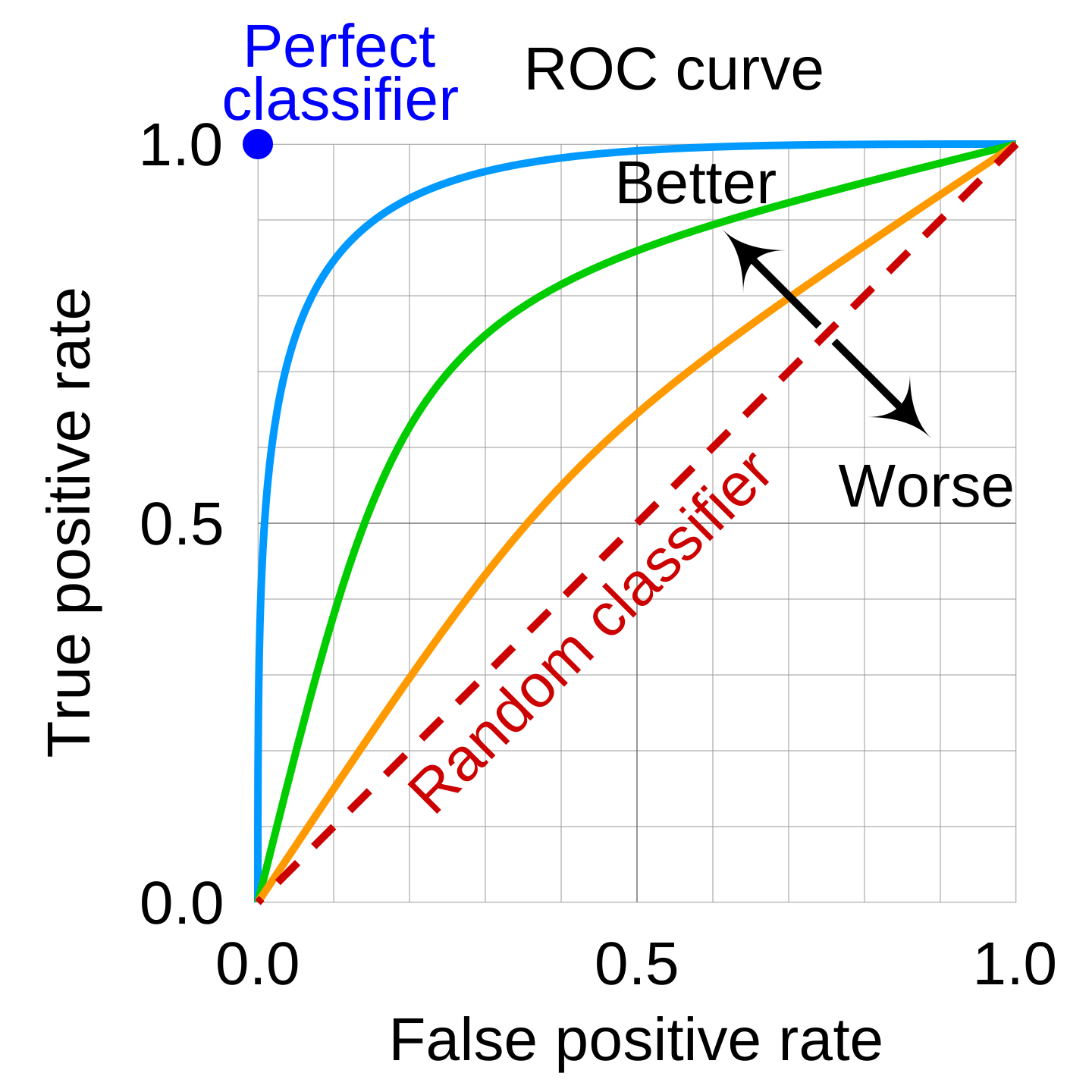
Illustrative ROC curves provide background for thinking carefully about a metric; the multiple-choice scoring in MMLU-Pro is a different evaluation procedure.
CMG Lee and Martin Thoma · Image source · CC BY-SA 4.0

Changing an examination from four possible answers to ten sounds like a straightforward way to make it harder. MMLU-Pro did considerably more: it introduced more reasoning-focused material and reviewed problematic questions in a broad academic benchmark. Yet one of its most instructive recent updates concerns something much smaller than reasoning. On January 18, 2026, the dataset maintainers reported fixing leading spaces in answer options that could act as a shortcut. Their March leaderboard update confirms that the project remains active. Together these details show why a test’s visible difficulty and its actual information content can diverge, even in a carefully curated evaluation.
What the Pro revision set out to change
The MMLU-Pro paper appeared in June 2024 and was accepted to the NeurIPS Datasets and Benchmarks track that year. It extends Massive Multitask Language Understanding with more demanding questions and generally increases the answer set from four choices to ten. The project reports more than 12,000 questions across 14 broad domains. Its purpose is to separate capabilities that older, easier questions no longer distinguish well. That origin should remain visible when discussing the project’s later maintenance.
A familiar classroom example clarifies what more choices can achieve. Ask for the energy of a moving object and offer one correct expression among several implausible alternatives; recognition may suffice. Now add distractors corresponding to a missing factor of one half, a squared mass, or an omitted squared speed. Choosing correctly requires distinguishing plausible mistakes. The improvement comes from what the alternatives test, not simply from printing more letters. Ten meaningless distractors could still leave the same easy recognition problem.
What ten options do to chance
If all answers are equally plausible and exactly one is correct, uniform guessing succeeds 25 percent of the time with four options and 10 percent with ten. Those are assumptions for a simple baseline, not an account of actual model behavior. A solver can eliminate choices, exploit wording, or recognize a concept imperfectly. The dataset card also notes that some reviewed questions retain fewer than ten options, so the nominal option count is not a universal item-level rule.
Imagine a solver that eliminates eight of ten alternatives but cannot distinguish the remaining two. Randomly choosing between those survivors gives a 50 percent chance, a substantial gain over uniform guessing that still falls short of knowing the solution. A final-letter score cannot reveal whether the solver performed that partial reasoning or confidently applied a mistaken formula. Error analysis should therefore inspect both which distractors attract responses and how stable those responses remain when the alternatives are reordered.
A tiny feature can carry unintended information
The January 18, 2026 dataset note says leading spaces in answer options affected chemistry, physics, and other science-related subsets and could have been exploited as a shortcut. The maintainers fixed that formatting inconsistency. The note identifies a vulnerability in the representation; it does not establish that every model used it or quantify how much each score changed. Inferring exploitation requires comparisons or other evidence, not just the existence of an accidental cue.
Consider a hypothetical worksheet where the right answer is the only option ending with an extra space. A student following that cue could pass without understanding the subject. Fixing the space removes an information channel unrelated to the intended skill. A useful controlled experiment holds the question wording fixed, normalizes formatting, and reruns the same model under the same decoding settings. If performance changes, further tests can examine whether the effect comes from that cue or from a broader sensitivity to formatting. This is a measurement question that harder subject matter alone cannot solve.
A robust score still has a domain of validity
The original paper reports experiments with 24 prompt styles and greater score stability than the original MMLU in that tested setting. It also finds benefits from stepwise reasoning on its more demanding questions. These findings concern the prompts, models, and evaluation conditions actually examined in the paper. They do not imply invariance to every instruction, every language, or every future reasoning architecture. Robustness is always robustness to a defined set of changes.
An independent thought experiment separates two useful tests. First change a harmless instruction from “choose the best answer” to “select the correct option” while preserving all substantive information. A stable system should usually agree. Next change a question from “which is always true?” to “which can be true?” A system should often change its answer. Reporting only invariance could reward a model that ignores both changes. A meaningful robustness suite must distinguish irrelevant variation from edits that genuinely alter the task.
The protocol travels with the result
The project’s dataset card explains that leaderboard entries can come from the authors or other submitters, and it describes differences in demonstration settings. Its March 11, 2026 update adds newer frontier systems rather than claiming a new benchmark paper. The code repository exposes alternative evaluation paths and answer-extraction utilities. This gives readers useful material to examine, but it also means that a familiar model label alone does not specify a complete experiment.
Before comparing two entries, ask whether they used the same dataset revision, examples, token limits, sampling policy, and answer extraction. A demonstration can teach an output format or hint at a solution method. Retrying a wrong answer changes the quantity being estimated. Tool-enabled evaluation changes it again. These conditions may all be reasonable for a particular purpose; the problem arises when they are hidden inside a single percentage. A reproducible entry should preserve raw responses and the exact procedure that converted them into correct and incorrect labels.
The average encodes a weighting decision
Broad academic benchmarks combine unequal collections of questions. A micro-average counts every question equally, so a larger subject contributes more to the final percentage. A macro-average first computes a score per subject and then gives subjects equal weight. Neither is inherently the right summary for every user. They answer different questions about the evaluated collection, and both can conceal a weakness in a subject central to a particular application.
For a numerical illustration, suppose a small test has 90 mathematics items and 10 history items. A model answering 81 mathematics and two history questions correctly earns 83 percent overall. Its average of the two subject percentages is 55 percent: the mean of 90 and 20. Neither calculation is wrong. The 28-point gap comes entirely from weighting. Someone using the model for historical research would learn little from the larger headline alone. Subject counts and per-subject results make the weighting choice visible and allow a more relevant interpretation.
Maintenance is part of scientific validity
MMLU-Pro’s continued corrections demonstrate that a public benchmark can improve through outside scrutiny. The dataset record includes answer-key and category maintenance as well as model additions. This makes the revision history an important companion to any result. Keep an immutable copy or revision identifier, describe changes, and avoid treating scores from different snapshots as automatically comparable. The January formatting repair is especially instructive because it concerns information that a reader might never notice in the rendered question.
The broader lesson for evaluating an assistant is to choose complementary evidence. Multiple-choice questions efficiently probe broad academic competence. Open responses can test whether the model constructs an answer without seeing alternatives. Prospective tasks can reduce exact-item familiarity. Representative workflows can reveal whether explanations and uncertainty help the user. MMLU-Pro contributes a useful academic measurement, and its active maintenance makes that measurement more trustworthy. Choosing a good test means understanding both the skill it intends to reveal and the unintended paths by which a system might appear to succeed.
Sources & further reading
Primary papers, project documentation, and research releases used in this article. Publication dates below refer to the sources themselves.
- MMLU-Pro: A More Robust and Challenging Multi-Task Language Understanding BenchmarkarXivPublished Checked
- MMLU-ProTIGER-AI-LabChecked
- MMLU-Pro DatasetTIGER-LabPublished Checked
- MMLU-Pro LeaderboardTIGER-LabChecked
FOLLOW THE QUESTION
Study engineering foundations