ARTIFICIAL INTELLIGENCE
LiveBench and the Contamination Clock
LiveBench’s January 2026 tasks highlight a moving-target problem: fresh questions help only when dates, scoring, agent tools, and versions stay visible.
Research checked
Newest cited publication
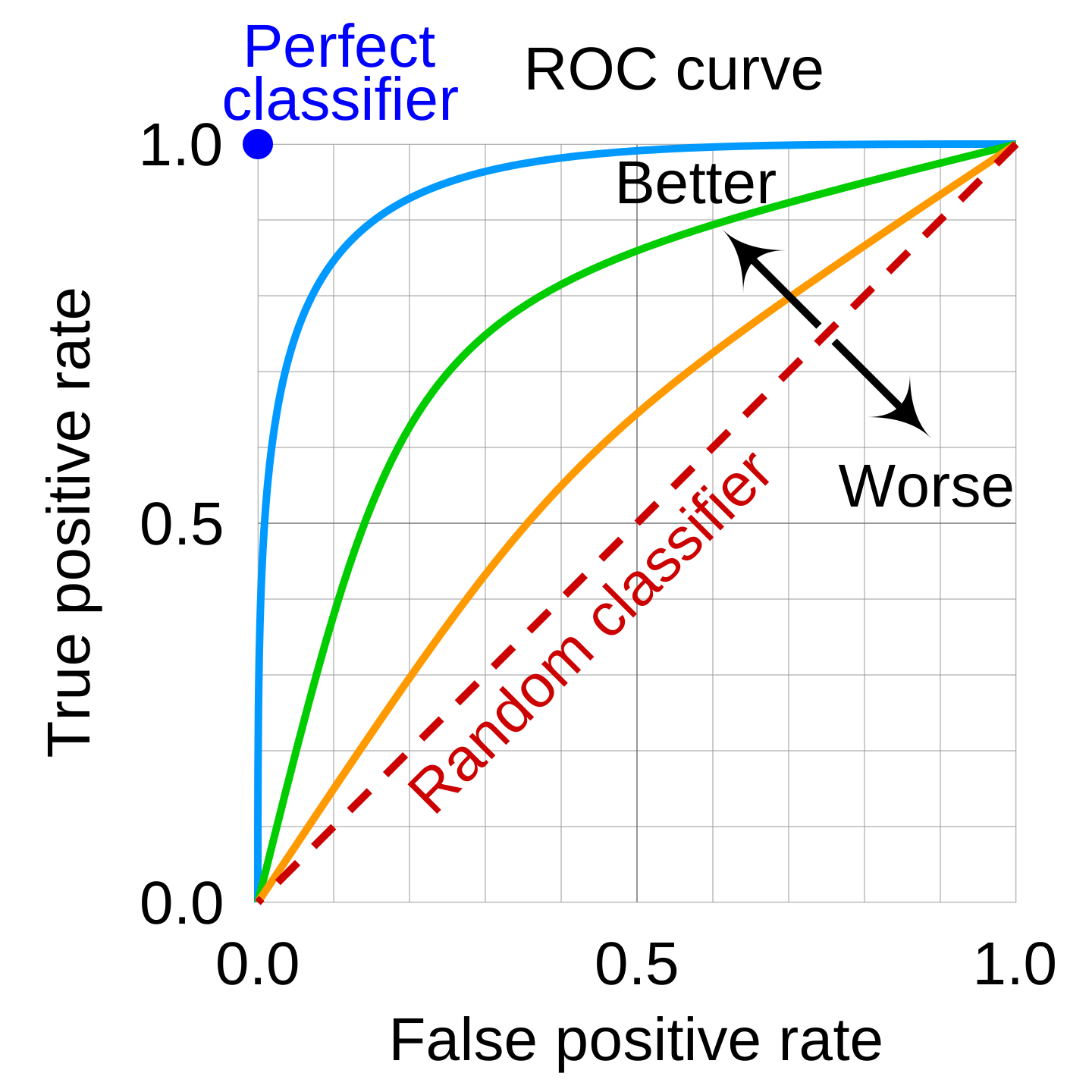
Illustrative ROC curves show how changing an evaluation threshold changes measured errors; LiveBench uses the distinct scoring and contamination controls described in the text.
CMG Lee and Martin Thoma · Image source · CC BY-SA 4.0

A benchmark starts aging the moment its questions become available. They can enter training corpora, public explanations, retrieval indexes, or carefully selected demonstrations. After enough exposure, a high score may reflect a different mixture of competence and familiarity than it did at launch. LiveBench addresses this problem by renewing questions and using objective scoring where possible. Its official changelog’s latest verified entry at the October 18, 2026 cutoff is January 8, adding new mathematics and data-analysis tasks. The project offers a useful case study in measurement over time: freshness helps, but dates and versions have to travel with every result.
The clock begins before evaluation
The LiveBench paper, revised in April 2025 and presented at the International Conference on Learning Representations that year, describes frequently refreshed tasks sourced from recent material. Its coverage includes mathematics, coding, reasoning, language, instruction following, and data analysis. The design aims to limit contamination while scoring against objective ground truth. The current paper title says contamination-limited. That cautious wording captures a useful principle: a maintenance strategy reduces a risk without proving its complete absence.
Suppose a model is frozen on March 1, and a question is first written on April 1. That ordering makes direct memorization of the exact question during the frozen training process less plausible. It does not establish that the model has never seen the underlying theorem, programming exercise, or source document. Nor does it exclude later retrieval. The dates constrain possible explanations rather than delivering a binary certificate of purity. Useful evaluation separates exposure to a particular answer from the ordinary background knowledge that makes solving possible.
New tasks change the target
The January 8, 2026 changelog adds a mathematics task combining integrals with a game-theoretic problem and a data-analysis task concerned with consecutive events. The preceding December entry adds logic with navigation. These are documented changes to the test, not evidence that a particular model improved. A fresh task can expose a new weakness even when older tasks have become easy. It can also change the weighting of abilities in an overall average.
An invented navigation exercise illustrates the compositional idea without reproducing a benchmark question. Start at coordinate zero, infer whether a conditional instruction applies, then move three units right or two left. A model might understand the logic yet lose the position, or track the position while applying the wrong condition. Combining operations probes their coordination. When a task is added, evaluators should inspect the new failure modes rather than assuming its novelty automatically makes it a better measure of every application.
Three forms of familiarity
It helps to distinguish exact-item exposure, template exposure, and source exposure. Exact-item exposure includes seeing the question with its answer. Template exposure means practicing many structurally similar questions. Source exposure means knowing the material from which a question was derived. The second and third can represent legitimate learning, yet they can also make a supposedly surprising test less diagnostic. The boundary depends on whether the claim is memorization resistance, transfer to new instances, or general competence.
Consider a new table-formatting task built from yesterday’s data. Its numbers may be unseen, while the required transformation is familiar and appropriate for the model to have learned. A strong result supports transfer of that transformation to fresh inputs. It does not necessarily establish a new reasoning skill. Conversely, replacing names in a public logic puzzle can preserve its entire solution structure. The article’s inference is that freshness reports should describe what was renewed: raw material, wording, constraints, task family, or some combination. A release date alone cannot answer that question.
The grader is an instrument too
LiveBench’s repository describes ground-truth scoring intended to avoid reliance on a language model judging difficult answers. That is attractive when an answer can be checked exactly. It also shifts scrutiny to answer extraction, equivalence rules, and the generation of valid questions. The project’s changelog records repairs to ambiguity and question-generation problems, illustrating that a deterministic grader can operate perfectly on a defective task. Objectivity in the scoring function does not guarantee correctness of the specification.
Imagine a task expecting the ordered pair 2, 3. A response giving x equals 2 and y equals 3 could be mathematically identical but fail a brittle parser. A response with the expected pair inside an unrelated disclaimer might pass an overly permissive parser. Neither case requires a language model judge; both require an explicit policy. Small adversarial tests of the grader should cover valid alternative forms and plausible invalid forms. Recording raw outputs allows a later correction without silently rewriting what the model originally said.
An agent harness can move a leaderboard
The October 3, 2025 changelog records switching agentic coding from SWE-Agent to Mini-SWE-Agent and increasing the step limit from 50 to 250. It also says the coding tasks were rerun and the existing May 30 leaderboard updated. Those are substantial experimental conditions. A coding model acts through a harness that presents tools, formats observations, and decides when an interaction ends. A score belongs to that combined system rather than to a model name in isolation.
An independent workshop analogy is useful here. Giving two mechanics the same engine does not make a comparison fair if one receives diagnostic tools and five times as many opportunities to inspect it. More steps can permit recovery from a wrong turn; a simpler interface can reduce misunderstandings. Neither improvement is illegitimate. The reporting obligation is to say which apparatus produced which result. Keeping the former configuration available, or rerunning all compared models under the new one, makes the interpretation substantially stronger.
A moving ruler needs a bridge
A model tested in January and another tested in June can be compared directly only if the evaluated question population and procedure are appropriately aligned. Otherwise model and benchmark changes are confounded. The repository exposes a release-selection argument and category-specific evaluation machinery, enabling more explicit comparisons. A reader should look for the selected release, the relevant question dates, and the same scoring implementation before interpreting an overall ranking as a historical capability curve.
A practical design uses overlapping panels. Retain a set of stable anchor questions, add a fresh panel, and evaluate several unchanged reference models on both. If every reference model improves on the fresh panel, the panel may simply be easier. If a new model gains particularly on fresh questions while reference models remain stable, the evidence for improved transfer is stronger. This proposal is a general evaluation design, not a claim that LiveBench currently implements that exact analysis. It shows how a renewed test can retain continuity without pretending it never changed.
Read the maintenance log beside the score
LiveBench’s current materials demonstrate that a benchmark is a maintained research instrument. Its paper explains the goal, its dataset exposes task records, its repository provides the procedure, and its changelog explains changes that an attractive leaderboard may hide. None of those documents should be treated as interchangeable. The most recent-looking page may contain an older demonstration command, while a dated changelog supplies the actual task update. Record the configuration used rather than guessing from the surrounding website.
For someone choosing an assistant, the decisive question remains whether the tasks resemble the intended work. A useful system might be excellent at structured data operations but unreliable at a long coding repair; the overall average can obscure that tradeoff. Fresh evaluations, raw answers, category breakdowns, and reproducible settings let readers make their own judgment. The contamination clock never stops. Good evaluation does not claim to stop it; it gives every measurement a date, a well-described instrument, and enough preserved evidence to understand what changed.
Sources & further reading
Primary papers, project documentation, and research releases used in this article. Publication dates below refer to the sources themselves.
- LiveBench: A Challenging, Contamination-Limited LLM BenchmarkarXivPublished Checked
- LiveBenchLiveBenchChecked
- LiveBench changelogLiveBenchPublished Checked
- livebench/reasoningLiveBenchChecked
FOLLOW THE QUESTION
Study engineering foundations