PHYSICS
The Hubble Tension After Webb: What a Cleaner Cepheid Test Actually Rules Out
Webb’s Cepheid observations test a specific source of distance bias. Follow the physics from crowded stars to the 2026 distance-network comparison.
Research checked
Newest cited publication
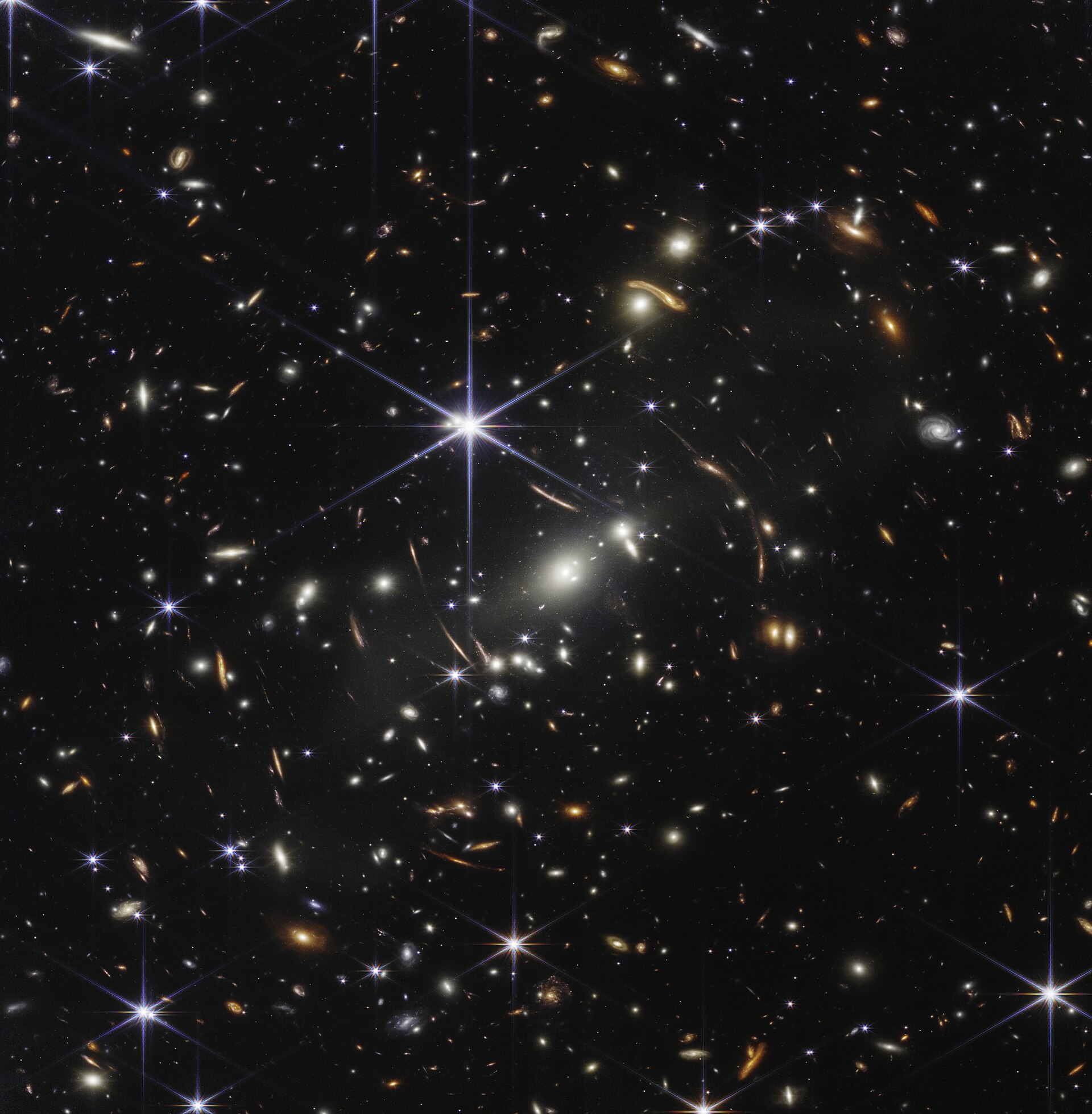
Webb’s deep-field view supplies telescope context. The Cepheid measurements used in distance-ladder tests target different stars and fields.
NASA, ESA, CSA, and STScI · Image source · Public domain

A sharper telescope does not settle a disagreement simply by taking a better picture. It settles a specific question when researchers can state which error the sharper picture would reveal. The James Webb Space Telescope's work on Cepheid variable stars illustrates this distinction. A September 1, 2025 study used an unusually clean stellar environment to test whether unresolved neighboring light was biasing distances measured with Hubble. The broader comparison continued into the 2026 publication of the Local Distance Network report. Together, these developments narrow explanations for the Hubble tension without identifying its cause. The scientific advance is an increasingly specific account of which measurements agree, which dependencies they share, and which proposed mistakes are becoming harder to sustain.
The disagreement compares different chains of inference
The Hubble constant describes the present expansion rate of the universe. Local distance methods infer it by connecting calibrated distances to the expansion of galaxies farther away. Early-universe methods infer it from observations such as the cosmic microwave background, evolved forward within a cosmological model. The disagreement is therefore not two instruments pointing at the same object and reporting different velocities. It compares measurement networks with different physical assumptions and different opportunities for systematic error.
A simple analogy is determining a building's height with a tape measure and predicting it from architectural drawings. The tape may be stretched; the drawings may omit a later alteration; both may have errors. Agreement among several tape measurements checks the tape route more thoroughly but does not independently verify every detail in the drawings. Conversely, drawings that fit many other dimensions deserve careful consideration. The task is to find a specific explanation that reconciles all the useful information, rather than announcing that one route must automatically be correct.
A variable star supplies a repeatable physical relation
Cepheids pulsate, and their pulsation periods are related to their luminosities. Once the relation is calibrated using objects with independently known distances, the period of another Cepheid helps predict its luminosity. Comparing that prediction with observed brightness yields a distance estimate, after accounting for effects such as dust and stellar population differences. Cepheids in galaxies that also hosted Type Ia supernovae then connect the stellar scale to supernova measurements reaching farther into the expanding universe.
Each connection introduces uncertainty and potential shared dependencies. A calibration offset can shift many galaxies together. An error affecting stars in a specific environment can instead generate a trend with distance or host properties. These patterns are testable. The purpose of a second telescope is strongest when its different resolution or wavelength response changes the suspected error while keeping the underlying distance unchanged. The resulting comparison is an experiment on the measurement process, not merely a second estimate to average with the first.
Extra light can make a star seem too close
If an unresolved neighboring star adds flux to a Cepheid, the Cepheid can appear brighter than it truly is. At a fixed inferred luminosity, extra apparent brightness makes the estimated distance smaller. A simple numerical example shows the sensitivity. If the measured flux is ten percent too high, the inverse-square relation gives a distance smaller by a factor of one divided by the square root of 1.1, about 0.9535. A subsequent expansion-rate estimate could therefore be biased upward by roughly 4.9 percent in this simplified case.
Those invented numbers are not an estimate of the actual Cepheid bias. They explain why crowding was a serious hypothesis worth testing. A genuine error large enough to reconcile the tension should leave observable consequences, including differences between low- and high-crowding environments or between instruments that separate neighbors differently. The 2024 Webb crowding study compared more than a thousand Cepheids and reported no significant mean distance discrepancy between Webb and Hubble. Its rejection significance concerned the proposed distance-dependent crowding explanation, not every possible source of error.
A cleaner environment changes the suspected contaminant
The September 2025 preprint examines Cepheids in NGC 3447, an interacting system with two contrasting stellar environments. One component contains mixed stellar populations; the younger companion offers an unusually low-background environment. That creates a particularly useful comparison because the stars belong to essentially the same distance system while their crowding conditions differ. The paper reports no component-to-component offset and substantially reduced scatter in the cleaner environment. Better precision and an unchanged mean are different pieces of information, and both matter.
Think of measuring identical weights first on a vibrating table and then on a stable bench. The stable bench should reduce scatter. If the average also moves, vibration may have biased the original measurement; if it does not, a large bias becomes less plausible even though individual readings were noisier. The astronomical test is more complex, but its logic is similar. A less crowded Cepheid sample is useful because it deliberately alters the suspected contaminant instead of merely adding more stars with the same observational limitations.
A different sample can move the mean without exposing a telescope error
Another primary analysis, first submitted on August 21, 2024, studies how early Webb supernova-host subsamples compare with the larger Hubble set. It finds that sample selection can explain substantial differences between some early expansion-rate estimates. This is an essential qualification when reading apparently conflicting Webb headlines. A small set of calibrator galaxies need not reproduce the average of a larger population exactly, even when the distance measurements in the shared galaxies agree.
An independent toy example makes this intuitive. Suppose a class contains equal groups with scores averaging 60 and 80. The class average is 70, but a sample containing three students from the first group and one from the second averages 65 even before individual variation is considered. The selection shifted the estimate without changing the accuracy of the examination. Cosmological calibrators are not school scores, but the lesson carries over: compare overlapping objects, sample definitions, and uncertainties before assigning a difference to the telescope or to new physics.
More methods do not automatically mean more independent information
The Local Distance Network report, first posted in October 2025 and published in Astronomy & Astrophysics in 2026, combines several distance indicators while accounting for correlated calibrations. Its baseline result is 73.50 plus or minus 0.81 kilometers per second per megaparsec. The report examines robustness when indicators or downstream methods are removed. This approach broadens the empirical crosschecks, but the presence of many methods does not mean that all their uncertainties are independent.
Suppose three instruments each have independent noise of one unit but also share an unknown calibration offset of two units. Averaging them reduces the independent component to about 0.58 units. It does not reduce the common two-unit uncertainty. The combined uncertainty is then about the square root of 4 plus one third, or 2.08 units, rather than 0.58. This deliberately simplified calculation explains why covariance belongs in the physical argument. A network must track shared anchors and shared supernova samples rather than turning every named indicator into a separate vote.
A successful answer must preserve the crosschecks
The relevant conclusion from Webb is narrower and stronger than a slogan that all measurement errors are ruled out. Specific crowding explanations have faced increasingly demanding tests, and the compared Cepheid distances have remained consistent. At the same time, the early-universe inference is supported by detailed internal relationships; the ACT baseline analysis finds strong consistency within its tested model. Any proposed new physics must improve the disagreement without spoiling those successes. Any proposed observational correction must explain why the targeted crosschecks did not reveal it.
My assessment is that progress should be judged by discriminating predictions. An error hypothesis should identify an environment, wavelength, distance range, or calibration comparison where a discrepancy must appear. A physical extension should predict more than a shifted Hubble constant. Independent geometric distances and differently calibrated expansion probes can then test the proposal. The clearer Cepheid observations and distance-network work do not finish the story. They make the remaining explanations more accountable, which is a concrete scientific achievement even while the underlying cause stays unresolved.
Sources & further reading
Primary papers, project documentation, and research releases used in this article. Publication dates below refer to the sources themselves.
- JWST Observations Reject Unrecognized Crowding of Cepheid Photometry as an Explanation for the Hubble Tension at 8 sigma ConfidenceAdam G. Riess and collaborators / arXivPublished Checked
- The Perfect Host: JWST Cepheid Observations in a Background-Free SN Ia Host Confirm No Bias in Hubble-Constant MeasurementsAdam G. Riess and collaborators / arXivPublished Checked
- JWST Validates HST Distance Measurements: Selection of Supernova Subsample Explains Differences in JWST Estimates of Local H0Adam G. Riess and collaborators / arXivPublished Checked
- The Local Distance Network: a community consensus report on the measurement of the Hubble constant at 1% precisionH0DN Collaboration / arXiv and Astronomy & AstrophysicsPublished Checked
- The Atacama Cosmology Telescope: DR6 Power Spectra, Likelihoods and ΛCDM ParametersACT Collaboration / arXivPublished Checked
FOLLOW THE QUESTION
Explore physics