ARTIFICIAL INTELLIGENCE
V-JEPA and Predicting in Latent Space
V-JEPA 2.1 strengthens dense video features in 2026. The result clarifies how latent prediction connects observation, spatial detail and robot planning.
Research checked
Newest cited publication
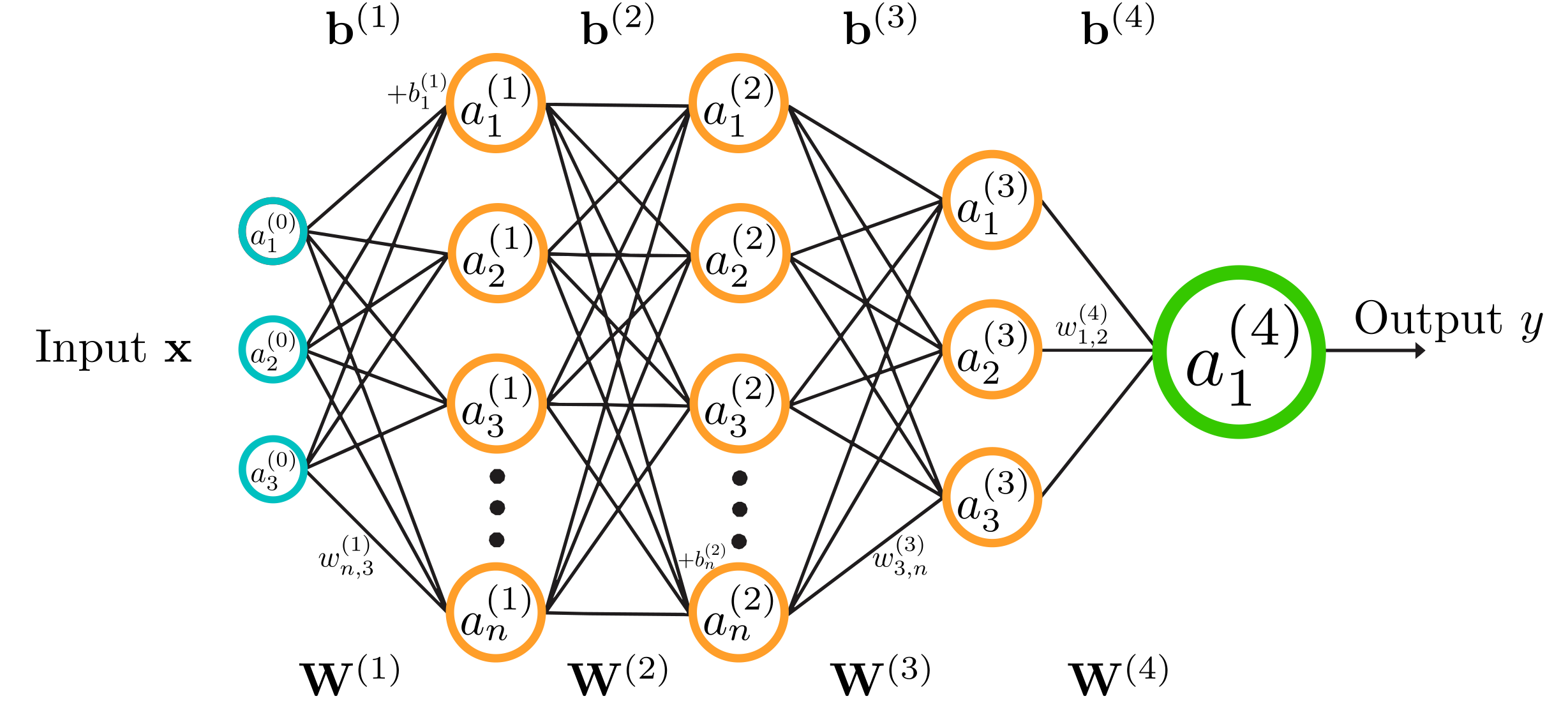
A layered-network illustration provides background for representation learning and prediction in a learned feature space.
QuantuMechaniX8 · Image source · CC0 1.0

When a cup slides toward the edge of a table, useful anticipation does not require inventing every pixel of the next camera frame. It requires retaining information about the cup, the edge and their changing relationship. That is the attraction of predicting in a learned representation, often called latent space. Meta's V-JEPA 2 demonstrated a route from large-scale video observation to limited robot planning in 2025. V-JEPA 2.1, first submitted on March 15, 2026 and revised on June 11, extends the story toward detailed, spatially organized features. The distinction matters: recognizing the overall event and preserving the local geometry needed to act are related achievements, but they are not interchangeable.
Prediction without rendering a future movie
V-JEPA abbreviates Video Joint Embedding Predictive Architecture. Its central setup trains a predictor to recover representations of withheld visual content from available context. The 2025 V-JEPA 2 paper describes pretraining on more than a million hours of internet video, followed by separate routes for video understanding and action-conditioned planning. The objective operates on learned features rather than requiring a photorealistic reconstruction. This does not mean that the representation is automatically a complete account of physical state. It means the learning problem can emphasize predictable visual structure without reproducing every surface detail.
An independent example makes the tradeoff concrete. Imagine two recordings of the same rolling ball, one under a flickering light. Pixel prediction must account for both motion and brightness changes. A representation useful for interception might ignore some illumination variation while preserving position and velocity cues. But it must not ignore a thin barrier in the ball's path merely because the barrier occupies few pixels. Choosing what to discard is therefore part of the scientific problem. A representation can be beautifully compact and still remove exactly the detail a downstream task needs.
Why the 2026 model pays attention to local structure
V-JEPA 2.1 changes the training recipe with a dense predictive objective, hierarchical supervision across intermediate encoder layers, unified image-and-video training components and scaling. Its abstract reports that visible as well as masked tokens contribute to the objective. The stated goal is to preserve strong whole-scene recognition while learning features that remain spatially structured and consistent through time. This is a targeted response to the difference between knowing what a clip depicts and representing where its relevant parts are.
Consider a hypothetical feature map for a hand lifting a lid. A global descriptor could identify the event correctly even if neighboring locations have indistinguishable features. A robot seeking a grasp location needs more: the handle and hinge should remain distinguishable as the viewpoint changes. Dense evaluation asks whether useful information can be read from particular positions. Temporal consistency asks whether those positions continue to refer to related content in successive frames. Neither property follows merely from a correct action label. This is why adding dense tasks to an evaluation can expose weaknesses concealed by a strong average recognition score.
Action conditioning adds a different kind of evidence
The 2025 planning variant, V-JEPA 2-AC, adds action-conditioned learning using less than 62 hours of robot interaction video from DROID. The paper reports image-goal pick-and-place experiments with Franka arms in two laboratories, without collecting data from the deployment robots in those environments. This is a concrete form of transfer, bounded by those tasks and platforms. It should not be expanded into a claim that passive internet video alone taught unrestricted manipulation or that the robot needed no interaction data during training.
The distinction is causal. Watching an object move can reveal that movement is likely in a situation. Planning an action requires predicting what happens if a particular command is executed. The same visible scene can permit several outcomes: push left, push right or remain still. An action-conditioned predictor can compare those possibilities when its training supports them. A planner then chooses a candidate sequence whose predicted outcome resembles a goal, executes part of it and observes again. Repeated observation is valuable because a prediction error need not be allowed to accumulate through an entire imagined sequence.
A better score is a result under a protocol
The 2026 paper reports 7.71 mean average precision on Ego4D short-term object-interaction anticipation, 40.8 recall at five on EPIC-KITCHENS action anticipation and a 20-percentage-point improvement in its real-robot grasping comparison with V-JEPA 2-AC. These are different measurements. Average precision evaluates ranked detections or predictions under a benchmark definition; recall at five allows several guesses; a grasp success rate counts physical trials. Placing them beside one another illustrates breadth without making their numerical scales comparable.
For an independent toy illustration, a predictor that includes the correct action among five suggestions in four of ten cases has recall at five of 40 percent on those ten examples. That does not mean its first suggestion is right 40 percent of the time. Likewise, an increase from 50 to 70 successful grasps per hundred trials is twenty percentage points, and forty percent relative improvement. Those quantities answer different questions. Good reporting preserves the denominator, evaluation setting and uncertainty rather than letting the largest-looking interpretation travel into a headline.
Diverse observations still have a collection process
DROID's project documentation describes 76,000 demonstration trajectories, approximately 350 hours of interaction, collected across 564 scenes and 86 tasks. Its platform uses a shared robot setup across institutions, and the project later released improved camera calibration for part of the collection. These details are useful because a dataset is more than a large number of frames. Camera geometry, action conventions and the situations chosen by demonstrators shape what a learned predictor can infer.
A model trained mostly on reachable tabletop objects may have little evidence about tangled cloth, fragile assemblies or the contact forces inside a closed drawer. Even within the same scene, image agreement can conceal a failure: a gripper may hover over an object in an apparently goal-like pose while holding nothing. An illustrative evaluation would combine image goals with an independent success signal, such as whether the intended object is actually supported by the gripper. That proposal follows from the limitations of visual evidence; it is not a claim that a particular published trial used an inadequate success test.
A world model is useful to the extent that its predictions are useful
The official V-JEPA repository exposes code and checkpoints for the 2, 2-AC and 2.1 variants. This allows researchers to ask whether improvements survive a changed camera, a different scene or a deliberately unusual motion, instead of relying exclusively on a demonstration video. Reproduction also requires matching preprocessing, evaluation heads and the amount of downstream adaptation. A frozen-feature result and a fully fine-tuned result can probe very different properties of the same encoder. This keeps the learned representation separate from the adaptation procedure used to assess it.
My reading of the progression is that latent prediction is becoming a more versatile visual substrate, while its usefulness for physical intervention remains an empirical question. The next convincing evidence would connect dense feature quality to robust closed-loop behavior under carefully described shifts. It would report failures, recovery and computation alongside success. V-JEPA 2.1 advances the representation side of that agenda in 2026. It does not settle every debate about whether a learned feature space deserves the name world model, and it need not settle that debate to make its measured contributions valuable.
Sources & further reading
Primary papers, project documentation, and research releases used in this article. Publication dates below refer to the sources themselves.
- V-JEPA 2: Self-Supervised Video Models Enable Understanding, Prediction and PlanningMeta FAIR / arXivPublished Checked
- V-JEPA 2.1: Unlocking Dense Features in Video Self-Supervised LearningMeta FAIR / arXivPublished Checked
- V-JEPA 2, V-JEPA 2-AC and V-JEPA 2.1 — official repositoryMeta FAIR / GitHubChecked
- DROID: A Large-Scale In-the-Wild Robot Manipulation DatasetDROID Dataset TeamChecked
FOLLOW THE QUESTION
Study engineering foundations