MATHEMATICS
Twisted approximation must work at every scale
September 2026 preprints examine approximation with a fixed matrix, showing why repeated success and success at every large scale require different geometry.
Research checked
Newest cited publication
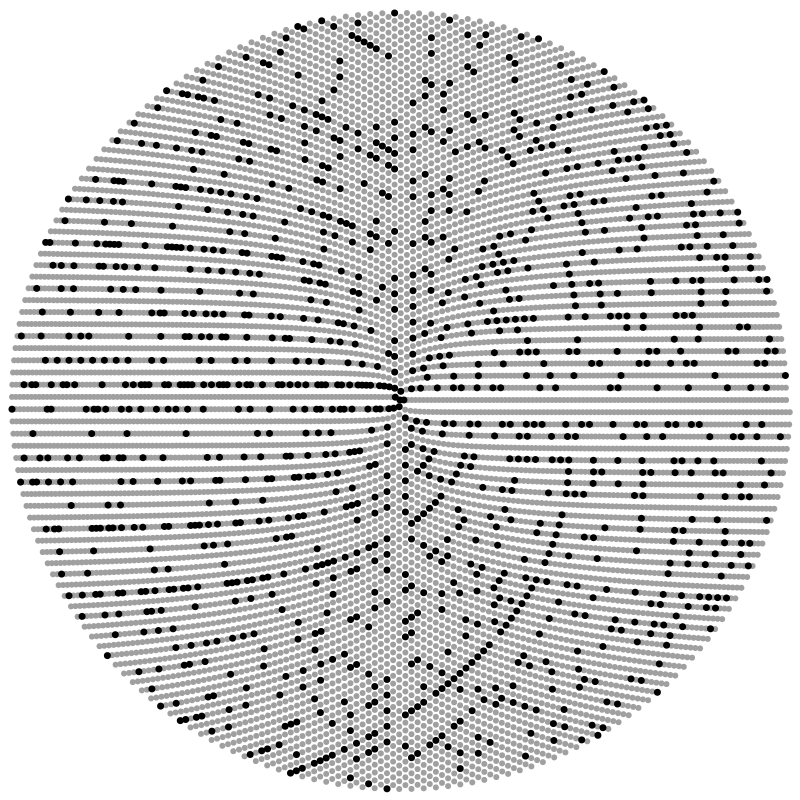
An integer spiral provides arithmetic background for the article’s discussion of uniform approximation across scales; it is not a visualization of the new bound.
Claudio Rocchini / Wikimedia Commons. Unchanged original image. · Image source · CC BY 2.5

Approximating a real quantity with rational data sounds like a question about a single excellent fraction. Many modern problems instead ask for an entire schedule of approximations. As the allowed denominator budget increases, how reliably can one hit a prescribed target? Taehyeong Kim and Vasiliy Neckrasov posted two preprints on 29 September 2026 that treat this issue with an arbitrary fixed real matrix. The uniform theory addresses success at every sufficiently large budget, while the companion asymptotic theory addresses infinitely many successes. That difference in quantifiers changes which exceptional sets must be measured and how geometric clustering enters the answer.
Fix the matrix, vary the target
Start with a one-dimensional rotation. Choose a real number a, multiply it by an integer q, and discard the integer part. The remaining point lies on a circle of circumference one. For a target b, closeness means that aq−b is near an integer p. A target near the end of the unit interval can be close to a point near zero because the two endpoints represent the same location on the circle. The natural error is therefore the absolute value of aq−p−b, minimized over p. The higher-dimensional version replaces a by a matrix, q by an integer vector, and b by a target vector. Twisted approximation holds the matrix fixed while allowing the target to vary.
This choice of variable matters. A theorem valid for almost every matrix and almost every target need not give an answer for the particular matrix chosen at the start. Exceptional matrices can produce exceptional behavior for a large family of targets. As an elementary illustration, let a equal one third. Its orbit modulo one visits only three points, regardless of the denominator budget. A target halfway between two of them cannot be approximated with arbitrarily small error. No amount of averaging over other choices of a resolves this fixed example.
Infinitely often is weaker than uniformly
Let T denote the budget and let psi(T) be a positive accuracy threshold decreasing toward zero. A uniform requirement asks for a permitted integer q with size at most T and error at most psi(T), for every sufficiently large T. A successful approximation at one budget can sometimes serve later budgets, but only until the decreasing threshold becomes smaller than its error. Long stretches without a replacement can therefore cause uniform failure even if record-breaking approximations appear infinitely often. The order of the words every and exists encodes this scheduling demand.
An invented record sequence makes the distinction concrete. Suppose candidate records arrive only at budgets 10, 10,000 and 10,000,000, with respective errors one thousandth, one millionth and one billionth. Against the threshold one divided by T, each record is impressive when it arrives. But the first error fails once T exceeds one thousand, leaving a gap before the next record. Infinitely many similarly spaced records would not establish uniform success. This example describes a logical pattern rather than claiming that these exact records arise from a specified irrational rotation.
Why one short lattice direction is insufficient
The uniform preprint reports dimension formulas for broad classes of approximation functions using the successive minima of an associated lattice trajectory. Its coverage includes all but finitely many power functions for a fixed matrix. Successive minima measure the scales at which independent lattice directions become available. The emphasis on all directions is crucial: knowing only that one direction is very short can miss clustering within a lower-dimensional family. The results are preprint theorems with stated regularity conditions, not an unrestricted assertion for every decreasing function.
A simple lattice picture explains the issue independently. In a square window, compare a grid with spacings one hundredth horizontally and one hundred vertically to a grid with unit spacing in both directions. Both fundamental cells have area one. The first grid contributes many points along a horizontal line but no comparable vertical diversity in a moderately sized window. Counting points solely from area can then misdescribe their distribution. Independent-direction information distinguishes genuine coverage from a crowded strand. In approximation problems, many denominator choices can similarly produce almost the same target location.
Why a naive probability calculation can fail
For a toy circle model, draw an interval of radius r around each of Q candidate orbit points. Adding the interval lengths gives 2Qr, capped at one as an upper bound on total coverage. Equality is not automatic because intervals can overlap. If every center were identical, the union would still have length only 2r. If the centers were well spaced and the intervals short enough, the union could have length 2Qr. Identical nominal volume budgets can therefore produce very different sets of successful targets.
The asymptotic companion paper reports an exact zero-one criterion under dyadic regularity, expressed through block volumes divided by homogeneous lattice-point counts. It also gives related Hausdorff-measure and dimension criteria. This is a specific response to the overlap problem: clustering must alter the effective contribution of a block of possible approximations. The dyadic viewpoint groups budgets between successive powers of two. It controls how contributions across scales accumulate while retaining enough geometric information to avoid treating dependent candidates as independent random trials. Its hypotheses should be checked before replacing the criterion with a simple divergent sum.
A null set can still contain substantial structure
Lebesgue measure asks whether a randomly chosen target, under uniform volume sampling, is likely to belong to a set. Hausdorff dimension asks a different question about scaling: how many small covering pieces are needed as their size shrinks? A set can have zero volume yet possess a nonzero dimension, as familiar fractal constructions illustrate. Determining dimension after proving measure zero therefore adds real information. It does not merely relabel failure. In the present setting, it quantifies the size of target families that satisfy demanding approximation requirements despite being invisible to ordinary volume probability.
There is a second subtlety when targets are constrained to a curve or surface. Victor Beresnevich, David Simmons and Sanju Velani study twisted approximation on manifolds in a paper first submitted on 6 July 2025 and revised on 7 February 2026. They provide sufficient conditions for twisted Khintchine-type behavior on nondegenerate analytic manifolds and investigate badly and well approximable intersections. Those conditions address geometric restrictions on the targets; they do not follow merely by restricting an ambient almost-everywhere theorem. A curve can lie inside an ambient exceptional set even when that exceptional set has zero volume.
What a useful application must specify
Before applying any of these results, write down the matrix, the norm, the allowed integer vectors, the target space and the exact accuracy function. Also decide whether positive denominators, signed denominators or a full vector box are intended. Changing this data can change the problem. In numerical experiments, separate the best observed error below a budget from the error at a single denominator. The former is a nonincreasing record function, while the latter can fluctuate violently. Confusing them can make a sparse sequence of lucky hits look like stable approximation.
Finite computation can illustrate clustering and test derived examples, but it cannot verify an every-sufficiently-large-budget claim by exhausting budgets. It can also miss the rare long gaps that determine uniform behavior. The September work is valuable because it organizes those hidden gaps through geometry, rather than relying on a picture of random orbit points. Further progress could clarify excluded critical power parameters or relax regularity assumptions, but those are separate questions. The present development already makes the central lesson precise: reliability across scales requires more information than the existence of arbitrarily accurate isolated approximations.
Sources & further reading
Primary papers, project documentation, and research releases used in this article. Publication dates below refer to the sources themselves.
- Twisted Diophantine Approximation II: Uniform TheoryarXivPublished Checked
- Twisted Diophantine Approximation I: Asymptotic TheoryarXivPublished Checked
- Twisted Diophantine approximation on manifoldsarXivPublished Checked
FOLLOW THE QUESTION
Explore mathematics