PHYSICS
Thorium nuclear clocks finally close the feedback loop
October 2026 thorium experiments turn nuclear spectroscopy into operating clocks, while crystal reproducibility remains a separate limit on precision.
Research checked
Newest cited publication
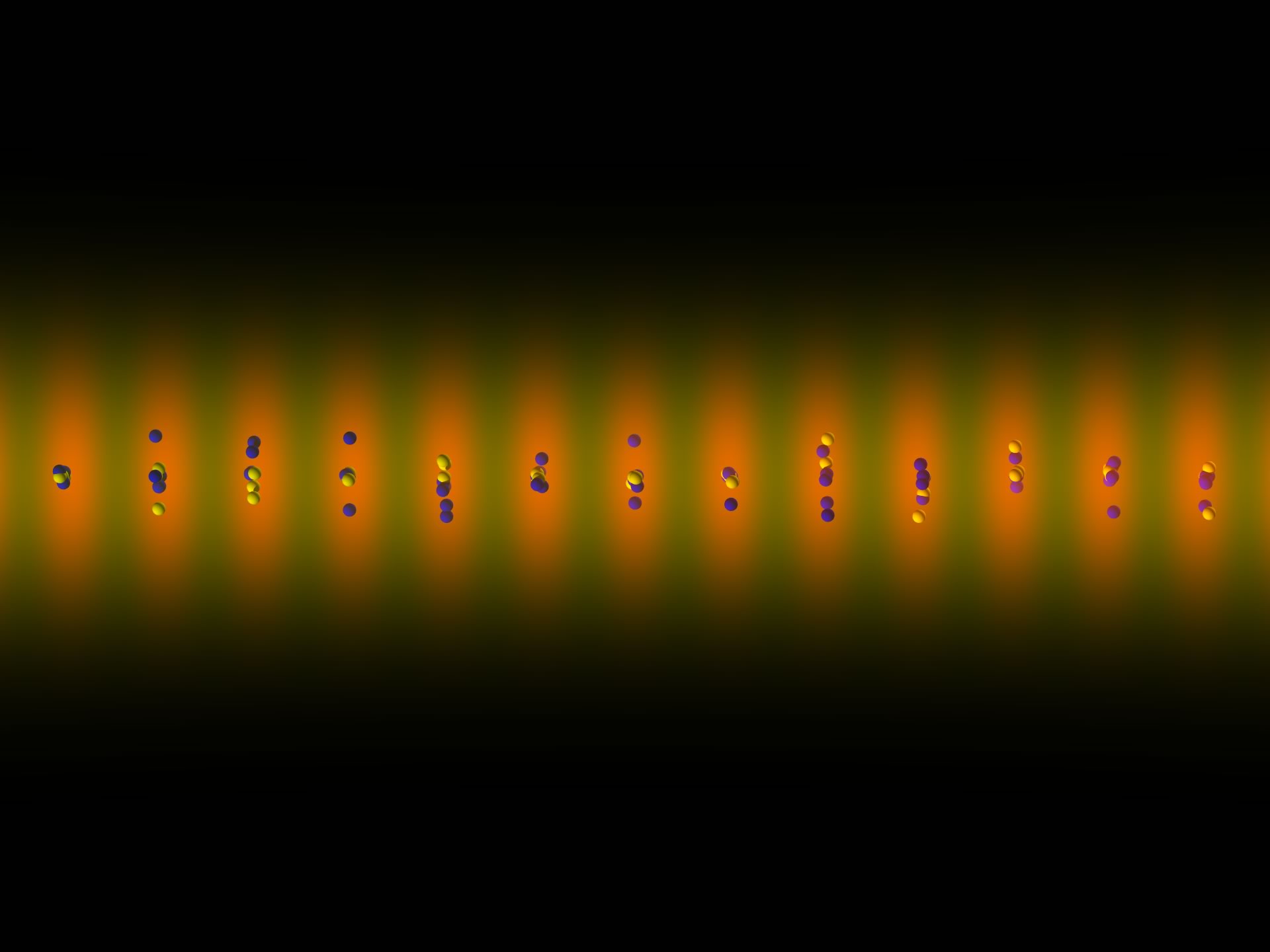
An optical-lattice visualization supplies precision-frequency context. The thorium nuclear-clock transition and feedback experiment use the distinct system described in the article.
NIST · Image source · Public domain

Finding a resonance is different from using it to run a clock. A resonance tells an experimenter where a physical system responds; a clock requires an oscillator that repeatedly consults that response and corrects its own drift. On 7 October 2026, two Nature papers reported nuclear clocks whose lasers were steered by thorium-229 nuclei in solid crystals. The distinction is the central achievement. It moves the discussion from whether the unusual nuclear transition can be illuminated to whether it can act as an operational frequency reference. It does not mean that nuclear devices have already surpassed the best electronic atomic clocks on every measure, or that crystal effects have disappeared.
The nucleus becomes part of the control loop
In the feedback-loop experiment, thorium nuclei were embedded in a room-temperature calcium-fluoride crystal and interrogated with continuous-wave light near 148 nanometres. Absorption measurements supplied a correction signal that steered the laser. The authors reported a shot-noise-limited fractional instability proportional to 3 × 10⁻¹² divided by the square root of averaging time in seconds, with continuous operation extending to a day. This is a measured early clock, with a demonstrated control loop, rather than a statement that every uncertainty is already at the level of leading optical atomic standards.
The logic resembles balancing on a narrow ridge. A signal measured only at the top may indicate maximum response, but it does not tell the controller which direction it has slipped. Sampling on opposite sides creates an error signal with a sign: one side responds more strongly when the laser is too high in frequency, and the other responds more strongly when it is too low. The controller can then push the oscillator back toward the centre. This explanatory picture is more useful than imagining that the nucleus continuously emits evenly spaced flashes. The usable clock output comes from an oscillator whose frequency is disciplined by a physical transition.
Why measuring missing light speeds the feedback
A Nature paper published on 16 September 2026 established continuous-wave absorption spectroscopy of the thorium nucleus. Instead of relying only on delayed light emitted after excitation, the experiment monitored the nuclear absorption of the incident beam. That supplied a route toward repeated, relatively fast measurements of the resonance. The importance is not that a long-lived nuclear excited state suddenly decays faster. It is that the measurement no longer has to wait for that decay to obtain all of its information about the laser’s position relative to the line.
To see the advantage, imagine testing whether a key fits a lock. One approach waits until the mechanism has completed a long cycle before reading an indicator. Another senses resistance while the key is being turned. The second observation can guide adjustments sooner even though the mechanism itself has not become faster. In spectroscopy, the actual signals and noise are more subtle, but the control principle is similar. Faster usable information permits shorter correction intervals. It also introduces tradeoffs: a weak absorption contrast demands careful photon counting, and fluctuations in source power or background transmission must not be mistaken for a frequency error.
A second clock checks the route to operation
The independent paper, A nuclear clock synchronized to 229Th, also published on 7 October 2026, reports a narrow-linewidth vacuum-ultraviolet laser locked to a resolved transition in thorium-doped calcium fluoride. Its reported fractional instability was 5 × 10⁻¹³ divided by the square root of averaging time in seconds. Two separately fabricated crystals agreed at the 10⁻¹³ level. The existence of independent implementations matters because a clock architecture becomes more convincing when a second laboratory can obtain a usable discriminator and maintain a lock, not merely observe a similar spectral feature.
The different instability coefficients should be read in context rather than converted immediately into a winner. A clock can be optimised for different source powers, signal collection, environmental conditions or measurement intervals. More fundamentally, instability and reproducibility answer different questions. Instability asks how much the measured frequency fluctuates during operation. Reproducibility asks whether returning tomorrow, replacing a component or using another crystal yields the same corrected frequency. A narrow distribution of readings during one run can coexist with a shift between runs. Keeping those questions separate prevents a promising operational demonstration from being mistaken for a complete absolute-frequency standard.
An unusually accessible nuclear energy scale
Most nuclear transitions require radiation far more energetic than ordinary optical photons. Thorium-229 is exceptional because its low-lying isomeric transition is around 8.4 electronvolts, corresponding to vacuum-ultraviolet light. Using the elementary photon relationship, energy equals Planck’s constant times frequency, a wavelength near 148 nanometres gives a frequency around 2 × 10¹⁵ cycles per second. This calculation explains why an optical technology can interrogate a rearrangement of the nucleus. It does not make the required laser easy to build: vacuum-ultraviolet generation, transmission, detector response and material quality remain demanding parts of the instrument.
The word nuclear also invites a misleading picture of a tiny independent object sheltered completely from its surroundings. The nucleus is smaller than the atom, but its energy levels still respond to fields and to the electronic and crystalline environment. The hope is to exploit favourable sensitivities while measuring the remaining shifts. A transition is useful for precision work because its response can be controlled and characterised, not because a label guarantees immunity. The same reasoning applies to the host material: adding many resonant nuclei can strengthen a signal, yet an ensemble is only an advantage if variations among their local environments do not obscure the reference frequency.
The host crystal is part of the clock
A separate Nature study published on 28 January 2026 examined frequency reproducibility in thorium-doped calcium fluoride. It reported a working temperature near 196 kelvin where first-order thermal sensitivity vanished, and a 220-hertz reproducibility, fractionally 1.1 × 10⁻¹³, between differently doped crystals over seven months at 195 kelvin. The paper’s proposed route toward smaller temperature-induced shifts is a future capability, not its measured total clock uncertainty. This distinction is essential: reducing one temperature coefficient does not automatically remove strain, concentration dependence, calibration offsets or other contributions.
An elementary expansion clarifies the benefit of a special operating temperature. Near a turning point, a frequency shift can begin approximately with the square of the temperature change rather than its first power. Halving a small temperature excursion then reduces that contribution by roughly four instead of two, provided the approximation remains valid. But a temperature error that moves the sample away from the turning point can restore a first-order response. The practical goal is therefore to locate the useful point, monitor it and establish its repeatability. Material growth and thermal control become metrology questions, not merely background preparation for the supposedly more interesting nuclear physics.
What the new clocks can test next
The feedback-loop experiment constrained selected ultralight-dark-matter models; it did not detect dark matter. A separate Nature Communications study published on 15 October 2025 analysed the transition’s sensitivity to changes in the fine-structure constant and emphasised uncertainties in the nuclear model. Interpreting a clock ratio therefore requires a model of how hypothetical changes affect the two transitions, together with the time range sampled. Comparing unlike transitions is attractive because a shared perturbation can affect them differently. A change in their ratio can therefore carry information that a lone oscillator cannot distinguish from its own drift. Environmental shifts still have to be excluded before a variation receives a fundamental interpretation.
The immediate research programme is unusually tangible: increase usable signal, preserve stable illumination of the same crystal region, measure environmental coefficients, compare independent devices and repeat the measurements after interruptions. Each improvement attacks a specific source of ambiguity. The October 2026 clocks make these questions experimentally accessible because the nuclear reference now participates in feedback. Their significance is the opening of a working platform, with limitations that can be tested. The strongest future claim will come when an improved number survives those tests across time and across instruments, rather than when an appealing nuclear-clock headline substitutes for an uncertainty budget.
Sources & further reading
Primary papers, project documentation, and research releases used in this article. Publication dates below refer to the sources themselves.
- A thorium-229 optical nuclear clock with feedback loopNaturePublished Checked
- Continuous-wave laser absorption spectroscopy of the thorium-229 nucleusNaturePublished Checked
- A nuclear clock synchronized to 229ThNaturePublished Checked
- Frequency reproducibility of solid-state thorium-229 nuclear clocksNaturePublished Checked
- Fine-structure constant sensitivity of the Th-229 nuclear clock transitionNature CommunicationsPublished Checked
FOLLOW THE QUESTION
Explore physics