ENGINEERING
Thermoset composites are being designed for a second life
Recent dynamic polymers and recyclable composite matrices reveal why recovering fibers, preserving resin and proving durability are different engineering tasks.
Research checked
Newest cited publication
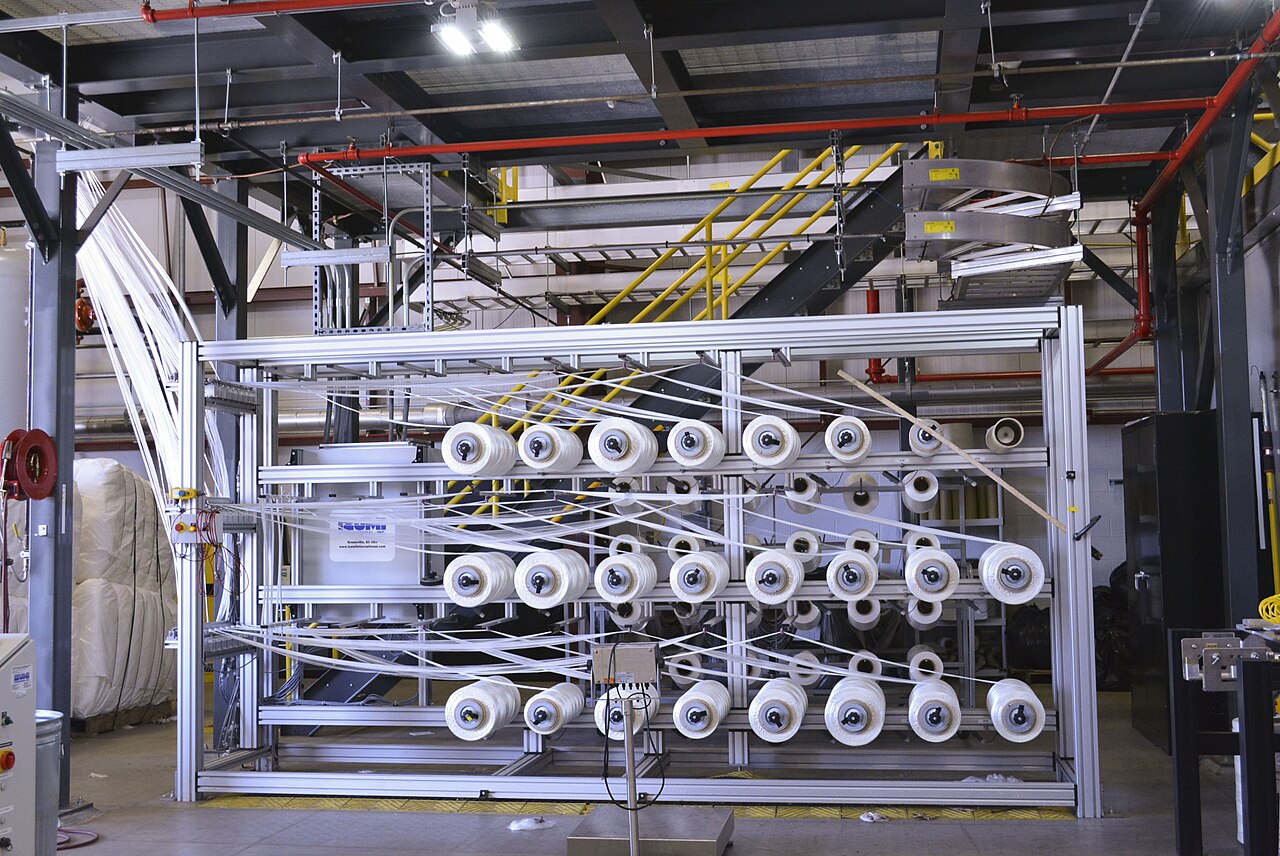
Carbon-fiber spools at Oak Ridge National Laboratory provide feedstock context for composites; the image does not show the newly designed recyclable thermoset chemistry.
Oak Ridge National Laboratory · Image source · CC BY 2.0

The chemistry that makes a composite useful can make it difficult to recycle. Long reinforcing fibers carry much of the load, while a cured resin holds them in position and transfers stress between them. In a conventional thermoset, that resin is a permanent molecular network. Heating it does not provide the convenient melting step available with many familiar plastics. Recent work is attacking several parts of this problem at once: converting existing networks into reprocessable materials, reducing the amount of dynamic chemistry needed in new polymers, and choosing entirely different composite matrices. The important development in 2026 is the variety of experimentally tested routes. Their differences matter, because a material that can be remolded, a resin that can be chemically recovered and a composite that preserves long fibers have passed different tests.
Can existing thermoset waste acquire a new processing route?
A feasibility study first published on December 4, 2025, in Global Challenges investigated solid-state shear extrusion as an alternative to batch ball milling for epoxy vitrimerization. A laboratory twin-screw extruder pulverized the thermoset and incorporated a catalyst under ambient conditions. Subsequent compression molding still required 250 degrees Celsius and 5 megapascals for an hour. The process therefore did not demonstrate an entirely room-temperature recycling cycle. It demonstrated a continuous preparation step that could replace a batch operation before heated consolidation.
This distinction is useful when evaluating scale. A continuous feeder can make throughput easier to manage, but it cannot remove the energy required elsewhere in the process. Nor does converting an epoxy powder automatically recover the original reinforcement architecture of a composite. Grinding a laminate cuts its continuous fibers, changing its structural role. A route suitable for resin-rich offcuts, adhesives or particulate waste may consequently need a different economic case from a route intended to recover long carbon-fiber fabrics. The relevant question is what valuable structure survives the chosen processing sequence.
A stiffer recycled resin can still break sooner
The extrusion study reported a higher Young’s modulus for its vitrimerized epoxy than for the initial resin, but a lower tensile strength. The reported mean strength decreased from 51.4 megapascals in the original epoxy to 34.3 megapascals after the extrusion route. Following three further reprocessing rounds, it was 28.8 megapascals. These numbers support feasibility and quantify a cost; they do not establish interchangeable performance with the starting thermoset. The authors also identify powder packing and particle interfaces as important influences on the resulting strength.
The apparent contradiction disappears once stiffness and failure are separated. Stiffness describes the resistance to small deformation before substantial damage occurs. Strength concerns how much stress the material withstands before failure. A rigid network containing poorly welded particle boundaries can resist initial stretching and still develop a crack early. For a structural designer, substituting the material on the basis of modulus alone would be a category error. An adequate qualification program would examine the properties that govern the intended part, including fatigue, impact and environmental exposure, rather than treating one favorable number as a complete mechanical description.
New networks try to make a little reversible chemistry go further
A 2026 Nature Communications paper explores a different strategy using N-hydroxyphthalimide-urethane bonds. The researchers designed dynamic linkages that dissociate readily under appropriate conditions and reform rapidly. Their proof-of-concept networks incorporated a small dynamic fraction, described as 5 mole percent relative to the diisocyanate component. The reported purpose was to preserve thermomechanical stability while retaining reprocessability and degradability. This is a new network formulation, rather than a treatment that makes arbitrary legacy epoxy waste recyclable.
The underlying design problem is a competition between service time and processing time. A panel should retain shape for years at its operating temperature, while a recycling press should rearrange the network within a manageable interval. If bond exchange is too fast in service, the material may creep under a sustained load. If exchange is too slow during processing, a nominally recyclable network becomes impractical to reshape. Reducing the number of dynamic sites is one way to change that balance, provided the remaining sites still permit the network to reorganize. The best formulation is therefore application dependent: a flexible seal and a precision support need different operating windows.
A recyclable composite need not begin with a synthetic thermoset
Fang He and colleagues reported another approach on February 21, 2026: using regenerated silk protein as a composite matrix. Their Nature Communications paper describes room-temperature forming and later separation of reinforcing fibers from the matrix using a solvent system. This is a relevant alternative to thermoset-matrix composites, rather than proof that silk is itself a conventional epoxy thermoset. The reported work tracked several recycling rounds, and its measured recoveries show why terms such as lossless should be read alongside the individual material data.
The approach broadens the design space while introducing its own process questions. Room-temperature forming can reduce heating at one stage, but extracting and preparing a biomacromolecule, recovering solvents and drying the product also consume resources. A useful environmental comparison must include those operations and compare products that perform the same job for the same lifetime. Choosing a biological feedstock does not establish a lower impact by itself. The engineering attraction is the possibility of preserving useful molecular complexity, then recovering both matrix and reinforcement, rather than reducing every discarded composite to short fibers and low-value residues.
Electronics provide a demanding test of recovered composite material
The vitrimer printed circuit board work, initially posted as a 2023 preprint and subsequently linked to a 2024 Nature Sustainability publication, supplies an instructive earlier demonstration. The researchers built functioning radio devices on vitrimer-based boards and investigated repair and component separation. The reported recovery fractions included polymer, reinforcement and solvent, making the material balance more informative than a single claim that a board was recyclable. These prototypes established a functional context for the chemistry, while remaining distinct from a large-scale electronics recycling operation.
Circuit boards illustrate why an intact specimen is not enough. Their material must provide electrical insulation, tolerate assembly temperatures, hold metal features in place and remain dimensionally stable. A recycling solvent must separate constituents without creating an equally difficult contamination problem. The same logic applies to a vehicle panel: recovery is useful only if the recovered material can meet an identified next specification. One can recover nearly all the mass while losing the precision fiber alignment that made the original product valuable. Measuring the destination’s requirements is as important as measuring what comes out of the recycling vessel.
The next benchmark is a closed loop with a complete bill of materials
These studies should be compared through explicit boundaries. Thermal reprocessing changes shape without necessarily returning the material to monomers. Chemical recycling deliberately breaks or separates selected structures. Repair extends the life of an existing component. Recovering a carbon fiber saves a different kind of value from recovering the surrounding resin. A credible development program can combine these routes, but it should account for additives, catalysts, solvents and the material that becomes unusable after each pass. Repeated laboratory cycles are evidence of durability under the reported protocol, not proof of unlimited recycling.
An informative next demonstration would begin with a used, contaminated component rather than pristine laboratory scrap. It would measure recovered fiber length, matrix yield, solvent losses and the properties of a newly manufactured part, then repeat the process under realistic variability. Costs and emissions would be reported for the full loop, including purification. That demanding standard does not diminish the recent chemistry. It identifies where the practical value lies: retaining enough molecular and structural organization to make a second useful product, while showing exactly what must be replaced to do so.
Sources & further reading
Primary papers, project documentation, and research releases used in this article. Publication dates below refer to the sources themselves.
- Recycling Thermoset Systems by Vitrimerization Using Solid-State Shear Extrusion- A Feasibility StudyGlobal Challenges / WileyPublished Checked
- Minimal N-hydroxyphthalimide-urethane bonds enable superior thermomechanical stability for covalent adaptable networksNature CommunicationsChecked
- A strategy for biomass-derived matrix with facile moulding and closed-loop recycling capabilitiesNature CommunicationsPublished Checked
- Recyclable vitrimer-based printed circuit board for circular electronicsarXiv; related journal publication in Nature SustainabilityPublished Checked
FOLLOW THE QUESTION
Explore engineering