ENGINEERING
From Tandem Cell Records to Reliable Solar Modules
A June 2026 tandem-module demonstration shows why interconnection, measurement and weather protection matter alongside a solar cell’s peak efficiency.
Research checked
Newest cited publication
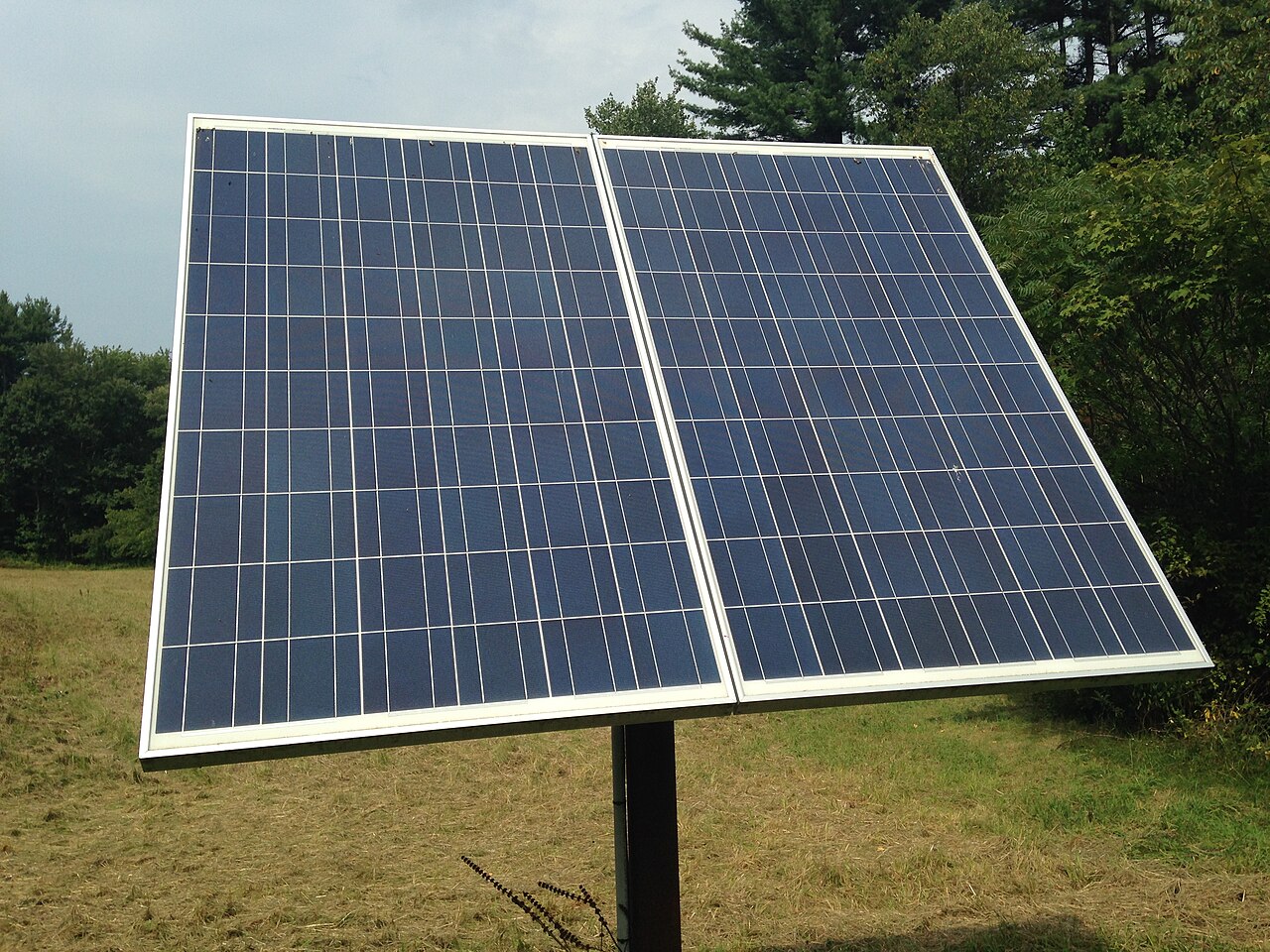
A conventional photovoltaic panel supplies deployment context; the article examines the additional reliability requirements facing tandem modules.
MarkBuckawicki / Wikimedia Commons · Image source · CC0 1.0

A solar cell can win a laboratory efficiency comparison while remaining difficult to turn into a dependable roof panel. That gap is becoming the central engineering story of perovskite–silicon tandems. On June 18, 2026, Fraunhofer ISE and Oxford PV described modules combining tandem cells with matrix shingled interconnections. The advance concerns an assembled product architecture: how cells are divided, connected, protected and measured. It deserves attention because every extra manufacturing step can either preserve the value of a high-performance absorber or quietly destroy it. The useful question is therefore changing from whether tandems can work to what evidence makes their power, energy yield and service life credible.
The semiconductor stack is only the beginning
A tandem divides the work of absorbing sunlight between materials. Its upper and lower cells can convert different parts of the spectrum more effectively than one absorber doing everything. Oxford PV describes depositing its perovskite top cell onto a silicon bottom cell, followed by electrical contacts and module assembly. This is a practical route toward integrating an unfamiliar absorber into an established manufacturing ecosystem. It does not mean every silicon production step can remain unchanged: a material added near the end still has to survive everything that follows it.
An ordinary series connection provides a useful way to understand the integration problem. Current must pass through every element, so one weak element can constrain the chain. A tandem adds internal electrical constraints before the manufacturer even connects neighboring cells. Optical design, charge collection, contact resistance and external wiring become coupled decisions. An improvement that looks attractive in an isolated layer can lose its benefit after connection. Engineers consequently need measurements at the cell, interconnected strip and complete module levels, with a clear accounting of where electrical power disappears.
What the June 2026 modules actually demonstrate
The 2026 release reports a 491-watt rooftop module covering 1.92 square metres and a 546-watt bifacial module covering 2.13 square metres. Both reached 25.6 percent efficiency over their entire module area. The partners cut tandem cells into strips, joined them using electrically conductive adhesive and arranged overlapping strips in a matrix. Glass on both faces and edge sealing protect the moisture-sensitive cells. These details identify the result as a manufacturing and packaging demonstration, rather than merely another small-cell efficiency announcement.
The reported numbers are internally consistent at standard irradiance. Multiplying 1.92 square metres by 1,000 watts per square metre and by 0.256 gives about 492 watts; the small difference from 491 watts is compatible with rounded published figures. This calculation is a check of stated units, not an independent efficiency certification. It also illustrates why the area definition matters. A percentage calculated over an active semiconductor region cannot be compared fairly with one calculated over a complete framed product without explaining the difference.
An electrical connection is also a mechanical joint
The earlier January 2024 Fraunhofer module report explicitly described developing gentle, low-temperature interconnection and encapsulation processes for temperature-sensitive tandem cells. That history explains why conductive bonding is more than a wiring preference. Heating and cooling a multilayer object makes materials expand by different amounts. A bond that conducts well immediately after assembly can accumulate damage when it repeatedly transfers these mismatched movements. Mechanical compliance, adhesion and conductivity therefore have to be considered together, rather than purchased as independent attributes on a component checklist.
Consider two candidate joints with identical initial resistance. One may be stiff enough to concentrate stress at an edge; the other may deform more but gradually lose electrical contact. Neither tradeoff is captured by an initial power measurement. A meaningful comparison repeats electrical measurements during a documented stress sequence and examines failure locations afterward. If a module loses power, identifying whether the absorber, interface, adhesive or seal changed is more informative than reporting one final percentage. That diagnosis determines whether the next design revision should alter chemistry, geometry or processing.
A tandem makes the test light part of the experiment
Fraunhofer’s 2024 report used a multispectral simulator and checked its measurement approach against outdoor measurements. The reason is fundamental: two absorbers need a representative distribution of wavelengths, not just the correct total illumination. A lamp can deliver the right watts per square metre while supplying too much light to one subcell and too little to the other. For a series-connected stack, that imbalance changes the measured operating point. Spectral control is consequently part of the measurement definition, alongside temperature, electrical sweep procedure and the area convention.
An independent purchaser should ask for uncertainty as well as a headline efficiency. Repeating a measurement under the same lamp establishes repeatability, but agreement between laboratories requires consistent calibration and device conditioning. Outdoor comparison adds realism while introducing changing temperature, spectrum and irradiance. Neither setting automatically outranks the other. A strong evidence package explains what each setting isolates and reconciles disagreements instead of averaging them away. This is especially useful when comparing a new tandem with a mature silicon reference that responds differently to the same sky.
Peak power and annual energy answer different questions
The matrix design is intended to provide alternative current paths around shaded regions. That is a plausible reason to investigate it for installations with moving shadows, but the value depends on the shadow pattern and the full electrical layout. A thin stripe crossing many strips is a different test from a small patch covering one corner. A reproducible comparison should describe shadow geometry, bypass behavior and the reference module, then repeat the comparison at relevant operating temperatures. The phrase shade tolerant is not a complete test condition.
Annual energy adds another layer. A module with higher rated power can still experience a smaller annual advantage if its relative performance changes on hot afternoons or under cloudy spectra. Conversely, an architecture that handles recurring shade well may gain useful energy without setting a new peak-efficiency record. These are engineering inferences, not annual-yield results supplied by the June announcement. A convincing field campaign would publish matched reference systems, comparable cleaning and monitoring, downtime records and enough weather data to explain when the advantage appears or disappears.
A demonstration is a starting point for lifetime evidence
A sealed glass package reduces exposure; it does not prove immunity to moisture, ultraviolet light or repeated thermal movement. The most informative reliability plan deliberately separates mechanisms before combining them. Dry heat can test one pathway, damp heat another, and illuminated operation another. Combined stresses then ask whether the mechanisms interact. The design of the experiment matters because acceleration can create a failure that would be rare outdoors or miss a field mechanism that requires a particular sequence of light, temperature and moisture.
Lifetime claims also require a population, not just a survivor. Manufacturers need to know the distribution of outcomes across production runs, including weak seals, uneven coatings and handling defects. Reporting the best unit says little about that tail. For deployment decisions, a useful next publication would connect manufacturing variation, accelerated tests and multi-season outdoor data without treating any short test as a literal calendar. The 2026 modules make the integration problem concrete. Their lasting significance will depend on whether repeatable manufacture and transparent reliability evidence preserve the extra power after the trade-show demonstration ends.
Sources & further reading
Primary papers, project documentation, and research releases used in this article. Publication dates below refer to the sources themselves.
- Perovskite-Silicon Solar Cells Meet Matrix Shingled InterconnectionFraunhofer ISEPublished Checked
- Oxford PV and Fraunhofer ISE Develop Full-sized Tandem PV Module with Record Efficiency of 25 PercentFraunhofer ISEPublished Checked
- TechnologyOxford PVChecked
FOLLOW THE QUESTION
Explore engineering