ENGINEERING
Solid-state batteries meet the production line
QuantumScape’s 2026 pilot-line updates and vehicle demonstrations show why pressure, separator quality and manufacturing yield now matter as much as cell records.
Research checked
Newest cited publication
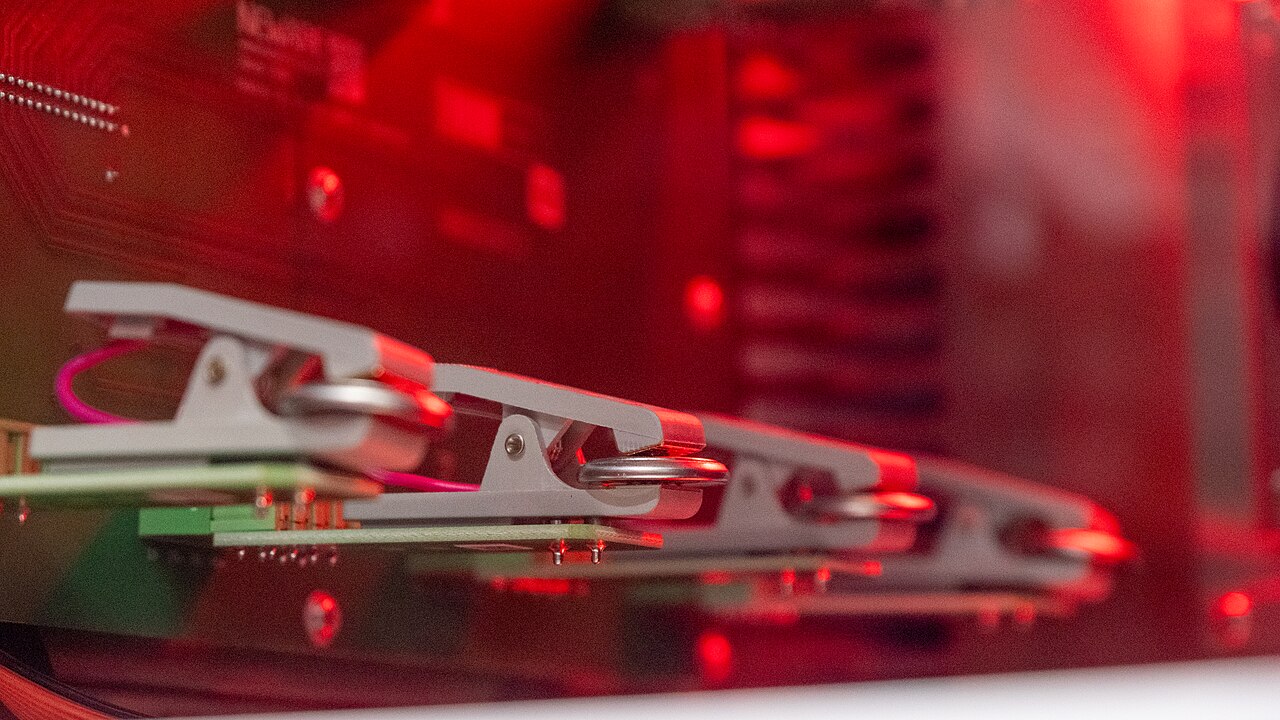
Coin cells mounted for laboratory tests illustrate the importance of controlled measurements. They are not evidence that a solid-state production process has reached commercial scale.
Chingo K / Wikimedia Commons · Image source · CC BY 4.0

Solid-state batteries are often introduced through a promise: more energy, faster charging or a safer cell. The harder story is how to reproduce the promising structure thousands or millions of times and preserve its advantages inside a vehicle. QuantumScape’s February 2026 Eagle Line inauguration and July manufacturing update bring that problem into focus. BMW’s all-solid-state i7 test programme and Mercedes-Benz’s 2025 long-distance demonstrator expose another part of it: cells must work as complete packs under changing mechanical and thermal conditions. These are valuable milestones, but each answers a narrower question than whether the entire industry has achieved economical mass production.
What a 2026 pilot line can prove
QuantumScape inaugurated its Eagle Line on February 4, 2026, describing automated equipment and a manufacturing platform incorporating its Cobra separator process. The line’s stated purposes included customer samples, demonstrations and proving scalable processes for licensing partners. The announcement therefore described a pilot-production step with industrial ambitions, not an already operating gigawatt-hour factory. Calling it a pilot does not diminish it; learning how to make repeatable product is precisely its engineering purpose.
In its second-quarter 2026 shareholder letter, the company reported core-tool uptime above 90 percent, increasing cell volumes and sample shipments. It also set a goal of further doubling output in the second half of 2026. The reported uptime is a present operating metric; the output increase is a future target. Neither discloses a complete public distribution of finished-cell cost, yield and automotive lifetime. Those distinctions keep manufacturing progress measurable without converting management expectations into completed results.
Solid-state describes a family, not one recipe
BMW’s May 20, 2025 report explicitly concerns all-solid-state cells from Solid Power using sulfide-based electrolytes in an i7 test vehicle. QuantumScape’s 2026 report emphasises a proprietary ceramic separator and an anode-free lithium-metal architecture. These are different material and manufacturing approaches. Their cell results should not be merged into a fictional average solid-state battery, nor should a demonstration by one developer be treated as proof that every other architecture has solved the same difficulty.
A useful comparison begins with a diagram of the actual cell: the negative electrode, positive electrode, electrolyte regions, separator and current collectors. Then it asks which layers are solid, how ions cross their interfaces and what changes during charging. Even the phrase anode-free needs a manufacturing context; it describes the initial architecture rather than an absence of electrochemical negative-electrode behaviour during operation. Clear boundaries make the claimed improvement and the remaining manufacturing burden much easier to understand.
Contact has to survive motion and volume change
BMW identified cell expansion, operating pressure and temperature adjustment as questions for its vehicle programme. That is a revealing list. A solid interface must maintain useful contact while the cell’s internal state changes. If contact deteriorates, the electrical current can become less evenly distributed. Engineering a pack therefore involves more than placing high-performing cells inside a protective box; it may require a carefully controlled mechanical environment throughout charging, discharge and vehicle operation.
Mercedes-Benz’s September 9, 2025 account makes this especially concrete. Its lithium-metal demonstrator pack used pneumatic actuators to accommodate volume changes while maintaining the required pressure. The company reported a 1,205-kilometre trip without a charging stop in late August. The journey is a system demonstration under a particular route and set of conditions, not a certified guarantee for every driver. The actuators are equally interesting: they show that mechanical support equipment can be central to realising an electrochemical advantage.
Bigger separators make statistics unavoidable
QuantumScape’s July letter reported that its Cobra process had produced larger-area separators for potential higher-capacity designs. Larger area can improve packaging efficiency, but engineers must also control defects across more material. The relevant question is not whether one large separator can be made; it is how the probability of an unacceptable flaw behaves across sustained production. The company’s reported progress establishes a manufacturing capability under development, rather than public proof of every future format’s commercial yield.
Consider a deliberately simplified defect model. If defects occur randomly and independently at an average rate of one per square metre, the probability of no defect in 0.01 square metres is about 99 percent. At 0.1 square metres it is about 90.5 percent. Real processes can have clustered defects and inspection thresholds, so those numbers predict no actual separator line. They illustrate why a successful small specimen does not establish large-area economics. Area, inspection and defect density must be reported together.
A running machine does not guarantee a good cell
Uptime measures whether equipment is available to operate. Yield measures how much acceptable product emerges from what enters the process. Throughput measures quantity per unit time. These metrics can improve independently: a line might run longer while rejecting more material, or produce excellent cells too slowly to reach its intended cost. QuantumScape’s uptime disclosure is therefore useful evidence, but it answers only one part of the manufacturing question that the pilot line is designed to investigate.
For an illustrative line with 90 percent uptime, 80 percent effective operating speed and 95 percent acceptable output, multiplying the three factors gives about 68 percent of ideal output. This is a hypothetical production account, not a reconstruction of QuantumScape’s undisclosed performance. It explains why several individually attractive percentages can still leave considerable room for improvement. A persuasive scale-up report should connect equipment availability, process speed, quality acceptance and test results rather than choosing whichever metric currently looks strongest.
Extra cell energy must survive the pack design
Mercedes-Benz reported 25 percent more usable energy in its demonstrator battery with weight and size comparable to the standard EQS battery. That is a manufacturer comparison for a particular pack and test vehicle. It should not be casually converted into a universal percentage advantage for all solid-state cells. BMW likewise stated that further development was required to create a competitive complete storage system. Both accounts direct attention to the pack boundary, where mechanical, thermal and electrical equipment must be included.
Imagine a hypothetical cell improvement that saves 40 kilograms but requires 30 kilograms of extra support hardware. The pack still benefits, yet much less than a cell-only comparison suggests. The same reasoning applies to volume, energy consumption and production cost. This does not mean every solid-state design needs heavy auxiliaries. It means that the appropriate engineering question is what the whole installation requires to maintain its performance, including the equipment that a laboratory fixture may provide outside the reported cell.
The evidence to watch after the demonstrators
The next decisive evidence should link manufactured batches to representative testing. That includes dimensional consistency, defect screening, performance across temperature and pressure ranges, ageing under realistic duty and the cost of accepted cells. A road test adds a valuable integration boundary, while a factory run adds a reproducibility boundary. Neither replaces the other. The strongest case will show that cells made by a practical process retain their benefit when assembled into packs and exposed to ordinary variation.
The recent milestones matter because they bring these boundaries into view. The 2026 pilot-line update is about process capability. The vehicle demonstrations are about integration. The remaining work concerns the connection between repeatable production, a manageable pack and a durable customer product. Solid-state batteries will become easier to judge as companies disclose that connection in comparable terms. Until then, a production line’s honest operating metrics can teach more than another isolated record cell with an impressive headline.
Sources & further reading
Primary papers, project documentation, and research releases used in this article. Publication dates below refer to the sources themselves.
- QuantumScape Inaugurates Eagle Line for Solid-State Battery Pilot ProductionQuantumScapePublished Checked
- Q2 2026 Letter to ShareholdersQuantumScapePublished Checked
- BMW Group and Solid Power are testing all-solid-state battery cells in a BMW i7.BMW GroupPublished Checked
- EQS mit Festkörperbatterie schafft 1.205 km.Mercedes-Benz GroupPublished Checked
FOLLOW THE QUESTION
Explore engineering