PHYSICS
Strange Metals: Why Linear Resistance Does Not Identify One Mechanism
Optical spectroscopy, numerical models and entanglement probes in 2026 show why a linear resistance curve cannot uniquely explain strange-metal behavior.
Research checked
Newest cited publication
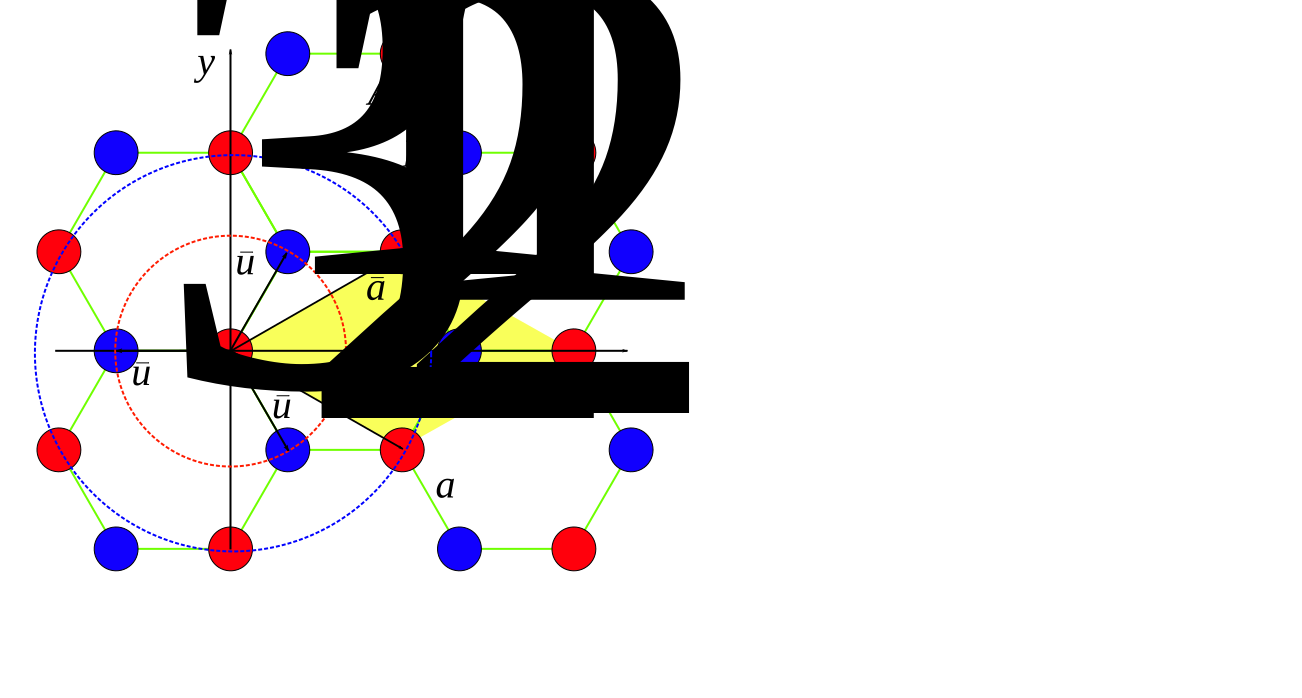
A lattice diagram provides background for thinking about electrons in a crystalline material; linear resistance alone does not identify the underlying transport mechanism.
Ququ · Image source · CC BY-SA 3.0

A straight line can hide a complicated many-body problem. In a strange metal, electrical resistivity often rises approximately in proportion to temperature over a regime where conventional expectations suggest a different dependence. That observation has motivated proposals involving quantum criticality, strongly scattered quasiparticles and transport beyond a particle picture. Results appearing through October 2026 sharpen an important distinction: recognizing an unusual resistance law is easier than identifying the microscopic process responsible for it.
A resistance exponent is not a direct clock
In the simplest Drude picture, resistivity is proportional to effective mass divided by the product of carrier density and relaxation time. This elementary relation already shows an ambiguity. A temperature-dependent resistivity can reflect the relaxation rate, the effective mass, the carrier density or a failure of the assumptions used to separate them. In an interacting multiband material, the apparent parameters can depend on measurement frequency and field. Treating a fitted resistance exponent as a direct measurement of a unique collision time therefore introduces assumptions that need independent tests.
For an algebraic example, suppose an optical effective mass varies as one over temperature while a relaxation rate varies as temperature squared over a finite range. Keeping the effective carrier density fixed makes their product proportional to temperature, so the resistivity is linear despite the quadratic relaxation rate. This is not a claim that such scaling can continue to absolute zero. It demonstrates why the line itself cannot identify which microscopic quantity carries the temperature dependence. Frequency-resolved measurements are valuable because they supply additional independent structure.
A 2026 optical experiment separates two masses
A preprint submitted on 24 March 2026 by Jingyuan Wang and colleagues investigates CeCoIn5 using high-field time-domain terahertz spectroscopy. They report an approximately quadratic temperature dependence of the current relaxation rate in a regime with strange-metal resistivity, together with an optical effective mass varying roughly inversely with temperature. They distinguish that optical mass from the mass governing cyclotron motion. The authors interpret the result as evidence for hidden Fermi-liquid-like behavior over a substantial field range. As a preprint, it should be read with that provisional status and with attention to the extraction model.
Different effective masses need not be a logical contradiction. In a crystal, mass is a description of a response, not simply a replacement number for the electron’s vacuum mass. Optical acceleration and closed-orbit motion can weight electronic states differently, especially when interactions reshape those states. The real question is whether one internally consistent model explains the different experiments and respects their frequency and temperature windows. Reporting the window is essential: a power law that fits an intermediate regime may fail when a new energy scale becomes important.
Numerical transport asks whether one mechanism is necessary
A Nature Physics paper published on 24 September 2026 studies strange-metal behavior in the two-dimensional t–J model using improved finite-temperature Lanczos calculations. Simone Fratini and colleagues examine both steady and frequency-dependent conductivity. Their results find widespread strange metallicity when antiferromagnetic order is suppressed and associate apparent Planckian behavior with the quantum statistical charge response rather than simply a temperature-dependent scattering process. This is a calculation within a specified interacting-electron model. It is not a direct demonstration that every real strange metal follows that model.
The methodological gain is the ability to compare a zero-frequency number with a spectrum and a time-dependent response. Two models can give nearly identical resistivity slopes while predicting different redistribution of optical weight or different early-time current decay. Those extra observables make an explanation more falsifiable. A finite numerical system still requires careful control of size, resolution and accessible temperatures. Calling a calculation numerically exact means exact for the defined numerical problem within its stated procedures; it does not remove the approximation involved in choosing the material model.
Measuring correlations beyond the resistance curve
A different experiment, published in Nature Physics on 15 June 2026, uses inelastic neutron scattering and quantum Monte Carlo simulations to study a heavy-fermion strange metal. Federico Mazza and colleagues extract quantum Fisher information associated with magnetic fluctuations and find strong growth on cooling near Kondo-destruction criticality. The evidence supports substantial multipartite entanglement in the studied setting. It adds a microscopic descriptor rather than defining the material solely by the failure of an ordinary transport law. It does not establish that all strange metals possess the same entanglement structure.
Quantum Fisher information is connected to how sensitively a quantum state responds to a chosen perturbation. In a magnetic solid, the relevant response can be related to a dynamical susceptibility measured by neutron scattering. Entanglement witnesses use carefully normalized bounds to decide whether independent or only weakly grouped moments could account for that response. The operator being measured, energy coverage, normalization and temperature weighting all matter. A bulk entanglement witness does not mean that an entire macroscopic crystal has become one individually controllable quantum-computing register.
Even disorder and current paths need careful treatment
A theoretical preprint first submitted on 22 December 2025 and revised in April 2026 studies quantum critical transport in a periodic potential using a holographic model. Eric Nilsson and Koenraad Schalm obtain different electrical and thermal transport behavior and approximately magnetic-field-linear longitudinal magnetoresistance in an appropriate regime. The construction uses a gravitational dual as a mathematical tool for strongly interacting matter. It does not assert that laboratory electrons are literally moving around astrophysical black holes, and it is not a material-specific experimental identification.
The broader lesson is that measured transport reflects the way currents navigate an inhomogeneous environment as well as the local rules for charge motion. A bottleneck can dominate an overall resistance, while parallel paths can bypass an obstacle. Heat and charge may weight those paths differently. Consequently, a successful explanation should be tested against geometry, sample variation and thermal response where possible. A striking magnetic-field dependence does not remove this need; more than one microscopic or spatial mechanism can generate an approximately linear trend over a finite range.
A Planckian scale is not automatically a bound
The frequently discussed thermal quantum timescale is the reduced Planck constant divided by the product of Boltzmann’s constant and temperature. At ten kelvin it is about 0.76 picoseconds, or an inverse time near 1.3 trillion per second. These are unit conversions for an illustrative temperature, not relaxation times measured in the cited experiments. A fitted rate comparable to this scale motivates a physical question about thermal and quantum dynamics. It does not, by dimensional analysis alone, prove a universal maximum scattering rate.
To make that comparison meaningful, the definition of relaxation must match the measurement. Decay of electrical current, broadening of a single-particle excitation and redistribution of energy are different processes. They can share a characteristic scale in a model without being identical observables. A claim of universal behavior becomes stronger when the proposed relationship survives these distinctions and predicts a numerical coefficient, rather than merely reproducing the only obvious combination of temperature and fundamental constants.
What would make an explanation win?
A persuasive experimental comparison would fit electrical, optical, Hall and thermal data using parameters that remain mutually consistent. If the same model requires incompatible carrier densities or relaxation rates for nearby measurements, its apparent success on the resistance curve is incomplete. Controlled tuning toward and away from a quantum critical point can add another test: does the proposed mechanism track the independent critical signatures, or merely the part of the phase diagram where superconductivity has been suppressed? Negative results outside the favored regime are valuable constraints.
These 2026 developments do not close the strange-metal problem, but they improve the standard of explanation. Optical spectroscopy exposes parameter combinations hidden in direct-current transport. Numerical work tests whether a proposed ingredient is necessary inside a controlled model. Neutrons add information about quantum correlations, and transport theory reminds us to examine spatial structure. The next advance may come from bringing those distinctions into the same material rather than announcing one universal interpretation of a straight line. An exponent is a useful observation; a mechanism must explain substantially more.
Sources & further reading
Primary papers, project documentation, and research releases used in this article. Publication dates below refer to the sources themselves.
- Reconciling strange metal transport in CeCoIn5 through the difference of optical and cyclotron effective massesarXivPublished Checked
- Strange metal behaviour from underlying bad metallicityNature PhysicsPublished Checked
- Quantum Fisher information in a strange metalNature PhysicsPublished Checked
- Quantum critical theories in a periodic potential: strange metallic thermoelectric and magnetotransportarXivPublished Checked
FOLLOW THE QUESTION
Explore physics