PHYSICS
GWTC-5: Why 390 Gravitational-Wave Candidates Are Not 390 Identical Measurements
The May 2026 gravitational-wave catalog reaches 390 candidates. Its selection rules explain what that number reveals about black holes and detector sensitivity.
Research checked
Newest cited publication
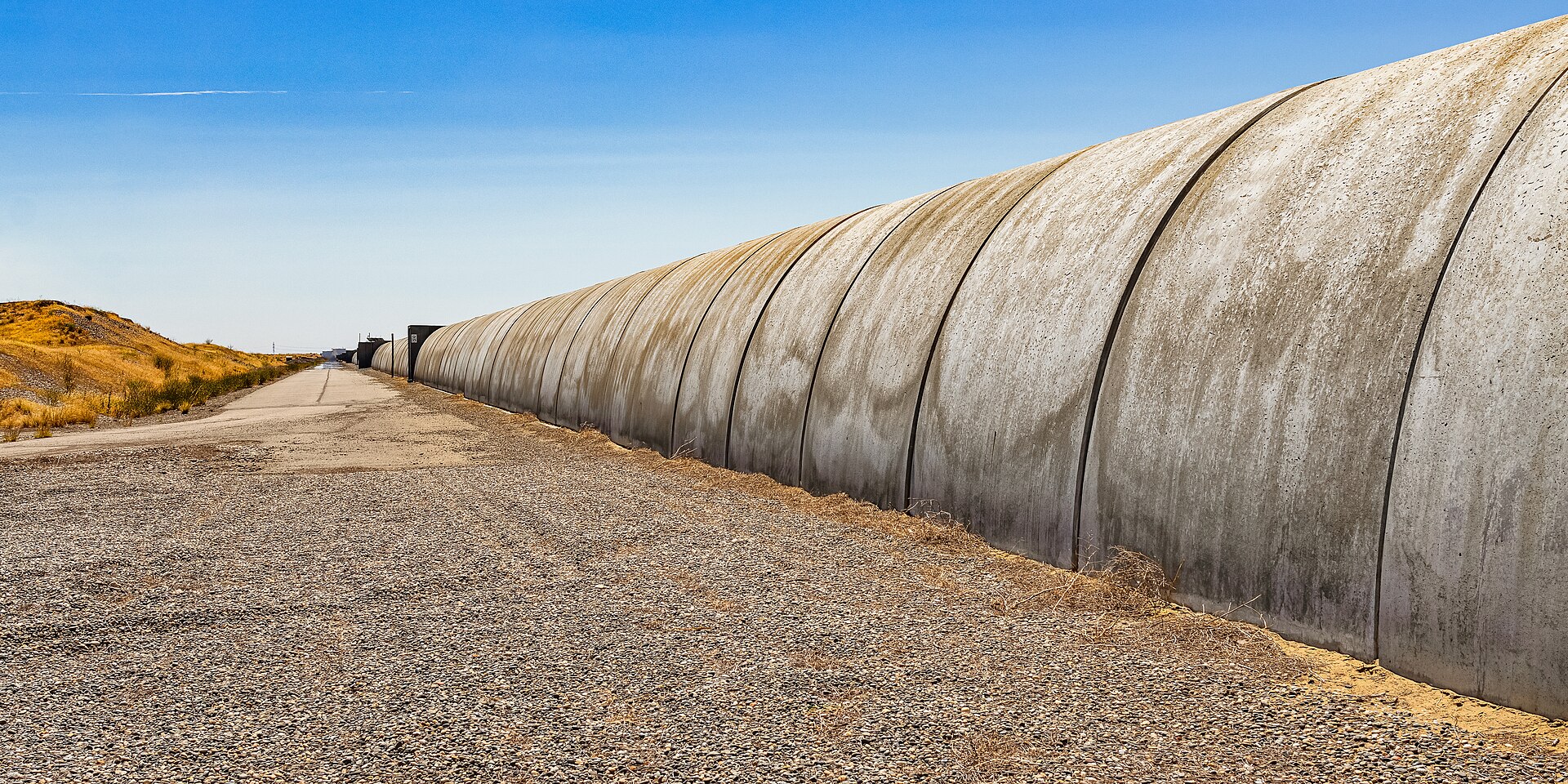
The LIGO Hanford interferometer’s long beam tube illustrates the physical detector infrastructure behind gravitational-wave observations and catalog selection.
NOIRLab/LIGO/NSF/AURA/T. Matsopoulos · Image source · CC BY 4.0

A gravitational-wave catalog is an unusually demanding kind of census. The objects are invisible, the events cannot be replayed, and the instruments become more sensitive between observing seasons. On May 26, 2026, the LIGO–Virgo–KAGRA collaboration released the initial preprints for GWTC-5.0, its fifth Gravitational-Wave Transient Catalog. The headline total was 390 candidates. Understanding that number requires separating a detection list from a population experiment. Some entries permit detailed measurements; others sit close to the boundary between astronomical signals and instrumental noise. The scientific advance lies in publishing those distinctions alongside the events, so that a larger collection can support better questions rather than merely a larger headline.
Three numbers that answer different questions
GWTC-5.0 adds 161 candidates from the second part of the fourth observing run, called O4b, and updates the cumulative earlier sample to 229. Together they make 390 entries with an estimated astrophysical probability of at least one half, after event validation. A more restrictive group of 104 new candidates receives detailed source-property analysis. The observing interval for O4b ran from April 10, 2024, to January 28, 2025, with a small preceding engineering interval also analyzed. The publication date therefore marks an analysis release, not the date when all those mergers reached Earth.
These distinctions matter even before discussing astrophysics. A candidate threshold is a rule for entering a database. A parameter-estimation threshold decides where a more expensive and interpretable inference is worthwhile. Neither is a claim that every database row has the same certainty. Imagine two weather stations reporting possible storms: one records every plausible event, while the other publishes wind reconstructions only for its clearest records. Their lists can be consistent without having identical lengths. Likewise, comparing catalog editions requires comparing selection rules and revisions, not subtracting two prominently advertised totals and calling the result a discovery rate.
Astrophysical probability is different from a false-alarm rate
A false-alarm rate describes the expected frequency with which a search would produce a noise event at least as signal-like as the candidate under consideration. It has units of inverse time. The probability that a candidate is astrophysical is instead dimensionless and depends on the relative populations of signal and noise triggers. A rate alone cannot supply that probability without assumptions about how frequently real sources occur. This is why a catalog can sensibly publish both quantities without treating them as interchangeable measures of confidence.
As a deliberately simplified example, suppose a ranking interval contains an expected eight genuine signals and two noise triggers. A randomly chosen trigger in that interval would have an astrophysical probability of 8 divided by 10, or 80 percent. If the assumed source rate changed, that probability could change even if the instrumental background did not. This example is an explanation of mixture inference, not a reconstruction of the collaboration's pipeline. Real searches use ranking statistics, background estimation, multiple observing conditions, and validation of the relevant detector data. The useful habit for readers is to ask what probability statement is actually being made before comparing numbers from different tables.
A detector census is weighted by what the instruments can hear
Two equally common kinds of binary need not appear equally often in the detected sample. Their waveforms occupy different frequencies, spend different times in the observing band, and interact differently with frequency-dependent noise. Orientation and distance also matter. A binary seen in a favorable direction can produce a stronger measured signal than an otherwise similar system seen from another angle. These effects mean that a raw histogram of catalog masses measures the detected population, not directly the underlying population of merging black holes.
A basic geometric calculation illustrates the size of the issue. If an improvement lets an instrument detect a particular source type out to twice its previous distance in a nearby, approximately uniform universe, the accessible volume increases by a factor of eight. That does not mean the universe began producing eight times more mergers. It means the survey now includes more space. Cosmological expansion, source evolution, detector downtime, and gradual detection efficiency make real survey volumes more complicated. Nonetheless, the cubic scaling explains why seemingly modest sensitivity improvements can transform an event catalog, and why a rate analysis must include the places and times in which events could have been missed.
Artificial signals measure the missing part of the survey
Selection effects can be studied by adding simulated signals to real or representative detector data and asking whether the search recovers them. Each injection has known source parameters. Repeating the exercise across masses, spins, distances, sky directions, and observing conditions estimates a detection probability rather than assuming a perfect boundary. In a toy bin containing ten detected events with an average detection probability of one half, a simple completeness correction would suggest roughly twenty underlying events. Actual population inference treats parameter uncertainty and continuously varying selection together, rather than correcting every bin independently.
The distinction also explains why the methods paper is part of the scientific result. A posterior distribution for a single event can depend on waveform assumptions, calibration, and noise treatment. A population model then combines many such distributions while accounting for the chance that each source would enter the sample. A narrow population claim can become misleading if it treats uncertain individual masses as exact points. Conversely, many individually broad measurements can jointly reveal a persistent distributional feature. The catalog's methodological documentation makes these combinations auditable and gives outside researchers a way to test whether a claimed feature survives an alternative modeling choice.
More sensitivity changes the kind of questions available
The new catalog includes GW250114, an exceptionally clear black-hole merger with a catalog network signal-to-noise ratio of 76.9. That number measures clarity relative to detector noise; it is not an energy output or a direct measure of how violent the source was. A nearby modest event can be easier to study than a more massive distant one. Consequently, the most important event for a precision test may not be the event with the largest inferred mass. Catalog breadth and individual signal clarity improve different parts of the scientific program.
Detector geography supplies another kind of information. Arrival-time differences between observatories restrict the possible direction of a source. Two sites generally leave a broad localization degeneracy, while a third site can break much of it when its data are informative. Better sky localization helps astronomers decide which galaxies might host an event and where other telescopes should look. It does not guarantee an electromagnetic counterpart: an isolated binary black-hole merger can be dark. The conceptual gain is that a network measures more than a shared oscillation. Its spatial arrangement turns a fleeting signal into a constrained location, an orientation estimate, and a more useful comparison with the rest of astronomy.
How to use the release without overstating it
The release includes public strain data and documented event products through the Gravitational Wave Open Science Center. Those are complementary resources. Strain is the calibrated detector measurement, while a posterior sample is the result of analyzing a measurement under particular assumptions. Reproducing an astrophysical conclusion requires tracking which product was used, which version it belonged to, and which waveform or population model connects it to the claim. A cumulative catalog can revise earlier measurements without implying that the original event never happened.
A productive reading strategy starts with a question precise enough to have a selection function. Are heavier black holes intrinsically rare, or simply sampled differently? Does a spin feature persist if uncertain events are removed? Does a cosmological inference survive another model of source masses? These are author-proposed questions, not additional GWTC-5.0 discoveries. They show why the catalog's varied confidence levels are a strength. As of the October 18, 2026 research cutoff, the verified GWTC-5.0 material provides a large, explicitly qualified observational foundation. Its value is the opportunity to learn from the entire measurement process, including uncertainty and incompleteness, rather than pretending every candidate is a perfectly measured black hole.
Sources & further reading
Primary papers, project documentation, and research releases used in this article. Publication dates below refer to the sources themselves.
- GWTC-5.0: An Introduction to Version 5.0 of the Gravitational-Wave Transient CatalogarXiv; LIGO–Virgo–KAGRA CollaborationPublished Checked
- GWTC-5.0: Methods for Identifying and Characterizing Gravitational-wave TransientsarXiv; LIGO–Virgo–KAGRA CollaborationPublished Checked
- GWTC-5.0: Observations from the Second Part of the Fourth LIGO-Virgo-KAGRA Observing Run and Updates to the Gravitational-Wave Transient CatalogarXiv; LIGO–Virgo–KAGRA CollaborationPublished Checked
- GWTC-5.0: Updating the catalog with observations from the second part of the fourth LIGO-Virgo-KAGRA observing runLIGO Scientific CollaborationChecked
- GWTC-5.0 Data Release DocumentationGravitational Wave Open Science CenterChecked
FOLLOW THE QUESTION
Explore physics