PHYSICS
GW231123 and the Difficult Origins of Very Heavy Black Holes
GW231123 challenges simple stories of black-hole birth. Its large masses, rapid spins, and modeling uncertainty illuminate the search for repeated mergers.
Research checked
Newest cited publication
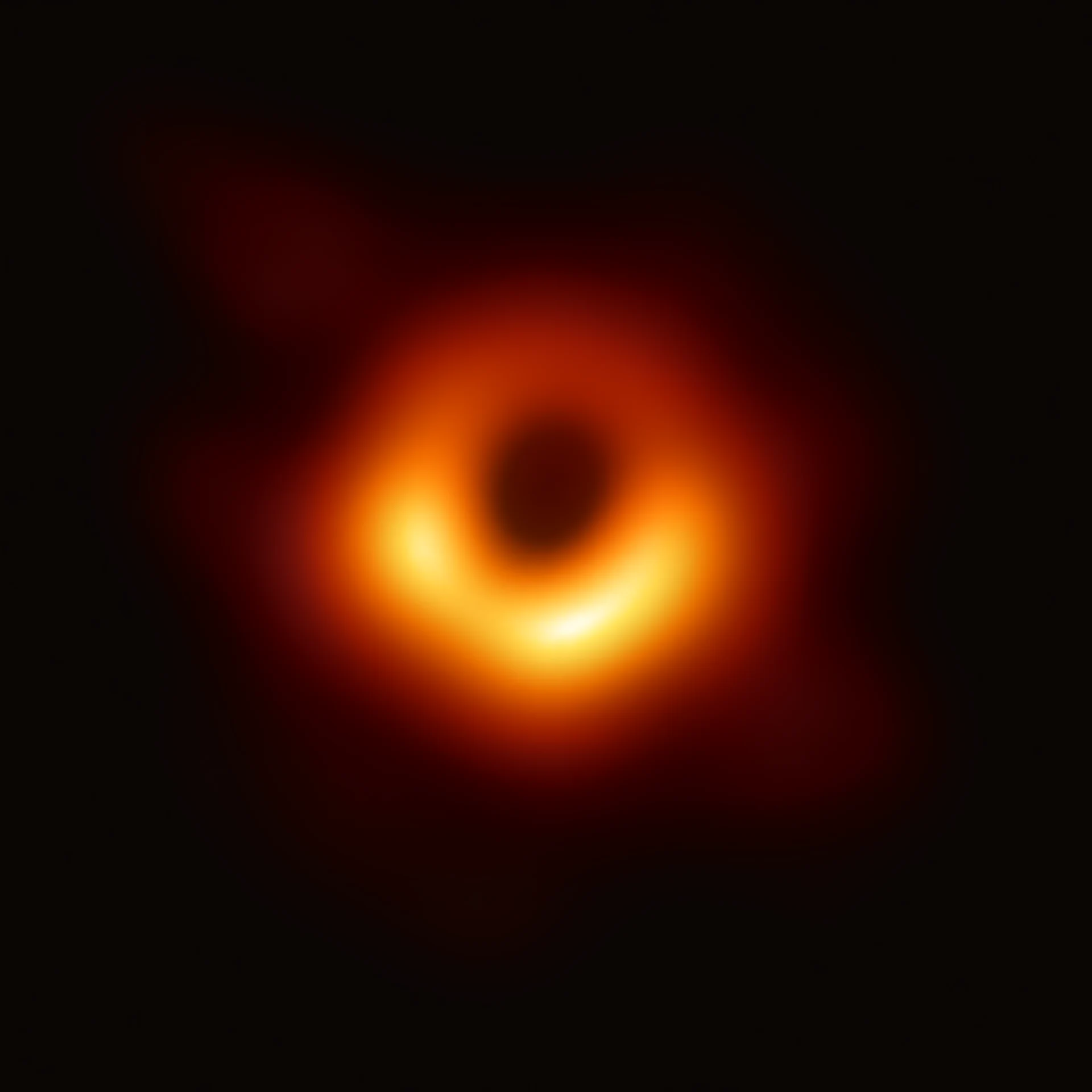
The Event Horizon Telescope’s M87 image provides observational black-hole context; it is a different system from the merging black holes inferred from GW231123.
Event Horizon Telescope / ESO · Image source · CC BY 4.0

On November 23, 2023, two LIGO observatories recorded a brief signal that would become a particularly difficult black-hole origin story. The collaboration announced GW231123 on July 14, 2025, following a preprint first posted four days earlier. The reported component masses were roughly 137 and 101 solar masses, with broad credible intervals and substantial waveform-model uncertainty. Those numbers place the event in territory where simple expectations for the death of isolated massive stars become uncomfortable. By May 2026, population studies supplied a broader context for interpreting rapidly spinning black holes. The interesting question is how much an unusual merger can tell us about its ancestors when no telescope observed their earlier lives.
Why a very massive merger makes a short laboratory
Increasing the total mass of a black-hole binary stretches its characteristic dynamical timescales and shifts its gravitational-wave frequencies downward. A ground-based instrument has a limited useful frequency band. Consequently, a sufficiently massive binary can complete much of its inspiral below that band, leaving only the late merger and ringdown clearly accessible. A short observed signal therefore need not mean a less informative astrophysical event, but it does change which parameters the data can separate cleanly. Information that would normally accumulate over many inspiral cycles may be unavailable.
A useful scaling comes from the gravitational time GM divided by c cubed. For one solar mass, that is about 4.93 microseconds; for a notional 240-solar-mass system, it is about 1.18 milliseconds. This is a characteristic scale, not the predicted duration of GW231123 or its measured waveform. Actual frequencies also depend on the dimensionless orbital state, spin, and cosmological redshift. The calculation explains the direction of the effect: higher mass slows the waveform's natural clock. It also explains why extending low-frequency sensitivity and improving merger simulations are complementary ways to learn about the heaviest systems.
The mass gap is a prediction with astrophysical conditions
The GW231123 paper discusses a theoretically expected scarcity of black holes in an approximate 60-to-130-solar-mass interval associated with pair-instability processes. Its primary component lies within or above that region, while the secondary's uncertainty extends across it. The important word is scarcity. The interval is not a rule in general relativity forbidding black holes of those masses. It emerges from models connecting particular stellar cores to particular remnants. The observation therefore challenges an origin model, not the mathematical existence of a black hole.
The underlying feedback is a competition between pressure support and gravity. At high temperatures, energetic photons can create electron–positron pairs, changing how effectively thermal energy supports the star. Contraction can then accelerate nuclear burning. Depending on the core and its history, the result can include major mass loss or disruption rather than an ordinary collapse retaining the expected mass. Translating that mechanism into a sharply bounded remnant distribution requires assumptions about composition, mixing, nuclear reactions, and binary interactions. A measured black hole in the nominal gap motivates comparing those assumptions with alternative formation channels. It does not, by itself, reveal which ingredient should change.
A merger remnant can become a component of another binary
A hierarchical merger is one in which at least one participating black hole was itself made in a previous black-hole merger. This offers a direct route to a heavy component without requiring one star to produce the entire mass in a single collapse. Dense environments can supply encounters and potential partners, but simply placing black holes together is insufficient. The earlier remnant has to remain available, form another sufficiently tight binary, and merge within the time allowed by the environment's history.
Consider an explicitly illustrative mass budget. If two 70-solar-mass black holes merge and radiate five percent of their combined rest mass, the remnant has about 133 solar masses. A later merger involving that remnant could create a system resembling the heavy part of the observed population. The assumed five percent is a convenient example, not a fit to an ancestral GW231123 event. It demonstrates why mass grows by less than simple addition. Gravitational radiation carries energy away, and angular momentum is redistributed too. A convincing formation history must respect both balances and explain how the remnant avoids ejection when asymmetric gravitational radiation gives it a recoil.
Rapid spin supplies another clue, with its own ambiguities
The event analysis inferred large component spins, approximately 0.9 and 0.8 in dimensionless units, again with substantial uncertainties. These parameters describe angular momentum relative to the mass-dependent scale set by gravity and the speed of light. They are not percentages of an equatorial surface speed, because a black hole has no material surface moving like a solid ball. Spin affects the dynamics of the binary and the shape of the emitted waveform, making it an important potential record of formation.
For ancestry, the combination of mass and spin is more useful than either quantity alone. A prior merger can leave a remnant with considerable spin even when the original holes rotate slowly, because the binary initially carries orbital angular momentum. Yet high spin can also arise through other histories involving stellar evolution or accretion. Nor does one measured spin automatically locate a source in a star cluster. The inference becomes stronger when a formation model predicts a joint distribution of masses, spin magnitudes, orientations, and merger rates that resembles the observed population. That joint requirement prevents an appealing explanation for one event from becoming an untested explanation for every event.
What the May 2026 population analysis adds
The GWTC-5.0 population preprint, first posted on May 26, 2026, analyzes 267 selected mergers and reports evidence for rapidly spinning subpopulations at two mass scales. It describes signatures consistent with hierarchical assembly, while leaving other production mechanisms open. This broadens the discussion beyond one spectacular heavy merger. A population contains information about how often particular mass-and-spin combinations occur, which can discriminate between a process that is merely possible and a process that contributes appreciably to the merger population.
That comparison still requires correcting for observational selection. A formation channel that produces easily detectable systems can be overrepresented in a catalog relative to its actual cosmic rate. A different channel may produce many mergers that are faint or lie outside the most sensitive frequency range. The most informative confrontation therefore takes simulated histories, generates their predicted waveforms and parameter distributions, passes them through an observational selection model, and compares the resulting detected population with the data. This is an inference strategy, not a claim that the 2026 paper has reconstructed GW231123's individual family tree. Its benefit is that it forces the ancestry story to survive a quantitative census.
The next advance must improve the comparison itself
The GW231123 study explicitly reports differences in inferred properties between signal models. That qualification should travel with every numerical retelling of the event. If two plausible waveform calculations map the same data to noticeably different masses or spins, increasing confidence in a single model's posterior does not eliminate the discrepancy. Better numerical-relativity simulations, more complete waveform families, and careful validation in the relevant high-spin region are ways to address it. Additional signals can help, but they do not automatically repair a shared modeling limitation.
An observation that would move the argument forward is a repeated pattern: several well-measured events occupying the same difficult mass-and-spin region, with compatible results across independent waveform treatments and an occurrence rate that a proposed environment can sustain. This is an author's criterion for stronger evidence, rather than a forecast that a particular instrument will achieve it on a particular date. GW231123 is already valuable because it connects stellar nuclear physics, relativistic dynamics, and the ecology of dense stellar systems. Its most durable lesson is that finding an extraordinary object begins the explanation. Establishing its origin requires a population, a reliable measurement model, and an honest account of the alternatives.
Sources & further reading
Primary papers, project documentation, and research releases used in this article. Publication dates below refer to the sources themselves.
- GW231123: a Binary Black Hole Merger with Total Mass 190-265 M⊙arXiv; LIGO–Virgo–KAGRA CollaborationPublished Checked
- GW231123LIGO Scientific CollaborationPublished Checked
- GWTC-5.0: Population Properties of Merging Compact BinariesarXiv; LIGO–Virgo–KAGRA CollaborationPublished Checked
- GWTC-5.0: Population properties of merging compact binariesLIGO Scientific CollaborationChecked
FOLLOW THE QUESTION
Explore physics