PHYSICS
Kagome Charge Stripes Reveal More Than a Superconducting Rival
New kagome studies identify frieze stripes, strain-sensitive domains and widely separated ordering temperatures, complicating a simple competition picture.
Research checked
Newest cited publication
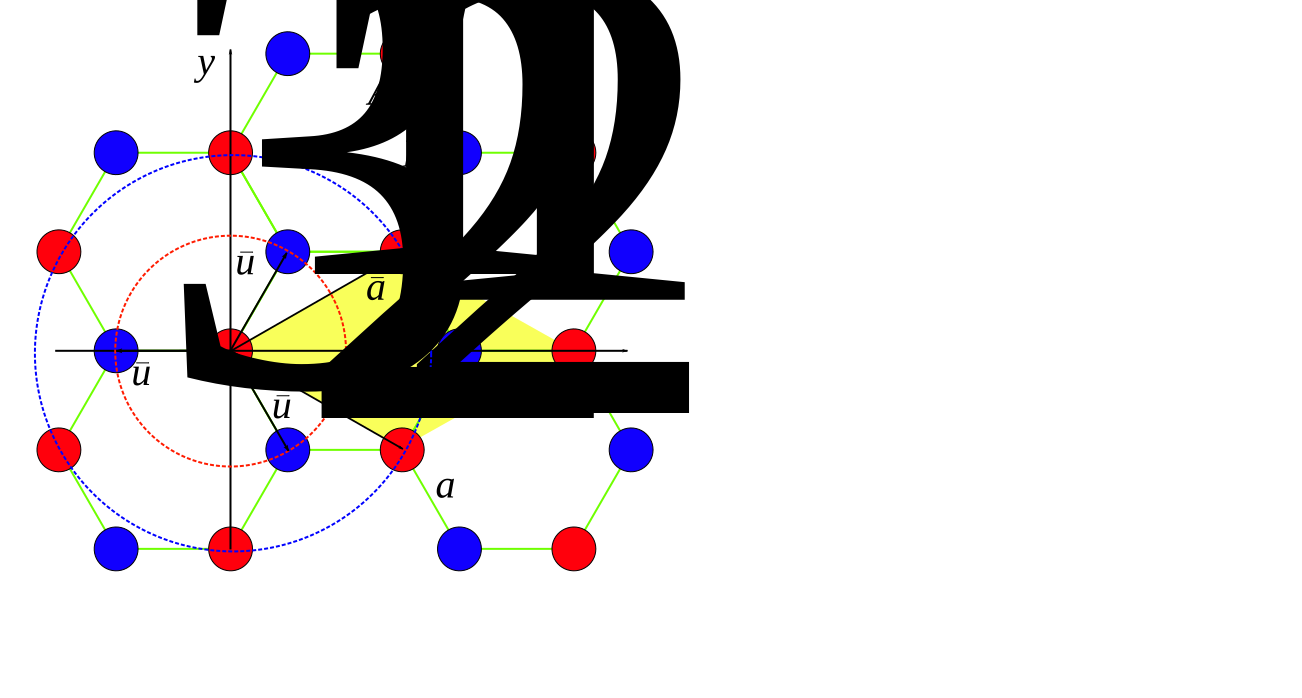
A graphene honeycomb provides a useful contrast to a kagome lattice; the materials and charge-order geometry discussed in the article are different.
Ququ · Image source · CC BY-SA 3.0

A lattice built from corner-sharing triangles can make surprisingly complicated demands on its electrons. In metallic kagome materials, geometry, orbital structure and interactions can favor several different collective arrangements. It is tempting to describe charge order as a straightforward competitor that steals electrons from superconductivity. Research published in 2026 shows why that shorthand is too coarse. The ordering pattern, the way layers stack, the response of domains to strain and the temperatures of separate transitions all influence what superconductivity actually inherits.
A stripe can retain an unexpected symmetry
A Nature Physics paper published on 2 April 2026 reports a sequence of density-wave transitions in the chromium-based kagome metal CsCr3Sb5. Siyu Cheng and colleagues use spectroscopic imaging scanning tunnelling microscopy to identify a unidirectional pattern that breaks mirror symmetries while retaining a mirror-glide operation. They classify this as frieze charge stripe order. Sublattice structure and internal textures of opposite handedness are central to their interpretation. This is evidence about an ordered electronic pattern; it does not directly measure the superconducting pairing mechanism.
A mirror reflects a pattern across a line. A glide combines that reflection with a translation. A repeated row of asymmetric motifs can fail the first test and pass the second because reflection alone places each motif in the wrong location, while sliding restores the arrangement. The distinction sounds decorative until it is used to classify electronic order. It tells a theorist which couplings and responses are allowed, which orientations are equivalent and which apparent symmetries would disappear if the internal structure of the unit cell were ignored.
Real-space images need reciprocal-space checks
Scanning tunnelling microscopy measures a current that depends on the accessible electronic states as well as the positions of atoms. Changing the voltage selects different electronic energies, so an apparent stripe can change contrast without the lattice physically moving. Fourier analysis translates a real-space map into its recurring wavelengths and directions. Combining maps at different voltages and temperatures helps separate atomic periodicity, electronic modulations and instrumental effects. A visually striking pattern becomes physically convincing when those independent descriptions are consistent.
Sublattices add another layer of information. If different sites inside a repeating cell carry modulations with different phases, averaging them can hide a signal that remains strong on each individual site. Conversely, a Fourier feature can be enhanced by the way several sublattices interfere. This makes the internal arrangement of a kagome unit cell more than a microscopic detail. A model that treats the entire cell as one featureless point can reproduce a stripe wavelength while missing the symmetry that the actual image reveals.
Strain reveals the pattern hidden by domains
A study published in npj Quantum Materials on 3 August 2026 examines CsV3Sb5 with high-resolution X-ray diffraction under uniaxial strain. E. Sadrollahi and colleagues find a strong domain response in its 2 × 2 × 4 superlattice, allowing them to identify an intrinsic double-wavevector modulation. The lower-temperature 2 × 2 × 2 order responds much less strongly to the small strains used. The two superlattices therefore cannot be treated as interchangeable versions of one simple order parameter. Their orbital coupling and stabilization mechanisms require separate attention.
A domain is a region that selects one of several symmetry-related orientations. A bulk measurement adds contributions from all such regions, potentially restoring the appearance of a symmetry that no individual domain possesses. Gentle strain can favor one orientation and make the underlying structure easier to identify. That process is called detwinning. It differs from creating the order from scratch or substantially changing its wavelength. Keeping those possibilities separate matters when interpreting diffraction intensity: one peak can grow because its domain occupies more volume, rather than because the local distortion itself has become larger.
The third dimension changes the electronic problem
The superlattice labels encode how the new periodicity compares with the original crystal along three directions. A 2 × 2 × 4 modulation repeats across twice the in-plane unit-cell lengths and four times the original stacking period. It is therefore not fully specified by a single-layer drawing. Earlier primary photoemission work, first submitted in February 2022, showed how three-dimensional charge ordering splits electronic bands in the vanadium kagome family. Composition and doping changed that ordering landscape and its relationship with superconductivity.
The conceptual consequence is straightforward. Electrons form wavefunctions across the actual repeated structure. If neighboring layers distort with different phases, their hopping pathways and allowed quantum states change even when an image of one isolated plane looks similar. A single density-wave amplitude is then an incomplete description. The relative phase between layers can matter as much as the amplitude within a layer. That is why experiments that probe bulk stacking and experiments that resolve a surface pattern should be compared carefully instead of being expected to report identical information.
High-temperature charge order is not high-temperature superconductivity
Another useful comparison comes from YRu3Si2. A Nature Communications paper published online on 21 December 2025, in a 2026 volume, reports charge order near 800 kelvin, additional low-temperature magnetic signatures and superconductivity near 3.4 kelvin. Its combination of diffraction, muon measurements, transport and calculations places these phenomena on very different temperature scales. The study finds that either a two-gap model or an anisotropic nodeless gap can describe its superconducting data. It does not uniquely select between those two descriptions.
Eight hundred kelvin is roughly 527 degrees Celsius, while 3.4 kelvin is roughly minus 270 degrees Celsius. Those conversions make a crucial distinction visible: a remarkably persistent charge-ordered structure is not a room-temperature superconductor. The wide separation also prevents a simple causal reading of nearby lines in a phase diagram. A state that appears hundreds of kelvin before pairing may reshape the available bands and interactions, but showing that it enhances or suppresses pairing requires an intervention that changes the state while controlling other relevant variables.
Competition is a statement about coupling
A simple phenomenological model makes the meaning of competition explicit. Represent superconducting order by one amplitude and charge order by another. A term in the free energy proportional to the product of their squared amplitudes penalizes coexistence when its coefficient is positive. A negative coefficient instead favors their presence together, provided the full energy remains stable. This is an explanatory model, not a fitted conclusion about any of the materials discussed here. Its value is that it translates a verbal claim into a sign that experiments must constrain.
Real crystals may require several charge-order components, separate stacking variables and strain couplings, so one coefficient may not suffice. Suppressing one component can strengthen another while changing the electronic bands available for pairing. That is why two transition temperatures moving in opposite directions provide suggestive evidence but do not independently identify a microscopic interaction. More selective interventions make the coupling question answerable.
How to test whether an order helps or hinders pairing
A useful experiment would tune one structural or electronic feature reversibly and monitor both superconductivity and the ordered pattern. If strain increases the transition temperature, researchers must determine whether it changed domain populations, band filling, interlayer hopping or the local distortion amplitude. Each explanation implies a different relationship between the two orders. Comparing heat capacity, magnetic screening and electrical resistance can also establish whether the change concerns the bulk condensate or merely the easiest current path through an inhomogeneous crystal.
The emerging picture is therefore a family of linked questions, not one universal kagome mechanism. Frieze stripes emphasize internal symmetry; detwinning exposes domain averaging; stacking changes the bands; and the ruthenium system separates several energy scales. Together these results suggest more precise targets for theory and experiment as of October 2026. They make it possible to ask which part of charge order competes with superconductivity, which part prepares its electronic environment, and which part is simply a neighboring consequence of the same underlying interactions.
Sources & further reading
Primary papers, project documentation, and research releases used in this article. Publication dates below refer to the sources themselves.
- Frieze charge stripes in a correlated kagome superconductorNature PhysicsPublished Checked
- Strain-control of electronic superlattice domains in CsV3Sb5npj Quantum MaterialsPublished Checked
- Discovery of high-temperature charge order and time-reversal symmetry-breaking in the kagome superconductor YRu3Si2Nature CommunicationsPublished Checked
- Charge order landscape and competition with superconductivity in kagome metalsarXivPublished Checked
FOLLOW THE QUESTION
Explore physics