MATHEMATICS
An ellipsoid that makes room for more spheres
A 2026 revision of Boaz Klartag’s sphere-packing proof shows how a randomly evolving ellipsoid improves a general density guarantee in high dimensions.
Research checked
Newest cited publication
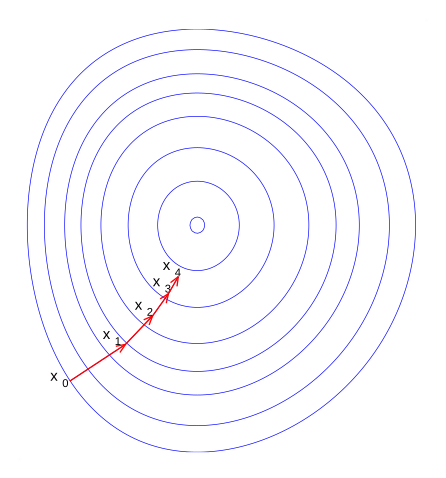
Gradient descent illustrates iterative movement toward an objective. The sphere-packing result uses its own probabilistic ellipsoid argument, explained in the article.
Zerodamage, based on Oleg Alexandrov / Wikimedia Commons. Unchanged original image. · Image source · Public domain (released by the creator)

A packing can become dramatically better without looking crowded. That is one of the surprises of geometry in many dimensions, where the fraction of space filled by equal balls can remain tiny even after a major mathematical improvement. Boaz Klartag’s paper, first submitted on April 7, 2025, and revised on January 25, 2026, establishes a lower bound of c n² 2⁻ⁿ for lattice sphere packing, with a positive universal constant c. This is an existence theorem, not a catalogue of optimal arrangements. Its central object is an ellipsoid whose random changes respect contacts with lattice points. The interesting question is why changing the shape of an empty region can eventually produce a denser arrangement of round balls.
Density without a useful picture
Start with an ordinary square grid whose neighbouring centres are two units apart. Place a unit disk at every centre. Each square fundamental cell has area four, while its disk has area π, giving density π/4. The same bookkeeping works for a full-rank lattice in n dimensions: divide the volume of one ball by the covolume, the volume of a fundamental cell. The word fundamental matters because the cell need not be a cube, and the shortest lattice vector need not be one of a chosen basis’s vectors.
This calculation also explains why uniform scaling cannot improve density. Multiplying every length by three multiplies both relevant volumes by 3ⁿ, so their ratio stays fixed. Improvement requires changing relative geometry. A shear or a directional stretch can alter which lattice vectors are shortest, potentially allowing larger balls relative to the cell volume. But every nonzero integer combination of basis vectors must remain long enough. Checking only the displayed basis would miss the very vectors that can cause overlap.
Read the polynomial and the exponential separately
The new bound combines a polynomial factor n² with an exponential factor 2⁻ⁿ. Those factors play different roles. Doubling n multiplies the polynomial by four, while squaring the exponential contribution. It is therefore possible for the theorem to guarantee a better density than earlier bounds and still guarantee a density tending rapidly to zero. A percentage taken from a three-dimensional fruit display gives almost no intuition for that competition.
For comparison, Campos, Jenssen, Michelen and Sahasrabudhe’s 2023 preprint established an asymptotic lower bound of approximately one half times n log n times 2⁻ⁿ for general packings. Formally comparing the scales gives n divided by log n, up to constants and asymptotic qualifications. That ratio grows without bound. It does not provide a numerical improvement factor at a specified small dimension: the constant c and the ranges in which estimates are effective cannot be discarded. Klartag’s result also guarantees a lattice packing, a more restrictive kind of arrangement.
Why an empty ellipsoid helps round balls
Here is the basic change of coordinates behind the strategy. Suppose an origin-symmetric open ellipsoid E contains no integer point other than zero. Translate a copy of E/2 to every integer lattice point. These copies have disjoint interiors. Indeed, an overlap would express the difference of two centres as the difference of two points of E/2. Convexity and symmetry put that difference inside E, contradicting the assumed absence of nonzero integer points.
An invertible linear transformation can turn E into a round ball. Applying that transformation to the entire arrangement simultaneously turns the integer lattice into another lattice. Density is unchanged because the same determinant multiplies the volume of the packed object and of its cell. The result is a packing by round balls. The factor 2⁻ⁿ now has a concrete origin: halving an n-dimensional body’s lengths divides its volume by 2ⁿ. Large lattice-free ellipsoids consequently translate into useful sphere-packing guarantees.
Contacts are constraints, not decoration
An origin-centred ellipsoid can be represented by a positive-definite symmetric matrix A through an inequality involving xᵀAx. In two dimensions that matrix has three independent entries; in three it has six. In general it has n(n+1)/2. This elementary parameter count suggests why considering a full ellipsoid offers more freedom than adjusting only n perpendicular lengths. Off-diagonal entries encode changes of orientation and coupling between directions.
In Klartag’s construction, a Brownian-type evolution changes the matrix while preserving lattice points that have reached the boundary. Each contact imposes a linear condition on subsequent matrix changes. The proof analyses how contacts accumulate and how the determinant behaves. The contact count alone is insufficient: an ellipsoid could acquire many contacts while remaining unhelpfully small. The difficult probabilistic work couples the boundary information to volume. This description is a guide to the mechanism, rather than a replacement for that analysis or a claim that arbitrary random perturbations succeed.
Construction and obstruction answer different questions
A lower bound comes from proving that a sufficiently dense arrangement exists. An upper bound must show that every arrangement is limited. Cohn and Elkies developed a different kind of tool for that second task: auxiliary functions whose sign and Fourier properties constrain packing density. Their 2001 preprint became an Annals of Mathematics paper in 2003. The direction of its logic is essential. An upper-bound certificate does not place centres, while a dense lattice does not rule out a denser competitor.
One can understand the distinction through a simpler optimization example. Exhibiting a rectangle of area twelve inside a region proves that the maximum is at least twelve. Proving that every admissible rectangle has area at most fifteen produces a separate ceiling. Improving either number narrows uncertainty, but neither alone gives the answer. High-dimensional packing has an analogous gap, with the added complication that admissible arrangements range over infinitely many centres and need not repeat periodically.
Why checking the basis misses a collision
A two-dimensional quadratic example makes the all-vectors condition tangible. Let the ellipsoid be defined by x² minus 1.5xy plus y² being less than one. Its symmetric matrix has eigenvalues 0.25 and 1.75, both positive, so this really is a bounded ellipse. The vectors (1,0) and (0,1) both give value one and sit on the boundary. A check restricted to those coordinate vectors would look encouraging. Yet (1,1) gives value 0.5 and lies strictly inside, immediately defeating the required lattice-free property.
This failure has nothing to do with numerical rounding. It comes from the cross term, which makes a diagonal direction cheap even when the displayed axis directions are constrained. If half-sized copies of this ellipse were put at all integer centres, the copies at zero and (1,1) would overlap. The example therefore explains why the stochastic construction must monitor new contacts throughout its evolution. Preserving earlier contacts does not grant permission to ignore other integer combinations. A successful change of shape must navigate the entire discrete set, rather than satisfy a convenient finite checklist chosen in advance.
What the theorem leaves to discover
The paper is available as a research preprint at the stated revision; this article does not infer a journal acceptance from its arXiv record. Its theorem supplies a universal guarantee rather than a claim of optimality in every dimension. Nor does an existence argument automatically yield a fast practical algorithm for finding a lattice of the promised quality. Proof, explicit construction, efficient computation and best-known small-dimensional records are four different achievements.
A productive way to approach the next question is to ask which part of the mechanism could support further gains. More parameters by themselves cannot establish a larger empty volume; one needs a process whose constraints and probabilistic estimates remain compatible. Better control of constants would answer a different, practical question about when the asymptotic improvement becomes useful. The durable insight is that round packing objects do not force the proof to remain round. Allowing a carefully controlled ellipsoid creates room in the mathematics before a final change of coordinates creates room for spheres.
Sources & further reading
Primary papers, project documentation, and research releases used in this article. Publication dates below refer to the sources themselves.
- Lattice packing of spheres in high dimensions using a stochastically evolving ellipsoidarXivPublished Checked
- A new lower bound for sphere packingarXivPublished Checked
- New upper bounds on sphere packings IarXivPublished Checked
FOLLOW THE QUESTION
Explore mathematics