MATHEMATICS
Fast Fourier decay does not guarantee a stable Fourier frame
Li and Liu’s 2025 Salem-measure examples separate strong Fourier decay from the existence of stable exponential expansions on fractal measures.
Research checked
Newest cited publication
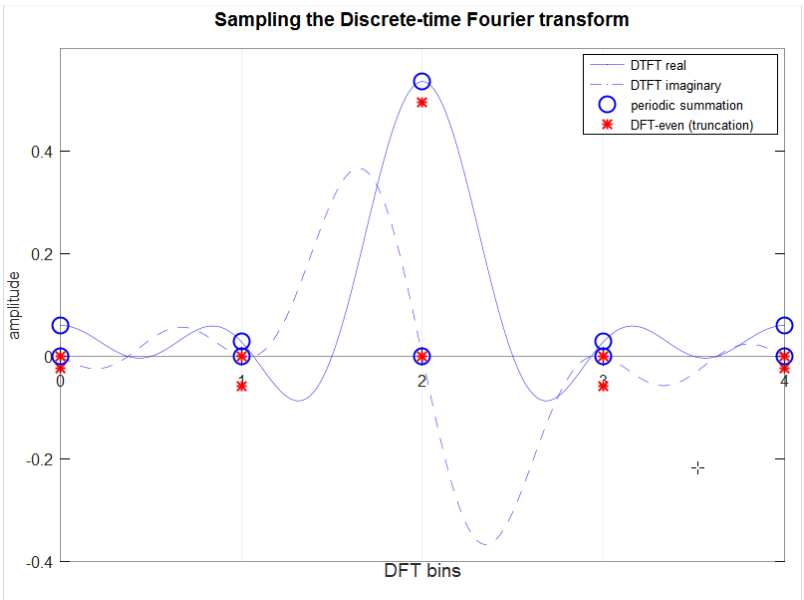
A Fourier-transform sampling diagram supplies background for the distinction between frequency decay and a stable system of Fourier measurements.
Bob K / Wikimedia Commons. Unchanged original image. · Image source · CC0 1.0

A signal may have excellent cancellation at high frequencies and still resist every proposed stable Fourier expansion of a certain kind. Longhui Li and Bochen Liu make that separation precise in a paper posted on June 2, 2025. For every dimension parameter s between zero and one, including one, they construct Salem measures on the unit interval that admit no Fourier frame. Their examples probe a tempting assumption: if a fractal measure looks sufficiently regular through its Fourier transform, perhaps exponentials should provide a stable way to analyze all square-integrable functions on it. The theorem shows why those two forms of regularity must be distinguished.
Stability is stronger than having many oscillations
An orthonormal Fourier basis expresses functions through mutually perpendicular exponential waves. A frame permits redundancy: coefficients need not behave like coordinates in a unique orthonormal expansion. What matters is a pair of uniform bounds. The sum of squared analysis coefficients must be bounded above and below by positive constants times the squared norm of the function. The same constants must work for every function in the space.
The lower bound prevents nonzero signals from becoming almost invisible to all measurements. The upper bound prevents the coefficient collection from amplifying energy without control. A collection of oscillations can be large, dense in frequency, or visually varied without satisfying both requirements. Completeness alone says that no nonzero function is orthogonal to everything. It does not rule out a sequence of unit-norm functions whose measured coefficient energy tends to zero. A frame excludes that instability.
Decay concerns one measure, not every weighted signal
The Fourier transform of a finite measure averages complex oscillations against that measure. Rapid decay means that high-frequency oscillations cancel efficiently. A Salem measure has decay compatible, up to arbitrarily small losses in the exponent, with the Hausdorff dimension of its support. For an s-dimensional measure, the characteristic decay exponent is s divided by two. This links geometric thinness to oscillatory behavior.
The frame question asks more. Its coefficients involve the Fourier transforms of f times the measure, for every square-integrable function f. Decay of the unweighted measure tests the special choice f equal to one. Even a very strong statement about that one choice cannot directly control all other choices. The logical gap resembles the difference between knowing that one vector behaves well under a linear map and proving a uniform lower bound on that map for every vector. The analogy isolates the missing uniformity rather than proving the theorem.
A broad family of negative examples
Li and Liu establish nonexistence of Fourier frames for Salem measures throughout the range zero less than s less than or equal to one. Their paper treats several construction mechanisms, including random Cantor constructions, random images and deterministic constructions using Diophantine approximation. It also identifies Brownian-image examples. These are mathematical probability constructions, not measurements of a physical random material.
The result does not say that every Salem measure fails to admit a frame. The authors explicitly discuss a weighted arc in the plane that is a one-dimensional Salem measure and possesses an orthonormal exponential basis. Their discussion leaves the existence question on the real line more delicate. The ambient setting and the chosen measure are part of the statement. Replacing these qualified conclusions with a slogan that randomness destroys Fourier analysis would obscure both the positive example and the actual content of the negative constructions.
Local mass distribution can defeat global cancellation
Earlier work by Dorin Ervin Dutkay and Chun-Kit Lai develops uniformity restrictions for measures with Fourier frames. In particular, comparing a measure with translated restrictions can reveal mass imbalances incompatible with fixed frame bounds. This supplies a useful conceptual counterpart to Fourier decay. Cancellation is a global oscillatory property; uniformity asks how mass is distributed among comparable pieces.
For a simple linear-algebra comparison, consider measuring a two-component vector using a diagonal map with entries one and epsilon. The map detects every nonzero vector whenever epsilon is positive. However, its smallest squared gain is epsilon squared, attained along the second coordinate. As epsilon tends to zero, stable inversion becomes arbitrarily poor. A multiscale measure can present successively more severe imbalances instead of just one small finite epsilon. This calculation explains why a common positive lower bound matters; it is not a reconstruction of a specific Salem example.
Dimension alone was already an unreliable guide
Nir Lev's earlier research on Fourier frames shows that even classifying a singular measure by dimensions of its components is insufficient. Some sums of measures of different dimensions can admit frames, while curvature can obstruct a frame for other sums of arc and surface measures. Thus a simple rule based only on matching dimensions cannot decide the spectral question.
This background helps locate the 2025 result. Salem regularity is a much more Fourier-sensitive condition than merely assigning a Hausdorff dimension. Nevertheless, it still does not force stable exponential analysis. The progression is instructive: one proposed geometric summary fails, then a stronger oscillatory summary also proves insufficient. That does not make summaries useless. It tells researchers which additional features a correct criterion must notice, including local mass behavior, translations and the way the supporting geometry interacts with exponentials.
Why the planar arc is an illuminating boundary
Consider the curve parametrized by x mapping to the point with coordinates x and the square root of one minus x squared, with x between minus one half and one half. Put on that arc the push-forward of ordinary dx. A function on the arc then corresponds to a function on an interval of length one. Exponentials with integer frequency in the first coordinate become the usual interval exponentials, so orthonormality and completeness transfer through the parametrization.
The weighting is essential. Uniform dx along the parameter is not the same as uniform arc length. Indeed the speed of the parametrization is one divided by the square root of one minus x squared. This distinction makes the example a useful exercise in reading the measure, not only its support. The paper additionally analyzes the Fourier decay of this weighted arc. Its role is to prevent an overgeneral conclusion from the negative examples: strong decay and stable exponential expansions can coexist in a suitable setting. The research challenge is to identify exactly when they coexist, and when multiscale mass irregularity separates them.
Checking an exponential basis directly
The interval calculation behind the planar example can be made explicit. The inner product of two exponentials with distinct integer frequencies is the integral of an exponential with a nonzero integer frequency over an interval of length one. Its antiderivative has the same value at the two endpoints, so the integral is zero. With equal frequencies the integrand is one and the integral is one. These checks establish orthonormality. Completeness is the usual Fourier-series theorem on that interval, transferred by the parametrization rather than inferred from the curve's appearance.
The negative theorem requires a much stronger kind of argument than finding one inconvenient frequency grid. Failure of integer frequencies would still leave the possibility of a different countable frequency set. Saying that a measure admits no Fourier frame excludes every such choice. This is why numerical optimization over a few grids cannot verify the result. An apparent failure could be cured by a better grid, while an apparent success on a finite-dimensional sample of functions could miss a sequence of increasingly localized functions. The research establishes a uniform obstruction in the infinite-dimensional space, beyond any finite coefficient experiment.
Sources & further reading
Primary papers, project documentation, and research releases used in this article. Publication dates below refer to the sources themselves.
- Fourier Frames on Salem MeasuresarXivPublished Checked
- Uniformity of measures with Fourier framesarXivPublished Checked
- Fourier frames for singular measures and pure type phenomenaarXivPublished Checked
FOLLOW THE QUESTION
Explore mathematics