MATHEMATICS
What the 2026 multicolour Ramsey improvements actually save
Two 2026 preprints sharpen multicolour Ramsey upper bounds. The savings concern exponential estimates under explicit growth conditions, not exact values.
Research checked
Newest cited publication
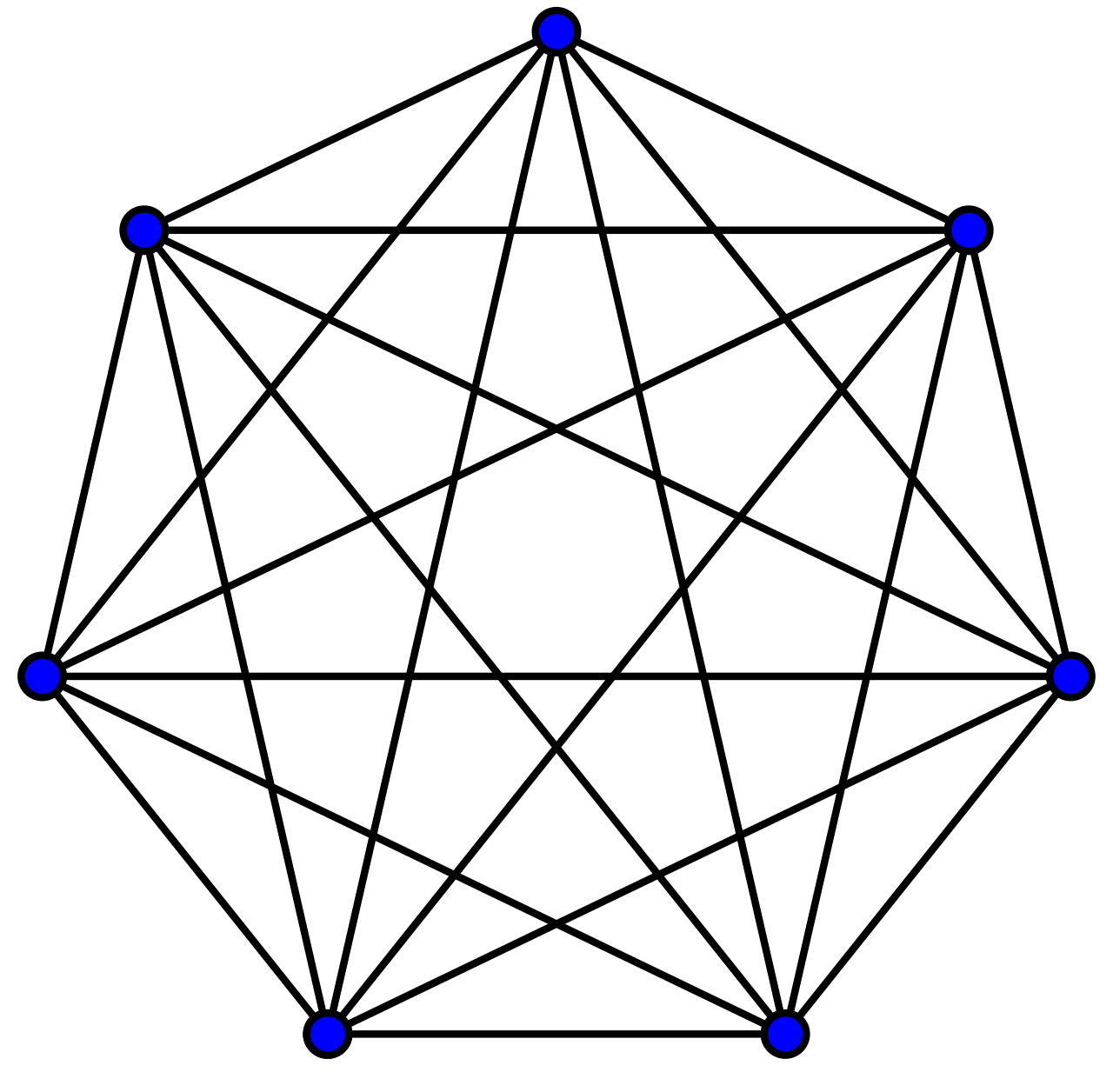
The complete graph K7 illustrates the graph underlying an edge-coloring problem; the monochromatic subgraphs in Ramsey theory depend on how those edges are colored.
David Benbennick / Wikimedia Commons. Wikimedia-generated PNG rendering of the SVG; no editorial changes. · Image source · Public domain (released by the creator)

Ramsey theory studies the point at which a large enough structure must contain a particular kind of order. Its questions can be explained with colored edges, yet its numerical bounds remain far apart. Two preprints posted in August and September 2026 refine a multicolour upper-bound estimate by changing how its saving depends on the number of colors. The improvement is best understood on a logarithmic scale and with the parameter restrictions left visible. It is not a newly computed exact Ramsey number, and it does not settle how large the true answer is. The mathematics lies in guaranteeing unavoidable order more efficiently in a difficult worst-case problem.
Two dated preprints and one precise comparison
Gang Yang and Yaping Mao's August 3, 2026 preprint bounds the diagonal r-color Ramsey number by r raised to rk, multiplied by exp of minus c times k divided by r squared times log to the fourth power of 2r. Sunghyeon Jo's September 4 preprint replaces that denominator by r times log squared of 2r. Both statements require k to be at least an absolute constant times r squared times log to the sixth power of 2r. These are preprint claims as of the October 18 research cutoff.
The constants are positive absolute constants, and their numerical values should not be silently set to one. The comparison improves the dependence of the guaranteed exponent saving by an order of r times log squared of 2r. It does not mean that every concrete input improves by exactly that multiplicative amount. Nor does it give a reliable numerical bound for a small k outside the theorem's range. An asymptotic expression with hidden constants is a growth statement, not a ready-made table of exact estimates.
One coloring can refute a claim; all colorings must support it
Write R_r(k) for the smallest number of vertices such that every coloring of the edges of a complete graph with r colors contains a k-vertex clique whose edges all have one color. The complete host graph has an edge between every pair; colors classify those edges rather than remove them. The word every makes an upper bound demanding. To prove a lower bound, one successful coloring avoiding the target is enough. To prove an upper bound, no avoiding coloring may remain.
That logical asymmetry explains why computational discoveries and general proofs often take different forms. A concrete coloring can be stored as a finite certificate and checked edge by edge. A universal upper bound needs an argument covering an enormous family of colorings. Failure to find an avoiding coloring after a long search does not by itself prove that none exists. Likewise, a theorem guaranteeing a monochromatic clique says nothing about whether a simple search heuristic will find that clique quickly on every input.
The triangle case shows the universal argument
For two colors and a triangle target, six vertices suffice. Choose one vertex. Among its five incident edges, at least three have the same color, say red, and let their other endpoints be A, B and C. If any edge among A, B and C is red, it completes a red triangle with the chosen vertex. If none is red, all three internal edges are blue and form a blue triangle. Every possible coloring is covered by those two alternatives.
Five vertices do not suffice. Color the edges of a five-cycle red and the remaining edges blue. The red graph has no triangle, and the remaining edges also form a five-cycle, so blue has none either. Together the two arguments establish the exact value six. This independent worked example is much stronger information than a general exponential upper estimate evaluated at three. It also clarifies why progress on asymptotic multicolour bounds should not be advertised as a solution to particular small exact Ramsey numbers.
An exponential saving still leaves an exponential bound
The coarse classical comparison r raised to rk has natural logarithm rk log r. Jo's reported improvement subtracts at least a constant multiple of k divided by r log squared of 2r from that logarithm. For fixed r, both terms are proportional to k. Thus the upper estimate still grows exponentially with clique size, but with a slightly smaller effective base. A factor that looks modest inside the base can become substantial when raised to a large k, which is why exponential improvements matter.
An independent algebraic illustration helps separate scales. Suppose a hypothetical bound is 100 to the power k multiplied by exp of minus k divided by ten. It equals (100 times exp of minus one tenth) to the power k, approximately 90.48 to the power k. It remains enormous, but the ratio to the old bound is exp of minus k divided by ten. This is only an illustration, not a numerical specialization of either new paper, because their unspecified constants and parameter thresholds must be respected.
Why the number of colors changes the comparison
Compare the symbolic denominators r squared log to the fourth power of 2r and r log squared of 2r. Dividing the first by the second gives r log squared of 2r. As r grows, the latter theorem therefore retains a much larger saving scale, up to its own constant. If r is fixed, that ratio is merely another constant. This is why a bound designed to improve dependence on a growing number of colors should not automatically be called the strongest available result for two colors.
The required lower threshold for k grows with r as well. A statement that holds for all fixed r once k is large can conceal poor uniform dependence on r. Conversely, a theorem providing absolute constants and an explicit joint growth condition makes that dependence part of the result. When comparing research in this area, three items belong together: the main upper expression, its constants' allowed dependence and the regime in which it holds. Reporting only the most attractive exponential factor loses the conditions that give it meaning.
A clique with common neighbors stores future options
A monochromatic book consists of a monochromatic clique, called its spine, together with common neighbors joined to every spine vertex in the same color. The page vertices need not themselves form a clique. As a simple independent example, a red four-vertex spine plus one page vertex gives a red five-clique. Several page vertices yield a larger red clique only if the needed edges among those vertices are also red. The distinction prevents a common visual misunderstanding of what a large book already guarantees.
Jo describes the refinement through off-diagonal targets: instead of asking for the same clique size in every color, retain a vector of different remaining requirements. That viewpoint records progress made in one color without discarding possibilities in the others. It is a form of proof bookkeeping, not a claim that color choices are independent. The earlier two-color work of Marcelo Campos, Simon Griffiths, Robert Morris and Julian Sahasrabudhe established an exponential improvement over the long-standing base-four bound; its first posting was in March 2023, with a revised version in August 2025.
Upper-bound progress leaves the true growth rate open
An upper bound is a ceiling, not an estimate automatically known to be close to the truth. If an avoiding coloring establishes a lower bound far below that ceiling, substantial uncertainty remains between them. Improving the ceiling is valuable even when it does not close the gap. The new preprints should therefore be evaluated as refinements of universal estimates and proof methods. Independent checking, subsequent revisions and eventual publication can clarify their status further; posting a theorem is not the same event as completing community review.
My inference is that the interesting feature is information retention: the proof compares several partially completed color goals rather than collapsing them too early into a single crude estimate. Readers can carry that idea back to small examples, drawing a spine and recording what remains to be forced on its pages. The exact six-vertex triangle proof supplies a calibration, while the asymptotic expressions show how hard it is to scale such guarantees. Both are about unavoidable structure, but they operate at different levels of numerical precision.
Sources & further reading
Primary papers, project documentation, and research releases used in this article. Publication dates below refer to the sources themselves.
- An Improved Upper Bound for Multicolour Ramsey NumbersarXivPublished Checked
- New upper bound for multicolor Ramsey numbersarXivPublished Checked
- An exponential improvement for diagonal RamseyarXivPublished Checked
FOLLOW THE QUESTION
Explore mathematics