MATHEMATICS
The Quantum Stein Lemma’s Formal Proof: From 2025 Milestone to 2026 Completion
The quantum Stein formalization reached a 2025 milestone with admitted facts. Its authors report an April 2026 completion; the distinction matters mathematically.
Research checked
Newest cited publication
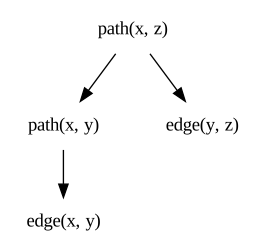
A simple proof tree supplies logical background for machine-checked mathematics; the quantum information theorem requires the formal structures described in the article.
Siddharthist / Wikimedia Commons. Adapted by GreatItself: corrected the transitive-closure premise to edge(y,z). · Image source · CC BY-SA 4.0

A theorem about distinguishing quantum states became a revealing test of what computer-verified mathematics actually promises. In their October 9, 2025 preprint, Alex Meiburg, Leonardo A. Lessa, and Rodolfo R. Soldati described a Lean formalization of the generalized quantum Stein lemma. The paper also stated that several standard background facts still remained admitted rather than proved inside the development. By the October 2026 research cutoff, the project’s public repository reports that those remaining facts were formalized in April 2026. These are different milestones. The later completion is an author-reported project status, not an independent build audit performed for this article. Following the distinction explains both the theorem’s mathematical content and why a precise account of assumptions is more valuable than a premature claim that every dependency has already been checked.
Two mistakes, one controlled error budget
A quantum state records the probabilities of possible measurement outcomes. In the finite-dimensional setting, it can be represented by a positive semidefinite matrix with trace one. A binary test uses an operator T between zero and the identity to represent acceptance of a target state ρ. If ρ is really present, rejecting it is a type-I error. If an alternative state is present, accepting ρ is a type-II error. These errors pull in opposite directions: always accepting the target eliminates the first while ruining the second.
Stein-type questions fix an acceptable type-I error and ask how small the type-II error can become as the number of copies grows. The ordinary quantum problem compares repeated copies of two specified states. The generalized problem allows a whole family of alternative states at each copy number. The test must handle the worst alternative in that family. This shifts the task from distinguishing two known preparations to separating a target from an entire mathematical class, including alternatives with correlations across subsystems.
The restriction that the fixed type-I tolerance lies strictly between zero and one is not merely a notation choice. At tolerance one, a test can reject the target every time; it then accepts no alternative either, making the usual type-II optimization degenerate. At tolerance zero, exact acceptance can impose support restrictions that behave differently from the interior regime. A limiting theorem with a fixed interior tolerance therefore needs that assumption stated. It also differs from a problem in which the tolerance itself changes with the number of copies. Replacing a constant by a sequence changes the quantified task and requires a separate argument.
A classical calculation gives the rate an interpretable scale
Relative entropy quantifies a directional statistical distinction. For classical distributions p and q with positive comparison probabilities, it is the sum of p_i times log(p_i divided by q_i). It is not a symmetric distance: exchanging p and q generally changes the result. The quantum expression replaces probability lists with matrices and uses their logarithms. When the matrices commute, choosing a common eigenbasis recovers the classical formula, which supplies a useful bridge to familiar statistics.
Consider an original two-outcome example with p = (3/4, 1/4) and q = (1/2, 1/2). Using natural logarithms gives D(p||q) = (3/4) log(3/2) plus (1/4) log(1/2), approximately 0.1308. This is measured in nats; base-two logarithms would express the same distinction in bits. A positive asymptotic exponent means that optimized error probabilities shrink exponentially at the associated rate. The calculation illustrates units and directionality. It does not supply an exact finite-sample error probability for a quantum experiment.
Why one copy does not settle the generalized problem
With a family of alternatives, the relevant quantity minimizes relative entropy over the allowed states for n copies and then divides by n. The limiting per-copy quantity is called a regularized relative entropy. Regularization prevents an unjustified assumption that the best comparison at many copies is simply the tensor power of the best one-copy comparison. Correlations or collective structure can alter that optimization. A rate theorem has to relate the limiting optimization to the limiting performance of actual admissible tests.
The formalized formulation imposes specific conditions on the alternative families, including compactness and convexity, closure under tensor products, and a full-rank free state at the one-copy level. These conditions do mathematical work. Convexity allows probabilistic mixing of alternatives to remain allowed; tensor closure makes independently combining permitted resources legitimate. A full-rank comparison avoids support pathologies in relative-entropy expressions. An arbitrary collection of states need not satisfy these hypotheses, so the theorem is not a universal statement about every imaginable notion of a free resource.
The history distinguishes a broken proof from a false theorem
The modern formalization sits behind an important sequence of mathematical events. Berta and collaborators identified a gap in the original generalized Stein argument; their paper appeared in Quantum in 2023 after a 2022 preprint. A gap means that the stated reasoning does not establish its conclusion. It does not by itself produce a counterexample. Hayashi and Yamasaki supplied a new proof in a 2024 preprint, and Lami supplied a separate solution. Their papers provide primary evidence for the repaired mathematics before its translation into Lean.
The formalization follows the Hayashi–Yamasaki route rather than treating the original argument as already sound. This matters because formalization cannot retroactively turn a missing inference into a valid one by changing notation. It must provide the inference, adjust the assumptions, or prove a different statement and say so. The broader scientific value is a dependency record: researchers can identify which applications need the generalized lemma and which additional results are required to connect it with a resource-conversion claim. That record is useful even before every surrounding application has been formalized.
The 2025 paper openly marked the unfinished foundation
The October 2025 preprint lists remaining background results, including data processing and properties of relative entropy. Lean permits temporary admitted statements during development. Downstream theorems can then be checked conditional on those admissions, much as a paper can prove a result assuming a named lemma whose proof is supplied later. This workflow is productive, but the conditional status must travel with the claim. A compiling development containing admitted dependencies is not the same artifact as a completed derivation using only the intended foundational assumptions.
The project repository now distinguishes the October 2025 argument-level milestone from completion of the standard background results in April 2026. It identifies the final theorem as limit_hypotesting_eq_limit_rel_entropy. The same repository reports that Lean-QuantumInfo merged with PhysLean to form Physlib in March 2026, making the successor library relevant to ongoing development. These are statements from the maintainers’ documentation. This article has inspected that documentation and the preprint, but does not claim to have independently established an axiom-clean build of a particular repository commit.
A statistical theorem does not certify a laboratory
The mathematical certificate concerns the stated finite-dimensional model and its definitions. It does not verify that a particular laboratory device prepares exactly ρ, that measurement noise is negligible, or that an asymptotically optimal test is feasible with available hardware. Nor does the generalized lemma alone prove every thermodynamic analogy suggested by resource theory. The 2025 formalization paper explicitly separates its lemma-focused goal from formalizing the second-law application in the latter half of the underlying mathematical work.
The result is nevertheless substantial because it connects an operational task with an optimized information quantity through a precise limiting theorem. Future formal work can reuse the matrix, entropy, and hypothesis-testing infrastructure instead of repeatedly reconstructing it. Further public audits could pin a source revision, rebuild the development, inspect assumptions, and compare the formal statement with the intended mathematics. Those would strengthen the evidence in specific ways. The advance visible by October 2026 is a carefully documented path from repaired analysis, through an openly conditional 2025 formalization, to the authors’ reported 2026 completion of its background proofs.
Sources & further reading
Primary papers, project documentation, and research releases used in this article. Publication dates below refer to the sources themselves.
- A Formalization of the Generalized Quantum Stein’s Lemma in LeanMeiburg, Lessa, and Soldati / arXivPublished Checked
- Generalized Quantum Stein’s Lemma and Second Law of Quantum Resource TheoriesMasahito Hayashi and Hayata Yamasaki / arXivPublished Checked
- On a gap in the proof of the generalised quantum Stein’s lemma and its consequences for the reversibility of quantum resourcesBerta and collaborators / arXivPublished Checked
- A solution of the generalised quantum Stein’s lemmaLudovico Lami / arXivPublished Checked
- Quantum Information in LeanAlex Meiburg and contributors / GitHubChecked
- PhyslibPhyslib contributors / GitHubChecked
FOLLOW THE QUESTION
Explore mathematics