MATHEMATICS
What a Kernel Fix Teaches Us About Mathematical Certainty
Lean’s July 2026 kernel fix illustrates the distinct roles of logical rules, proof terms, axiom audits, and independent checking in formal mathematics.
Research checked
Newest cited publication
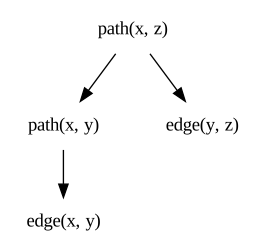
A Datalog proof tree illustrates the dependency of an argument on checked steps. The article examines Lean’s distinct kernel and the reported correction.
Siddharthist / Wikimedia Commons. Adapted by GreatItself: corrected the transitive-closure premise to edge(y,z). · Image source · CC BY-SA 4.0

On July 28, 2026, the Lean project released version 4.32.2 to repair a soundness defect in its kernel, the program responsible for checking formal proof terms. The official release notes explain that a deliberately constructed metaprogram could exploit incomplete handling of nested inductive declarations and cause the checker to accept a proof of False. That is a serious implementation issue, and a useful mathematical lesson. A formal proof is a claim about a precise statement, a logical system, and an implemented checking process. Keeping those layers distinct lets us assess a defect without either dismissing it or concluding that every previously formalized theorem is false. The July repair also provides a timely setting for understanding Lean4Lean and the broader research program of proving properties about proof checkers themselves.
The checker asks a narrower question than the author
In the propositions-as-types view, a proposition is represented by a type and a proof by an expression inhabiting that type. A proof of an implication is a function: supply evidence for the premise and it returns evidence for the conclusion. For an independent elementary example, evidence for both P and Q contains two components. A function that extracts the first component constitutes a proof that P and Q imply P. The checker verifies that the extraction matches the promised type.
This perspective separates proof construction from proof checking. A tactic can search, rearrange expressions, or call sophisticated procedures while building a proof term. The kernel then checks the resulting object against the formal rules. The attraction is architectural: one can improve the large collection of proof-producing tools while concentrating foundational trust on a smaller checker. Small does not mean infallible, however. A missed case in that checker can undermine the very boundary the design is intended to enforce.
A missing implementation check is not a new axiom
The official July notice locates the problem in nested inductive types with phantom parameters. An inductive definition describes objects through allowed constructors; a nested definition can place recursive objects inside another type constructor. Parameters that do not appear as stored data can still matter to the correctness of the type-level construction. The issue report describes malformed projections being accepted, and the linked repair adds a missing check when inductive declarations enter the kernel. The formal rules intended to govern those declarations did not authorize the malformed objects.
That distinction matters when interpreting an axiom report. If a soundness bug causes an implementation to accept an invalid derivation, the derived theorem may show no unexpected axioms. Counting assumptions is therefore necessary evidence about a proof, but it does not independently establish that the program followed the inference rules correctly. The issue is closed with a concrete fix; the release describes how maliciously constructed proof-generating code can reach the vulnerable path. This article supplies no executable exploit and makes no claim that ordinary library proofs all depended on that path.
Why one contradiction can erase the meaning of certification
In ordinary classical logic, a contradiction implies any proposition. One way to understand this is to recall what a proof of False is supposed to contain: nothing can construct it under consistent assumptions. A rule allowing a conclusion from False has no legitimate input in a consistent development. If a bug supplies such an input anyway, that rule can produce an arbitrary conclusion. A checker capable of certifying both an arithmetic statement and its negation has lost the discrimination the certificate was meant to provide.
There are two different questions after a defect is found. Does the implementation admit a bad derivation? Does a particular theorem’s proof use the defect? An affirmative answer to the first does not decide the second. For comparison, finding that a calculator mishandles one operation does not make every printed sum numerically wrong; it means results need evidence appropriate to the defective behavior. Rechecking artifacts with repaired software directly addresses the implementation question for those artifacts. Examining the statement and assumptions addresses a different part of their mathematical meaning.
Even equality checking contains mathematical substance
A dependent type checker must recognize some expressions as equal by computation. If a function is defined to add one, applying it to two should compute to three in the relevant representation. This definitional equality differs from an arbitrary theorem stating that two quantities happen to be equal. It is built into the machinery that checks whether an expression has the expected type. Efficient implementations may reduce only as much of an expression as needed, cache comparisons, and handle bound variables carefully.
Meven Lennon-Bertrand’s July 2025 paper studies what properties are needed to certify conversion checkers. It emphasizes injectivity properties in dependent type theory rather than treating normalization as the only central ingredient. The point for a nonspecialist is that checking equality is itself a theorem-sized subject. Proving that an algorithm accepts only expressions equal according to the specification requires connecting operational behavior with the mathematical rules. Proving termination, correctness of a cache, and fidelity of an input representation are additional obligations that cannot all be replaced by the statement that the code is short.
Two implementations help most when their failures differ
Lean4Lean supplies an external checker implemented in Lean and a development of relevant metatheory. Its paper began as a 2024 preprint and was revised in September 2025; the institutional publication record lists a 2026 proceedings paper. The project’s own documentation makes an essential qualification: its implementation derives directly from the C++ kernel and is not fully independent in design. It also distinguishes the executable checker from the theories and verification components. These are related achievements with different scopes.
Independent checking aims to reduce shared failure modes. A second program built from the same algorithm may catch language-specific mistakes while preserving the same conceptual omission. A checker designed from a different specification can offer another kind of protection, yet it too may have defects. The July release explicitly discusses this issue for external checking, including a separate fixed bug in nanoda. The reasonable inference is that diversity, repairs, and transparent assumptions strengthen confidence together. Merely accumulating the names of checking programs does not establish that their implementations are independent or their coverage identical.
A faithful theorem remains part of the proof obligation
An impeccable kernel can verify the wrong formal statement. Suppose a prose claim says every integer in a range has a property, but its translation accidentally quantifies over an empty range. The formal theorem can be perfectly valid and irrelevant to the intended question. Similarly, inserting a desired conclusion as a new axiom changes a proof into a conditional argument, whether or not its name sounds respectable. These problems concern specification and assumptions, rather than the July implementation defect, and require their own forms of review.
A useful research artifact therefore joins readable definitions, preserved proof terms, explicit axiom dependencies, and reproducible checks with identified tool versions. Verified-kernel research can further reduce uncertainty about implementation steps, while mathematical review checks whether the statement expresses the intended result. Neither task eliminates the other. The concrete 2026 development is a reported soundness bug and its repair, alongside continuing work on checker verification. It supports a practical account of mathematical certainty: trust becomes more defensible when its separate premises can be inspected, tested, and improved instead of compressed into the word certified.
Dependency tracking is especially important when a theorem invokes a helper that invokes another helper. If the last helper assumes an unproved assertion, hiding its name several layers away does not remove the assumption from the final conclusion. A transitive axiom audit follows that chain. By contrast, a bug in a parser or checker may not appear as a named assumption at all, because it lives in the process that interprets the artifact. This gives two concrete reasons to preserve both the mathematical dependency graph and the checking environment: they record different premises of the resulting confidence claim.
Sources & further reading
Primary papers, project documentation, and research releases used in this article. Publication dates below refer to the sources themselves.
- Lean 4.32.2 (2026-07-28)Lean projectPublished Checked
- Kernel accepts wrong-structure projections, allowing an axiom-free proof of FalseLean project issue trackerPublished Checked
- fix: missing check at kernel inductive declarationLean project / GitHubPublished Checked
- Lean4Lean: Verifying a Typechecker for Lean, in LeanMario Carneiro / arXivPublished Checked
- Lean-for-LeanMario Carneiro and contributors / GitHubChecked
- What Does It Take to Certify a Conversion Checker?Meven Lennon-Bertrand / Dagstuhl PublishingPublished Checked
- AxiomsLean projectChecked
- Propositions and ProofsLean projectChecked
- Lean4Lean: Verifying a Typechecker for Lean, in LeanChalmers University of TechnologyChecked
FOLLOW THE QUESTION
Explore mathematics