PHYSICS
Optical clocks turn height into a measurable frequency difference
A September 2026 European clock comparison shows why optical timekeeping now depends on networks, gravity corrections and independently checked uncertainty.
Research checked
Newest cited publication
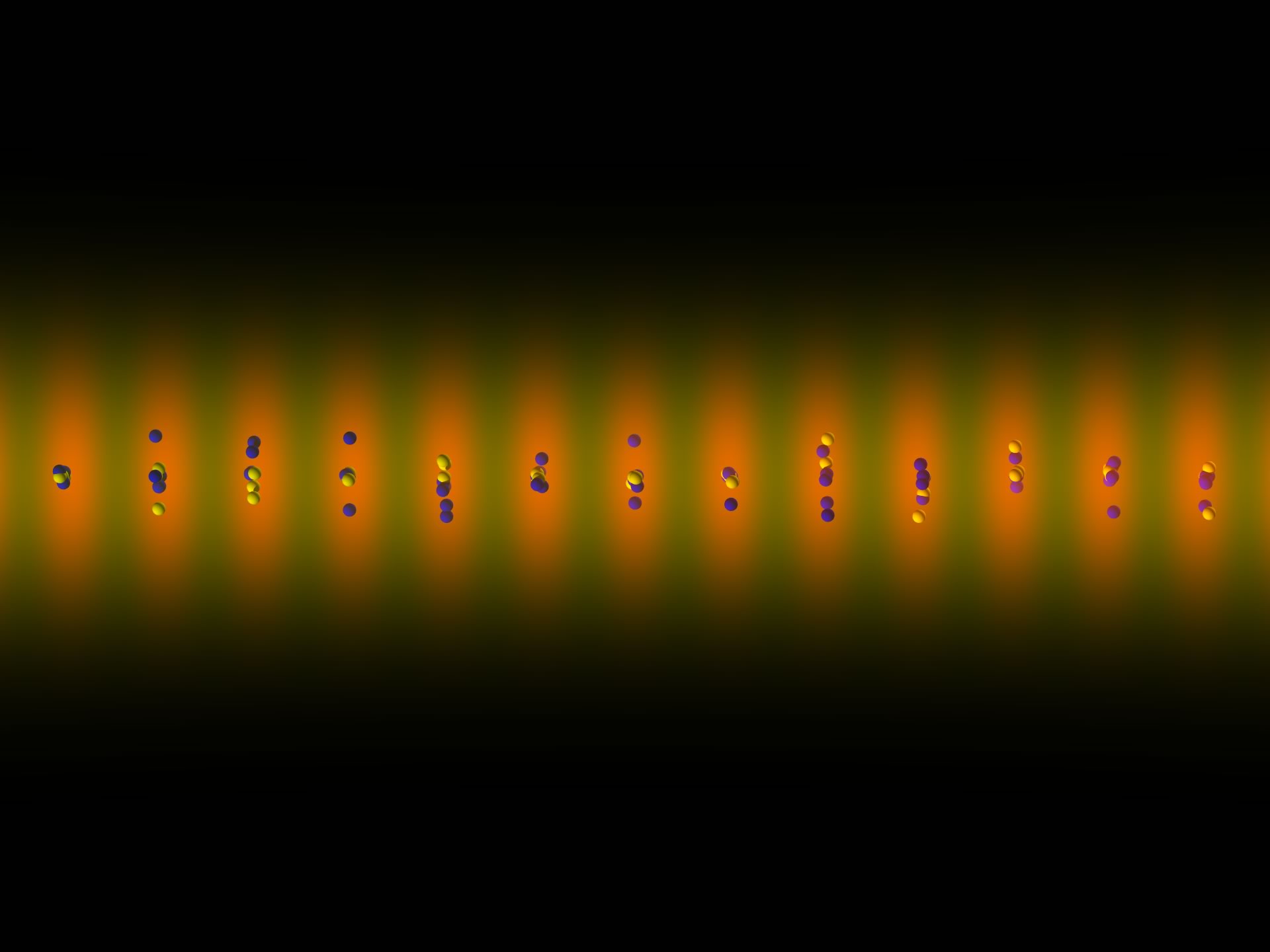
A NIST optical-lattice visualization illustrates the confinement geometry used in optical-clock research; the image itself is not a measured height-dependent frequency shift.
NIST · Image source · Public domain

A clock sufficiently precise to notice a change of height cannot be judged only by how beautifully it ticks on one laboratory bench. Its environment, the route used to compare it with another clock, and the gravitational potential of both locations become parts of the measurement. A European collaboration published an international optical-clock comparison on 1 September 2026, placing that wider problem at the centre of the story. The important development is a growing ability to compare independent instruments across borders. Understanding why this matters requires keeping several ideas separate: a stable rhythm, an accurate frequency, a common reference, and a physical explanation for differences that remain after the instruments are corrected.
A clock has to agree beyond its own laboratory
The 2026 Physical Review Research paper reports a two-month campaign connecting seven optical clocks at four national metrology institutes through the European optical-fibre network. The reported frequency-ratio uncertainties ranged from 7.7 × 10⁻¹⁸ to 6.1 × 10⁻¹⁷. Two independently developed ytterbium-ion clocks, at the United Kingdom’s National Physical Laboratory and Germany’s Physikalisch-Technische Bundesanstalt, agreed within the smallest of those uncertainties. This was an experimental comparison, not a projection of what a future network might achieve. Its value lies in independent systems meeting within an explicit uncertainty budget, rather than in treating the smallest number as a universal specification for every clock and link.
Consider a simpler measurement exercise. Two balances can display the same mass because both were calibrated with the same incorrect reference. Their agreement would not reveal the shared error. Clock comparisons face an analogous reasoning problem: common lasers, common reference data or common environmental models can create correlations. A network is especially useful when its different routes and different species provide checks that a single pair cannot. If three corrected frequency ratios form a closed cycle, their product should be consistent with one. A discrepancy identifies an inconsistency worth investigating, although the cycle alone does not say which instrument is responsible. This is why agreement has to be interpreted together with the independence of the contributing measurements.
Stability buys time; accuracy demands an explanation
An instructive recent example is the aluminium-ion clock reported in Physical Review Letters on 14 July 2025. The authors evaluated a fractional systematic uncertainty of 5.5 × 10⁻¹⁹ and a fractional instability of 3.5 × 10⁻¹⁶ divided by the square root of averaging time in seconds. A magnesium ion supplied cooling and quantum-logic readout. Laser-stability transfer across a 3.6-kilometre fibre link enabled one-second interrogation. These are distinct achievements: the uncertainty describes assessed frequency biases, while the instability describes fluctuations that can be averaged down under the reported operating conditions. Neither quantity alone supplies the complete performance of an international comparison.
A useful imaginary clock runs fast by exactly one microsecond every day. It could be exceptionally stable: each day repeats the same error. Once the offset is identified, its reading can be corrected. A second clock might have no known average bias but wander unpredictably. Combining many readings improves knowledge of its mean only if the noise behaves as assumed. This distinction explains why an uncertainty budget must identify physical effects, while a stability curve must state the averaging interval. Increasing measurement time is not an automatic cure for systematic errors or correlated drift. It also explains why a clock’s smallest published uncertainty should never be advertised as the accuracy of every timestamp produced by a larger service.
Gravity becomes both a correction and a signal
The underlying relativistic relationship is straightforward in the weak, slowly varying gravitational field relevant near Earth’s surface: the fractional frequency difference is approximately the gravitational-potential difference divided by the speed of light squared. For a small vertical separation where local gravitational acceleration can be treated as constant, the potential difference is approximately acceleration times height. Taking 9.81 metres per second squared and 299,792,458 metres per second gives about 1.09 × 10⁻¹⁶ per metre, or 1.09 × 10⁻¹⁸ per centimetre. The higher clock runs faster in this comparison. These are explanatory estimates; they are not an accuracy claim for the European campaign.
The physical effect has already been resolved within a single atomic sample. A Nature experiment published on 16 February 2022 measured the gravitational redshift across a millimetre-scale strontium sample. That older result is useful background because it shows that gravity is not an optional correction added after precision has been achieved. At sufficient resolution, it is present inside the measurement volume. Yet converting a clock comparison into a reliable height estimate requires more than dividing a frequency difference by the number above. One must account for the clocks’ other shifts, the reference potential and the actual gravity field. Frequency measurements naturally reveal potential differences, which do not always correspond to simple geometric height differences.
Sending a frequency is a measurement of the path
The NIST-hosted 2025 review of optical time and frequency transfer describes fibre and free-space approaches, as well as the different roles played by continuous-wave lasers and frequency combs. It also distinguishes distributing a frequency from distributing a time reading. That distinction is practical. A receiver may learn how fast a remote oscillator runs without knowing which particular tick is labelled noon. A frequency comb connects optical oscillations with countable electronic signals by providing a structured set of related optical frequencies. It does not remove the need to understand propagation delays and noise.
Imagine stretching a cable slightly while a repeating wave travels through it. The arriving phase changes because the route length has changed, even if the original oscillator has not. Temperature, vibration and mechanical motion can therefore masquerade as clock behaviour. A round-trip measurement can estimate path fluctuations and support a correction, but only to the extent that outward and returning signals experience sufficiently related disturbances. This gives an intuitive reason to document link operation alongside clock operation. A superb local oscillator attached to an uncontrolled route cannot establish the same comparison quality as the oscillator alone. It also motivates redundant routes: they help distinguish a changing path from a changing source.
What a centimetre-scale question actually asks
Suppose two otherwise ideal clocks differ in potential by the equivalent of ten centimetres in the constant-gravity approximation. Their fractional frequency separation is about 1.09 × 10⁻¹⁷. Over one day, that would correspond to roughly 0.94 picoseconds of accumulated time difference. This multiplication is a scale calculation, using 86,400 seconds per day. A frequency comparison does not need to wait until a display visibly accumulates that time error. It measures the relative phase evolution of oscillators. The tiny accumulated-time number nevertheless helps show why everyday clock-setting intuition is misleading when applied to optical metrology.
Now add a slowly changing thermal shift to one instrument. If its size is comparable to the gravitational signal, an apparent rise of the ground could instead be a laboratory-temperature effect. A useful campaign therefore includes environmental observations, calibration changes and independent checks rather than merely a long table of frequency differences. In a real geodetic application, the temporal question matters too: is the goal to identify a constant potential difference, a seasonal variation or a rapid disturbance? Each asks for a different combination of uptime, stability and systematic control. The numerical example explains a possible sensitivity scale; it does not establish that every such change has already been measured in the field.
The next milestone is dependable comparison
The September 2026 result supplies evidence that independent optical clocks can be checked internationally at a demanding level. Its broader implication is an engineering and scientific inference: as local uncertainties improve, the credibility of a clock network will increasingly rest on link performance, reproducibility and gravity knowledge. A lower local error bar is valuable, but a comparison becomes more useful when it can be repeated after maintenance, with a different route, or against a different atomic species. Such repetitions expose assumptions that a single excellent run might leave hidden.
For readers following the field, the decisive questions are concrete. Which transitions were compared? Was the reported number a systematic uncertainty, a statistical uncertainty or a combination? How much data were available at the same time? What corrected the gravitational shift? Were common errors treated as correlated? Answering those questions makes the latest precision figures more meaningful. Optical clocks are turning timekeeping into a way to examine both the consistency of our measurement system and the shape of Earth’s gravitational potential. Their promise comes from controlled comparisons, not from pretending that an extraordinarily regular tick is insulated from the rest of physics.
Sources & further reading
Primary papers, project documentation, and research releases used in this article. Publication dates below refer to the sources themselves.
- International optical clock comparison using the European optical fiber networkPhysical Review ResearchPublished Checked
- High-Stability Single-Ion Clock with 5.5 × 10⁻¹⁹ Systematic UncertaintyPhysical Review LettersPublished Checked
- High-Precision Optical Time and Frequency TransferNIST / Advances in Optics and PhotonicsPublished Checked
- Resolving the gravitational redshift across a millimetre-scale atomic sampleNaturePublished Checked
FOLLOW THE QUESTION
Explore physics