ENGINEERING
How NISAR unfolds a radar observatory in orbit
NISAR’s 2026 data releases show what follows a successful antenna deployment: stable geometry, dual-band interfaces and continuing in-orbit calibration.
Research checked
Newest cited publication
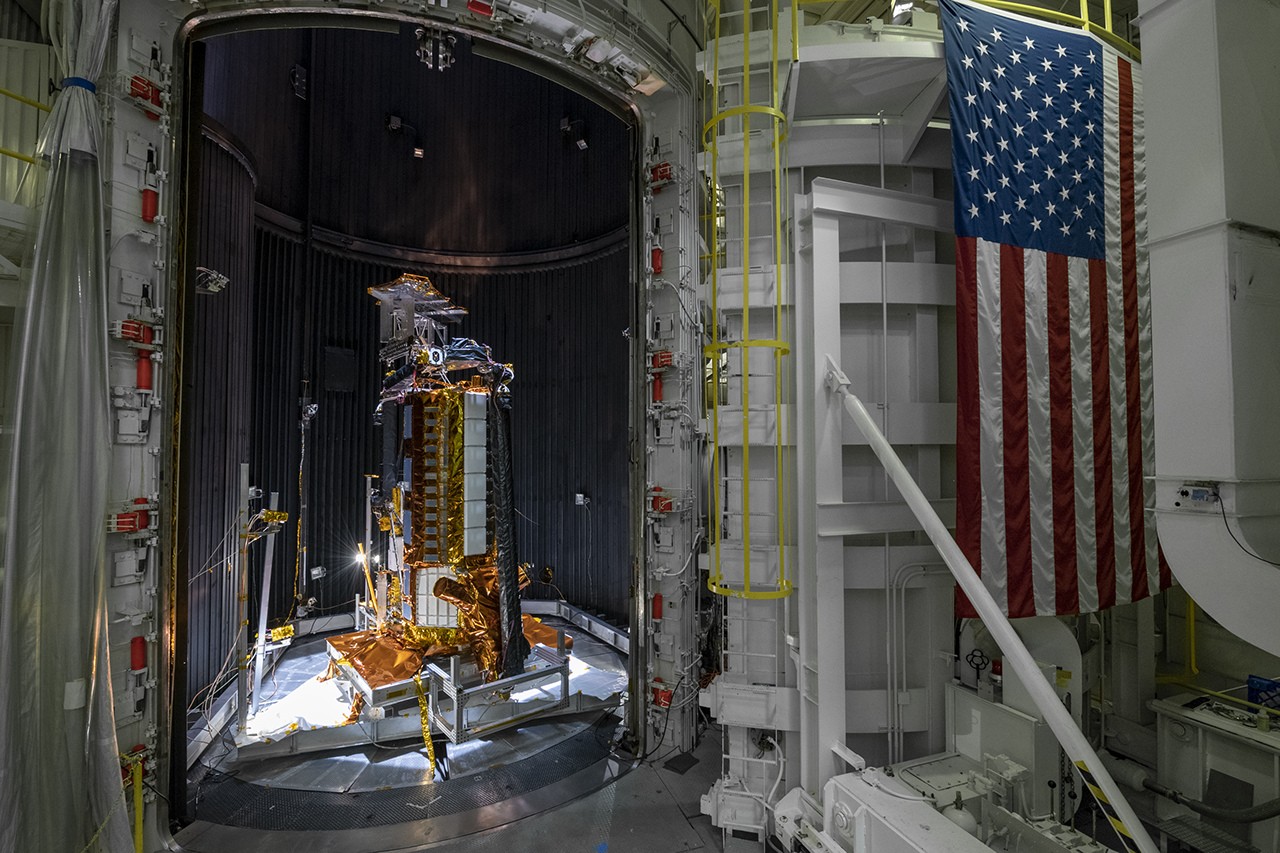
NISAR’s flight antenna appears in its stowed configuration during preflight thermal-vacuum testing documented in 2022. The image provides testing context for the deployment engineering discussed in the article.
Courtesy NASA/JPL-Caltech · Image source · NASA/JPL media reuse policy
In August 2026, NASA and the Indian Space Research Organisation marked a year since the launch of NISAR, their joint radar observatory. A July 2026 S-band data release had already described the spacecraft as operating in its science phase. Behind those usable data products is a remarkable mechanical transition: a reflector roughly 0.6 metres across when stowed expanded to approximately 12 metres after launch. It did not become a scientific instrument merely by opening. Its final shape, alignment and connection to two radar systems had to support repeatable observations of the ground below. NISAR makes a useful case study in a sometimes overlooked engineering challenge: building a large precision structure that must first behave like compact cargo, then transform itself without a technician standing nearby.
A large aperture begins as a packaging constraint
NISAR launched on July 30, 2025, and its reflector deployed on August 15. NASA’s deployment account describes a 64-kilogram structure opening over 37 minutes. Stored elastic energy first released a preliminary expansion; motors and cables then pulled the reflector into its working configuration and locked it. The sequence matters because an uncontrolled release is a different mechanical event from a controlled transition to a specified final geometry. A design must manage both the movement and the state left behind.
The ratio of deployed to stowed diameter is about twenty. This is a geometric comparison, not a claim that every part expanded equally or that the storage volume fell by twenty cubed. A mesh surface can fold while its support frame bends and its joints rotate. Launch restraints must carry vibration and acceleration without allowing damaging motion. Later, those restraints must release reliably. The mechanisms therefore solve almost opposing problems at different times: prevent movement during launch, permit movement during deployment, and prevent unwanted movement again during science operations.
The boom is part of the measurement system
The reflector sits at the end of a nine-metre boom. ISRO’s November 28, 2025 commissioning account records the staged deployment of its wrist, shoulder, elbow and root joints beginning August 9, before the reflector opened. That operational account is more useful for the actual sequence than a prelaunch document stating an intended schedule. It also reports that the antenna system performed satisfactorily after deployment.
A long boom does more than keep one component away from another. It establishes where the reflecting surface sits relative to the radar feeds and the spacecraft body. If an otherwise ideal reflector moves relative to a feed, the illumination and pointing can change. Small elastic motions also interact with spacecraft attitude control. The engineering concern is not that every micrometre of motion directly becomes a false ground displacement; processing and calibration are more complicated. It is that structural behavior must remain known well enough to preserve a stable instrument model.
Two radars share a mechanical reference
NASA supplies the L-band radar, while ISRO supplies the S-band radar and spacecraft bus. Both use the deployed reflector. NASA’s observatory description identifies separate radar instruments sharing this final radiating structure. That architecture couples payload engineering across electrical, mechanical and operational boundaries. A component can meet its own specification and still fail to satisfy the assembled system if the interface assumptions are inconsistent.
Consider the difference between mechanical fit and functional compatibility. Two assemblies might bolt together correctly while disagreeing about where an antenna coordinate axis is defined. Electronics can accept the right connector while expecting a different timing relationship. Engineering teams address such risks through controlled interface definitions, alignment measurements and integrated tests. The shared reflector makes those interfaces especially consequential: it is a common physical reference for two independently contributed instruments, rather than an interchangeable piece of spacecraft furniture.
The spacecraft must support the instrument continuously
The JPL spacecraft press kit describes an ISRO-provided bus with power, thermal management, sensors and actuators. It lists star and Sun sensors, gyroscopes, reaction wheels and small thrusters among the attitude and orbit-control equipment. These are background architecture descriptions, not a new 2026 performance claim. They explain why successful antenna deployment depends on a functioning spacecraft around it.
Reaction wheels can rotate the body without expelling propellant, but they exchange angular momentum with the vehicle. A flexible appendage responds differently from a perfectly rigid block. Temperature changes can also alter structural dimensions, while electronic loads create heat that must be transported and radiated. The practical question is whether the coupled system stays within its measurement tolerances across operating conditions. A satellite is not an optical bench sitting in a temperature-controlled laboratory. Its power generation, pointing, heating and data collection must coexist on one moving structure.
A particularly useful design distinction is between a static offset and a changing one. A stable alignment error may be measurable and represented in calibration. An alignment that changes with temperature or maneuver history can be harder to characterize, especially if the available sensors observe the spacecraft body more directly than the remote reflector. This does not establish that NISAR experienced such an error. It explains why teams characterize the assembled structure and monitor instrument behavior after deployment. The desired result is not perfect rigidity under all conditions, but a sufficiently predictable relationship between the physical hardware and the mathematical model used to interpret its observations.
Calibration turns an opened instrument into usable data
ISRO reports that S-band imaging began on August 19, 2025. Its commissioning account describes corner reflectors and rainforest observations used to refine pointing and acquisition parameters. The July 24, 2026 release then describes continuing radiometric, geometric and polarimetric calibration. These terms address different questions: how strong a return is, where it belongs on the ground, and how different polarization channels relate. Deployment success is a prerequisite, while calibrated measurement is the continuing product.
A corner reflector is useful because its geometry gives a strong, well-characterized radar response. Distributed targets offer different information, allowing consistency to be examined across a larger scene. Neither type alone guarantees that every landscape is interpreted correctly. Ground conditions, viewing geometry and processing choices still matter. Calibration therefore resembles maintaining a measuring instrument’s traceability: known references help separate changes in the instrument from changes in what it observes. That distinction becomes essential when a mission is designed to compare observations taken at different times.
Data releases expose engineering maturity and remaining limits
The July 2026 release states that routine processing from observation Cycle 25, beginning July 8, was being distributed through ISRO’s Bhoonidhi system, with older observations to be reprocessed in phases. It also identifies residual banding and radio-frequency interference artifacts that users could encounter. These statements are valuable evidence of an operational data system, alongside a candid account of remaining processing limitations. They should not be turned into a claim that every mission product is equally mature.
Versioned processing is an engineering response to an unavoidable reality: knowledge improves after a spacecraft starts operating. A later calibration may improve old observations without changing the hardware that collected them. Analysts must therefore keep track of product versions when comparing data. Otherwise, an apparent environmental change could partly reflect a changed processing baseline. The reliable delivery of science involves recorders, downlinks, archives and software provenance as surely as it involves an antenna opening correctly.
A deployed structure earns its value through repeated use
The anniversary event described in ISRO’s August 17, 2026 release reviewed mission performance, data generation and scientific applications. It is evidence that the collaboration had moved beyond a one-time deployment demonstration. It is not a replacement for quantitative product validation, nor does a celebratory event establish the accuracy of every derived map. The stronger engineering story combines the documented mechanical event, the commissioning measurements and the later operational data releases.
For future deployable observatories, the transferable lesson is to define success across the whole chain. Release mechanisms must work, joints must reach their intended states, the reflector must support the radar model, the spacecraft must point and power the payload, and calibrated observations must reach users with understandable limitations. NISAR’s enormous opening movement is visually striking. Its quieter achievement is maintaining a usable measurement relationship after the movement has stopped, long enough for repeated observations to reveal changes on Earth.
Sources & further reading
Primary papers, project documentation, and research releases used in this article. Publication dates below refer to the sources themselves.
- NISAR Team Deploys Radar Antenna ReflectorNASA Jet Propulsion LaboratoryPublished Checked
- NISAR Mission enters Science PhaseISROPublished Checked
- About the NISAR SatelliteNASAChecked
- SpacecraftNASA Jet Propulsion LaboratoryChecked
- NISAR S-Band SAR Data Products ReleaseISROPublished Checked
- ISRO and NASA Celebrate One Successful Year of NISAR Mission on OrbitISROPublished Checked
FOLLOW THE QUESTION
Explore engineering