MATHEMATICS
Why Fisher information stops the homogeneous Landau equation blowing up
Fisher information connects collision geometry to global smoothness, while 2025 rough-data results show why assumptions still matter for the Landau equation.
Research checked
Newest cited publication
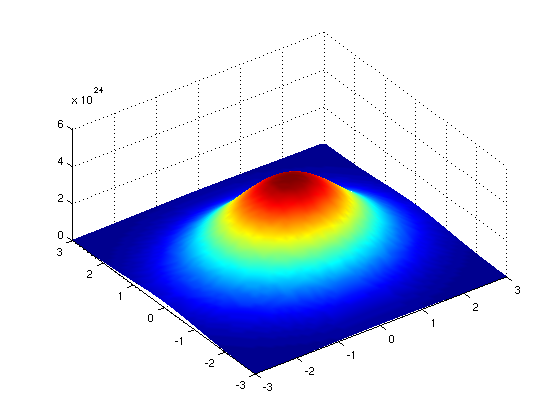
A two-dimensional Gaussian function illustrates a familiar smooth distribution, providing context for the article’s discussion of kinetic densities and information estimates.
Michael Hardy / Wikimedia Commons. Unchanged original image. · Image source · Public domain (released by the creator)

A collision equation can have a reassuring physical interpretation and still resist a proof that its solutions stay smooth. The spatially homogeneous Landau equation with Coulomb interactions was a striking example. Recent work changes that picture by finding a quantity that cannot increase: Fisher information. Nestor Guillen and Luis Silvestre’s theorem appeared in Acta Mathematica in 2025, and their explanation in the February 2026 Notices of the American Mathematical Society makes the geometric mechanism accessible. A separate May 2025 theorem addresses rougher initial distributions. Together these results show both the reach and the careful boundaries of modern kinetic regularity theory.
First remove space, but keep velocity
Spatial homogeneity means that the distribution depends on time and velocity but not on position. Collisions can redistribute velocities, yet there is no spatial transport term moving particles between locations. The resulting equation remains nonlinear and nonlocal: the diffusion experienced at one velocity depends on the distribution across velocity space. Coulomb interactions make this especially delicate because the interaction kernel is singular. Treating this model as an ordinary heat equation would overlook the dependence of its coefficients on the very solution whose regularity is being investigated.
Homogeneity is therefore a substantive assumption. Imagine a chamber divided into two regions with different temperature distributions. A spatially homogeneous model replaces that arrangement by one velocity distribution and cannot describe the interface between the regions. Even perfect knowledge of the homogeneous evolution does not control gradients generated by particles travelling across the interface. This is why the theorem should not be announced as a complete regularity theorem for the spatially inhomogeneous Landau equation. The simplification isolates collision dynamics, and the achievement is already considerable within that setting. The original global classical theorem starts with continuously differentiable initial data, a Gaussian upper tail and finite Fisher information. These conditions are another reason not to replace it with a claim about every weak solution of finite mass.
What Fisher information detects
For a positive density f, its Fisher information is the integral of the squared velocity gradient of f divided by f. Equivalently, it is four times the integral of the squared gradient of the square root of f. The latter identity follows by differentiating the square root: its gradient is the gradient of f divided by twice the square root of f. Unlike mass, this quantity can see how sharply a distribution changes. Narrow spikes carry a high gradient cost even when their total mass is small.
A one-dimensional normalized Gaussian gives a transparent calculation. If its variance is σ squared, the logarithmic derivative is minus v divided by σ squared. Averaging its square against the Gaussian gives Fisher information equal to one divided by σ squared. Halving the width therefore multiplies the information by four. In three independent Gaussian velocity coordinates with the same variance, the information becomes three divided by σ squared. This example is an independent calculation, not a Landau evolution solution; it explains why a bound on information can obstruct concentration that a mass bound alone would miss.
An anisotropic Gaussian makes the distinction sharper. If the three coordinate variances are a, b and c, the total information is one divided by a plus one divided by b plus one divided by c. Keeping the sum a plus b plus c fixed does not bound that expression: let a approach zero while adjusting the others. Total kinetic spread can remain controlled even as one coordinate becomes extremely narrow. Information detects precisely that hidden concentration.
The useful equation lives in more variables
Guillen and Silvestre prove that Fisher information is nonincreasing for a class of spatially homogeneous Landau interactions that includes Coulomb interactions. Their 2025 exposition explains a key construction: lift the problem to an auxiliary linear equation in twice as many velocity variables. For the Landau setting, the lifted collision dynamics can be understood through heat evolution on spheres. The larger equation is not an approximation replacing the nonlinear model. It is a mathematical device that preserves enough of the collision structure to establish the needed inequality.
The geometry can be motivated without reproducing the proof. For two velocities v and w, introduce their average and their difference. Elastic scattering preserves the average and the length of the difference, while changing its direction. Fixing those conserved quantities leaves an angular motion on a sphere. That explains why spherical diffusion is a natural object rather than an unrelated trick. Linearizing the bookkeeping in a larger space can expose a sign that is hard to see after projecting everything back to a single nonlinear velocity distribution.
Global smoothness and a rough starting distribution
William Golding, Maria Gualdani and Amélie Loher’s paper, published May 12, 2025, develops smoothing at the weighted L to the three-halves threshold. Its global theorem requires more than membership in an unweighted function space: polynomial integrability, a sufficiently high finite moment and a compatible positive polynomial lower tail are part of the hypotheses. It constructs smooth solutions for positive times and uses newly finite Fisher information to continue them. The paper establishes uniqueness above the three-halves threshold in a specified comparison class; the endpoint needs separate care.
There is a useful logical pattern here. A local theorem can turn a rough input into a smoother state after a short waiting time. A different theorem can then take that smoother state as its initial condition and continue it globally. The handoff needs an overlap of hypotheses, just as two sections of a bridge need a genuine joint. Knowing merely that the first solution is smooth is insufficient if the second theorem also needs tail bounds, positivity or information control. The paper’s work at this handoff is part of the result, not a technicality that can be removed from its statement.
The information method also reaches Boltzmann theory
A related paper by Cyril Imbert, Luis Silvestre and Cédric Villani, listed by Silvestre as published in Inventiones Mathematicae in 2026, proves Fisher-information monotonicity for a broad class of spatially homogeneous Boltzmann collision kernels. It links a sufficient monotonicity condition to an inequality on the sphere and obtains global smooth solutions in an important very-soft-potential regime. This is a distinct collision operator and a distinct theorem. The shared quantity suggests a structural connection between information inequalities and collision geometry, rather than a single statement that covers every kinetic equation.
Monotonicity should also be distinguished from conservation. Conserved mass stays constant; decreasing information can progressively discard the sharp features of an initial distribution. An inequality of the form information at time t is no larger than information at time zero is powerful precisely because it is stable under many approximation arguments. But it does not specify an exponential rate of approach to equilibrium, nor does it automatically identify the limiting profile. Those conclusions require additional estimates. A bound that prevents disaster and a rate that predicts relaxation solve different problems.
The next questions have precise shapes
The critical-data paper explicitly separates its results from a theory using only mass, energy and entropy for very rough data. It also distinguishes existence from uniqueness. A statement that at least one smooth positive-time solution exists does not establish that every weak solution with the same initial data coincides with it. Weak formulations deliberately permit less regularity, which makes compactness arguments possible but can remove the estimates used in a uniqueness proof. Reading the solution class is as necessary as reading the equation.
The broader research opportunity is to identify when collision geometry controls concentration despite nonlinear coefficients. The homogeneous theorem supplies a decisive example; the rough-data extension tests how much information must already be present at the start. Spatial transport, boundaries and weaker tails introduce genuinely different obstacles. For a reader following the latest work, the productive checklist is mathematical: which variables are present, which norm is controlled, when the control begins, and among which solutions uniqueness holds. Those distinctions explain why the new results are powerful without making them say more than they prove.
Sources & further reading
Primary papers, project documentation, and research releases used in this article. Publication dates below refer to the sources themselves.
- The Landau equation does not blow uparXivPublished Checked
- The Landau equation and Fisher informationarXivPublished Checked
- Global Smooth Solutions to the Landau–Coulomb Equation in L^{3/2}Archive for Rational Mechanics and AnalysisPublished Checked
- On the monotonicity of the Fisher information for the Boltzmann equationarXivPublished Checked
FOLLOW THE QUESTION
Explore mathematics