ARTIFICIAL INTELLIGENCE
GPT-3 in 2020: learning a task from the prompt
GPT-3 made examples in a prompt a serious adaptation method. Its 2020 results clarify the difference between contextual learning, fine-tuning, and general competence.
Research checked
Newest cited publication
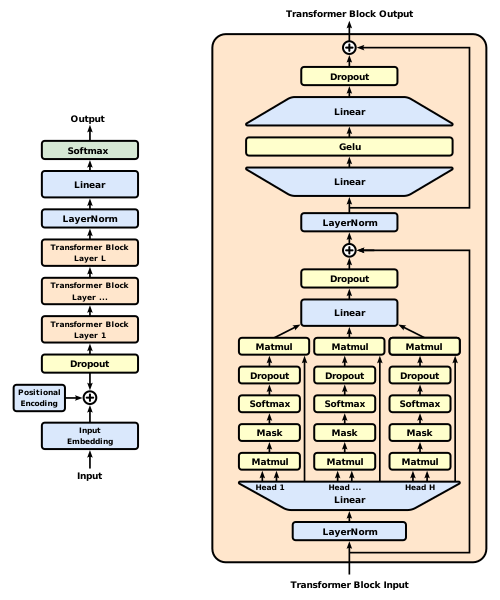
A general GPT architecture diagram supplies context for decoder-only language modeling. GPT-3’s few-shot experiments concern the prompts, model scale, and evaluations described in the article.
Marxav; vectorization by Mrmw · Image source · CC0 1.0

What changes when a model sees a few examples of a task? In the GPT-3 experiments first released on May 28, 2020, the examples changed the text supplied to the model rather than its trained parameters. This distinction helped make a large language model a flexible experimental interface: demonstrations and a new input could be written in one sequence, followed by a continuation. The landmark was an empirical expansion of what that interface could accomplish. It was not proof that a handful of examples could teach any unfamiliar skill, nor that the model's extensive earlier training had become irrelevant.
The earlier route changed the parameters
The original generative pre-training paper by Radford and colleagues used a broad language-model training stage followed by supervised adaptation for particular tasks. It sought to transfer representations learned from unlabeled text while keeping architectural changes modest. This made pretraining a reusable starting point, but the subsequent task-specific optimization still changed model parameters. The important contrast with prompt-based adaptation concerns where the new task information enters the system.
Imagine an illustrative document classifier. One approach collects labeled examples, updates the model using them, and saves a new checkpoint. Another supplies a few labeled documents inside the current input and asks for the next label. The second approach can change the answer without saving a new parameter setting. That does not make it free: the examples occupy input space and must be processed. Conversely, a fine-tuned checkpoint may spread its adaptation cost over many later requests. Choosing between them is partly a question about the workload, rather than an automatic ranking of intelligence.
Many tasks can be written as continuation
The GPT-2 research report explored performing tasks by conditioning a language model on text without task-specific parameter changes. It framed language modeling as a potential route to multitask behavior. This supplied important context for GPT-3: the idea of presenting a task through language did not suddenly appear with the largest 2020 model. GPT-3 investigated it more systematically with demonstrations and substantially larger models.
The underlying probability calculation is simple enough to work through. Suppose a hypothetical three-token continuation receives conditional probabilities 0.5, 0.25, and 0.8, each evaluated given the relevant preceding text. The sequence probability is their product, 0.1. This calculation does not assume the tokens are independent; conditioning is precisely what carries the dependence. A model can assign a high probability to a familiar false statement if its context makes that statement likely. Predicting a continuation and verifying its truth are different objectives, even when good prediction helps with many useful tasks.
A prompt can demonstrate an operation
In a prompt, write 'taro → orat' and 'nims → smin', then leave 'lume →' unfinished. Reversing the letters suggests the continuation 'emul'. The completed demonstrations communicate an input-output convention without a separate classifier or an explicit programming-language instruction. They can also communicate formatting details, such as whether to include punctuation or explanations. Whether a particular model follows that convention has to be measured; writing a clear pattern does not guarantee that the model will use it correctly.
The examples still leave ambiguity. A lookup table could reproduce both demonstrations while assigning any output to the third input. Many more complicated rules fit the same finite evidence. Successful generalization therefore depends on preferences already shaped during training, as well as information in the prompt. A stronger test would hold out unfamiliar lengths, unusual character patterns, and changed formatting. It would compare correct demonstrations with contradictory or irrelevant ones. Those interventions help distinguish responding to a demonstrated relation from simply continuing a familiar visual pattern.
Frozen weights do not mean an unchanged computation
The largest GPT-3 model in the 2020 paper had 175 billion parameters. Its zero-shot, one-shot, and few-shot evaluations supplied different amounts of task information without gradient updates for the evaluated task. The authors reported strong results on a range of language benchmarks, alongside substantial weaknesses. The evidence concerns the measured model and evaluation procedure, rather than an assurance that every prompt-defined task becomes solvable at that scale.
A fixed mathematical function can behave differently on different inputs. A calculator's multiplication rule need not change when its operands change. Likewise, a language model's internal activations depend on the examples and question it currently receives, even when its weights remain fixed. Calling this contextual learning describes a useful behavioral phenomenon; it does not settle whether the model constructed a novel algorithm, recognized a familiar task, or combined previously learned operations. Those possibilities require experiments that vary the task's relationship to earlier experience.
Few-shot is a data condition, not one algorithm
Schick and Schütze's September 15, 2020 preprint studied strong few-example performance with much smaller language models. Their method reformulated tasks using textual patterns, used gradient-based training, and could exploit unlabeled data. It challenged a simplistic equation between model size and useful low-data performance. Its setup differs from GPT-3's frozen-parameter prompting, so similar benchmark scores do not imply that the two systems learned in the same way or consumed identical resources.
Suppose two hypothetical systems each receive thirty-two labeled examples. If one may train on those examples and process a large unlabeled collection while the other only places the examples in a prompt, their supervision counts match but their adaptation budgets do not. Neither comparison is inherently unfair if the rules are explicit. A useful report separates labeled data, unlabeled data, optimization work, parameter storage, and inference cost. It should also say whether the task is reused thousands of times or changes with every request, since that affects which costs can be amortized.
Input space creates another cost. In a hypothetical two-thousand-token allowance, thirty-two examples averaging forty tokens occupy 1,280 tokens. Reserving two hundred tokens for the question and one hundred for the answer leaves 420 for instructions and separators. Different tokenization or longer examples can change which demonstrations fit. A fixed example count therefore does not imply a fixed context cost, and a demonstration that consumes more space must justify the room it takes from other evidence.
Task performance depends on how it is measured
A few examples are not a complete evaluation protocol. Their order, label vocabulary, separators, and relationship to the test query can all change the input. Consider a hypothetical sentiment task where positive examples use long reviews and negative examples use short ones. An apparent improvement could come from an accidental length cue. Balanced examples and counterexamples would reveal whether the intended distinction survives. The aim is to make a shortcut fail while preserving the intended relation between input and answer.
The original GPT-3 study also examined potential overlap between web-scale training material and benchmark examples. That historical concern identifies a general measurement problem: performing well on a public question does not reveal whether the exact question, a close relative, or only relevant background appeared earlier. An independent audit would preserve the training provenance where available, examine overlap, and add newly constructed cases. Novel wording alone is insufficient if it preserves an easy template. Conversely, overlap in a generic phrase does not prove memorization of the correct answer.
The lasting result was an adaptation question
The 2020 result made the prompt itself a serious object of study. A model could be evaluated on several tasks through one continuation interface, with demonstrations supplied as part of the current context. That creates useful flexibility, but it also moves some design choices from model training into task presentation. A clear historical reading therefore treats the reported outcome as evidence for a powerful adaptation route, while leaving general competence and the mechanism of adaptation as separate questions.
For a small reproducible demonstration today, one could compare an instruction alone, one correct example, several varied examples, and misleading examples on the same untouched test set. Report individual failures and formatting errors alongside average accuracy. Keep parameter updates separate from changes to the context. These suggested checks preserve the central lesson without inventing a later breakthrough: learning from a prompt is a measurable change in behavior, made possible by extensive prior training and constrained by the evidence the prompt actually contains. Its value becomes clearer when those ingredients remain visible.
Sources & further reading
Primary papers, project documentation, and research releases used in this article. Publication dates below refer to the sources themselves.
- Language Models are Few-Shot LearnersBrown and colleagues / arXivPublished Checked
- Improving Language Understanding by Generative Pre-TrainingRadford and colleagues / OpenAIChecked
- Language Models are Unsupervised Multitask LearnersRadford and colleagues / OpenAIChecked
- It's Not Just Size That Matters: Small Language Models Are Also Few-Shot LearnersSchick and Schütze / arXivPublished Checked
FOLLOW THE QUESTION
Study engineering foundations