MATHEMATICS
Gödel’s 1931 Boundary: What Arithmetic Cannot Prove About Itself
How Gödel encoded proofs in arithmetic, why his original theorem used omega-consistency, and what Rosser and Löb clarified about formal mathematical reasoning.
Research checked
Newest cited publication
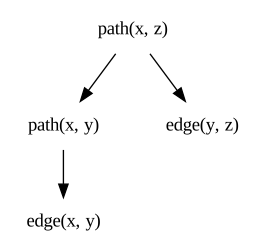
A simple Datalog proof tree illustrates how a formal conclusion depends on premises. Gödel’s incompleteness argument concerns the stronger arithmetic theories and proof encodings explained in the article.
Siddharthist / Wikimedia Commons. Adapted by GreatItself: corrected the transitive-closure premise to edge(y,z). · Image source · CC BY-SA 4.0

A proof normally turns an unanswered question into a settled one. Gödel’s 1931 paper turned proof itself into a mathematical object and asked which questions a specified collection of axioms could settle. His answer required carefully stated assumptions: enough arithmetic, effectively specified axioms, and an appropriate consistency condition. The result does not declare every question unanswerable. It shows why a single consistent, effectively axiomatized theory containing sufficient arithmetic cannot settle every arithmetical sentence. Understanding that boundary means separating Gödel’s original argument from later improvements, and separating statements about formal proofs from much broader claims about knowledge.
The system has to be specified
Imagine a rulebook containing axioms and permitted inference steps. A formal proof is a finite record showing how a conclusion follows from those rules. Consistency means that the rulebook does not prove a sentence together with its negation. Completeness, in the sense relevant here, means that every sentence in its language can be either proved or refuted. These properties concern the chosen rulebook; changing the axioms changes which statements it proves.
The effectiveness assumption matters just as much. Axioms must be mechanically enumerable, rather than selected by an inaccessible oracle. For a decidable axiom set, checking whether a proposed line is an axiom is straightforward in principle. With merely enumerable axioms, a finite proof certificate can include evidence of their appearance in the enumeration. Sufficient arithmetic supplies the means to express this finite bookkeeping inside the theory. A weak language that cannot represent the required computations does not automatically inherit the conclusion.
Making a proof into an arithmetical object
The surprising bridge is that symbols and finite sequences can be assigned numbers. Consider a toy encoding of a three-symbol sequence: encode the symbol values 1, 0, 2 by the product 2² × 3¹ × 5³ = 1500, adding one to each value before using it as an exponent. Factoring 1500 recovers exponents 2, 1, 3, and subtracting one recovers the sequence. This illustrates recoverability; a complete encoding must also handle arbitrary lengths and all the syntax of the formal language.
Once formulas and proofs have codes, checking a proposed proof becomes an arithmetical relation between numbers. A statement that a sentence has a proof can then quantify over possible proof codes. Notice the difference between checking one certificate and finding whether any certificate exists. Trying every number eventually discovers a proof when one exists. When none exists, the search offers no finishing signal. Encoding does not itself solve that unbounded search problem.
The numerical size of an encoding is incidental to the logical argument. A short string might receive an enormous code, and a proof checker might be impractically slow. What matters here is that the translation and verification have finite, specified procedures. Replacing the toy prime-power scheme with a more compact coding changes the bookkeeping while preserving that connection between finite syntax and arithmetic.
Self-reference without a liar paradox
Gödel arranged the encoding so that an arithmetical sentence, call it G, expresses its own unprovability in the specified theory T. The construction concerns substitution of numerical codes into formulas. It does not introduce an unrestricted truth predicate into the language. That distinction keeps the argument away from the familiar contradiction produced by a sentence declaring itself false.
Suppose T proved G. Because the proof is a finite object, its code would provide the arithmetic evidence that G is provable. But G asserts that no such proof exists. With the usual representability properties, consistency rules out that situation. Thus G cannot be proved in T if T is consistent. From outside the system, using the intended natural-number interpretation of the proof predicate, we can recognize that this particular assertion of unprovability is true. That observation does not say that every axiom of every consistent theory is true in the natural numbers.
Why the original hypothesis needs its Greek letter
The other half of independence needs care. Gödel’s original 1931 theorem used omega-consistency to exclude a proof of the negation of G. Roughly, omega-consistency forbids a theory from proving that some natural number has a property while also proving, separately for every standard numeral, that it does not have that property. Ordinary consistency only forbids a contradiction with a single finite proof. It does not by itself prohibit that infinite collection of individually compatible assertions.
This distinction matters because the negation of G asserts the existence of a proof, even while each actual proposed proof can be checked and rejected. Calling Gödel’s original statement independent under plain consistency would erase an assumption used in his argument. Rosser’s 1936 paper strengthened the result: for appropriate effectively axiomatized theories with sufficient arithmetic, simple consistency is enough to obtain a sentence that is neither provable nor refutable. The resulting sentence and argument are modified; the stronger conclusion should not be silently attributed to the unchanged original construction.
Which consistency statement cannot be proved?
Gödel’s second incompleteness theorem addresses a different sentence: the formal assertion that T has no proof of a contradiction, conventionally written Con(T). A safe standard setting is a consistent, effectively axiomatized extension of Peano arithmetic, equipped with its usual arithmetized proof predicate. In that setting, T cannot prove Con(T). The strength and the way provability is represented are part of the claim. An arbitrary formula informally advertised as consistency does not receive the same conclusion automatically.
Löb’s 1955 theorem makes the dependence on formal provability especially visible. Under the standard derivability conditions, if T proves that provability of a sentence implies that sentence, then T already proves the sentence. Apply this to a contradiction: the implication from its provability to the contradiction expresses Con(T). If T proved that implication, Löb’s theorem would make T prove the contradiction. A consistent T therefore cannot supply that internal guarantee. This is a mathematical restriction on a precise proof predicate, not a ban on all external consistency arguments.
For example, a stronger theory S might prove Con(T) using assumptions unavailable in T. A reader then has to examine those additional assumptions and the translation of T’s proofs into S. The second theorem does not render that work meaningless; it identifies why the stronger argument is not a certificate produced entirely from T’s own resources. Asking which assumptions justify a consistency proof is more informative than asking whether consistency can ever be discussed.
Adding an axiom moves the boundary
An independent sentence can be added as a new axiom when the resulting extension is consistent. This changes the theory; it does not refute incompleteness. If the enlarged rulebook remains effective and sufficiently expressive, the theorem applies again, with a new sentence about its proofs. There is no contradiction in settling yesterday’s independent statement while acquiring another boundary today.
Alternatively, take all arithmetical sentences true in the standard natural numbers as axioms. That collection settles each arithmetical sentence, but it abandons effective enumerability. The comparison identifies exactly what the theorem constrains. Arithmetic, effective axiomatization, consistency, and completeness cannot all be secured in the stated setting. Mathematicians can still prove particular results, compare theories, and justify stronger assumptions. What fails is the promise that one mechanically specified, consistent arithmetic rulebook will finish the entire task.
Nor does independence identify which new axiom should be accepted. Two consistent extensions can settle a formerly independent sentence in opposite directions. Questions about their intended interpretation, explanatory usefulness, and other consequences remain. The incompleteness theorem establishes the existence of a limitation; choosing an appropriate response requires examining the particular theories and mathematical aims involved.
Sources & further reading
Primary papers, project documentation, and research releases used in this article. Publication dates below refer to the sources themselves.
- Über formal unentscheidbare Sätze der Principia Mathematica und verwandter Systeme IMonatshefte für Mathematik und Physik; original paper hosted by Wilhelm K. EsslerPublished Checked
- On Formally Undecidable Propositions of Principia Mathematica and Related SystemsKurt Gödel, translated by B. Meltzer; university-hosted copyChecked
- Extensions of some theorems of Gödel and ChurchThe Journal of Symbolic Logic, Cambridge University PressPublished Checked
- Solution of a Problem of Leon HenkinThe Journal of Symbolic Logic; original paper hosted by the University of MarylandPublished Checked
FOLLOW THE QUESTION
Explore mathematics