MATHEMATICS
Dense sum-product growth reaches an optimal constant
A 2026 preprint studies the sharp tradeoff between addition and multiplication in dense prime fields, where the answer becomes a question of occupied space.
Research checked
Newest cited publication
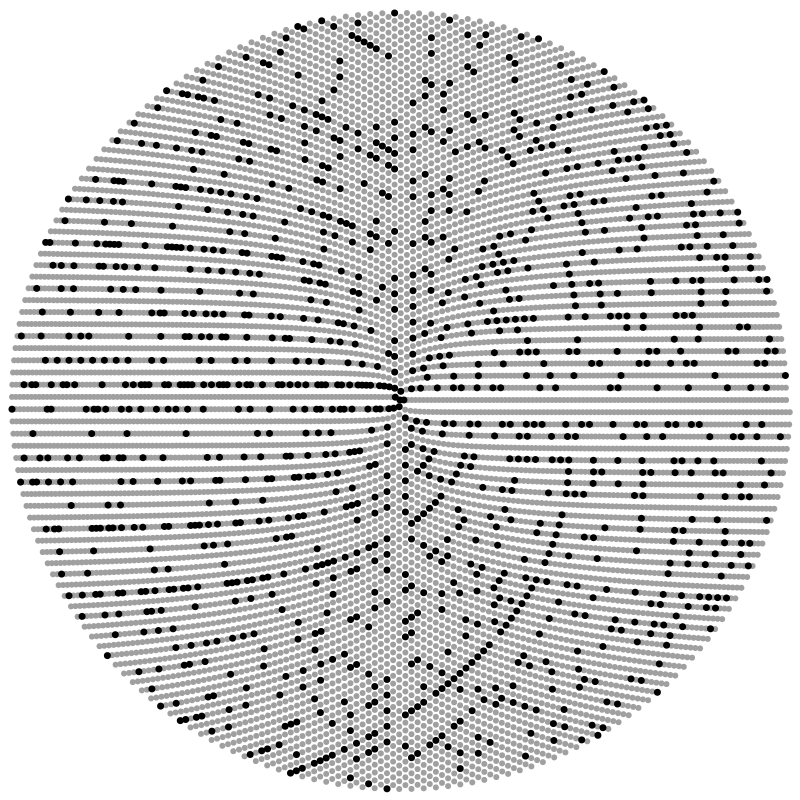
A Sacks spiral arranges integers and highlights primes. It provides number-theory context while the article studies how addition and multiplication expand finite sets.
Claudio Rocchini / Wikimedia Commons. Unchanged original image. · Image source · CC BY 2.5

Take a collection of residues, add every pair, and then multiply every pair. Either operation can generate surprisingly few outputs when the collection has the right structure. Making both operations stay confined is much harder. Xuancheng Shao's paper, initially submitted on 18 April 2026 and revised on 12 October with acceptance in Mathematika recorded, investigates the sharp form of this tension for sets occupying a fixed proportion of a field with prime order. Its interest lies in the change of question: once there is little room left for growth, an unspecified expansion factor stops being a satisfying answer. The meaningful quantity is the smallest fraction of the entire field that one of the two operations must reach.
Two operations measure different kinds of structure
Work modulo a prime p, so that all arithmetic returns one of the residues from zero through p minus one. For a set A, the sumset A+A contains its distinct pairwise sums; the product set contains its distinct pairwise products. Repeated outputs count once. For an elementary example modulo seven, let A be {1,2,3}. The sums are {2,3,4,5,6}, whereas the products are {1,2,3,4,6}. Both output sets have five elements despite nine ordered input pairs. This is a direct calculation, not a sample used in the 2026 proof.
The collisions themselves reveal structure. In an interval of ordinary integers, many pairs have the same sum because shifting one input upward and the other downward preserves their total. In a geometric progression, changing the two exponents while preserving their sum preserves the product. These are different organizing principles. A set that resembles an interval does not automatically resemble a multiplicative subgroup. Prime fields make this tension particularly clean because they contain no proper subfields that could remain closed under both operations. That last restriction matters when one tries to generalize the discussion.
Why a fixed density changes the question
The foundational work of Jean Bourgain, Nets Katz and Terence Tao, first posted in January 2003, established genuine power growth in prime fields when the set size stays between suitable powers of the field size. The exponent and constants depend on the separation from the very sparse and very dense extremes. This is a major structural statement, but it is not an exact dense-regime answer. A bound useful for a set of size p to a small power can become inappropriate near size p because no output set can contain more than p residues.
To see the obstruction without any advanced estimate, imagine a set with one tenth of the field. Multiplying its size by an increasingly large power gain cannot remain valid indefinitely: the field has a fixed capacity. At this scale, normalize output size by p rather than by the input size alone. The result is a number between zero and one. A sharp theorem should identify the worst possible normalized output among every admissible input set, while also exhibiting examples approaching that worst case. Upper and lower bounds then perform different jobs: one constructs resistance to growth, while the other rules out anything more resistant.
What the October revision reports
Shao reports an optimal asymptotic constant for every fixed positive input density in prime fields. The paper gives a piecewise description of that constant and obtains near-saturation once the input density reaches one quarter. Its argument uses a regularity statement in finite abelian groups to identify robust structure in sumsets. The October revision is marked accepted for publication in Mathematika; the result is asymptotic, rather than a claim that every finite field example attains the limiting value exactly. The limit concerns growing prime field sizes with density held fixed.
Consider the reported constant at density one tenth as a worked interpretation. The relevant competing expressions give a value of one half: the integer choice two balances an additive contribution of four tenths against a multiplicative contribution of one half. Nearby integer choices do worse. This calculation interprets the paper's stated dense-regime answer; it does not estimate its finite-size error. Saying that an output occupies approximately half a sufficiently large field is very different from promising exactly half of a particular small field. The vanishing error and the meaning of sufficiently large remain essential.
A saturation argument that can be checked by hand
There is a useful elementary benchmark above density one half. Fix any target residue t. The set A and the reflected translate t−A have the same size. If each has more than p divided by two elements, they cannot be disjoint. An element a in their intersection equals t−b for some b in A, so t=a+b. Because the target was arbitrary, A+A is the entire field. This proof does not use multiplication and does not need an asymptotic limit. It supplies a simple threshold against which stronger dense results can be compared.
The one-quarter phenomenon reported in the preprint asks for something subtler: below the elementary one-half threshold, an individual operation may leave many holes, but addition and multiplication cannot both do so in the worst compatible way. The logical word either is doing real work. A large sumset does not force a large product set by definition. Conversely, a large product set does not identify which sums are represented. Thinking about two different output maps prevents the common mistake of treating the theorem as a statement that every residue has both kinds of representation.
Why collisions connect this problem to character sums
A related paper by Ali Alsetri and Shao, first submitted in September 2025 and revised on 5 January 2026, studies Burgess-type character estimates on proper generalized arithmetic progressions of rank two. Its proof uses multiplicative energy bounds and geometry-of-numbers tools. A rank-two progression is generated by two independent integer parameters, with properness excluding collisions in the parameterization over the specified ranges. This separate result illustrates why additive structure must be quantified before one can understand cancellation under a multiplicative test. It is background, not an intermediate theorem claimed as part of the April result.
Energy can be understood directly as a collision count. Given four elements a,b,c,d, ask how often ab=cd. A product taking only a few possible values must receive many repeated representations. If r(t) counts ordered input pairs with product t, then the sum of r(t) is the square of the set size. Cauchy–Schwarz bounds the sum of r(t) squared below by the fourth power of the set size divided by the number of available products. Thus a small product set forces large multiplicative energy. This elementary implication explains why counting coincidences can be more informative than listing outputs.
What sharpness clarifies, and what remains separate
Sharp asymptotic information answers an extremal question, not an algorithmic one. Given a particular collection of residues, enumerating all ordered sums and products costs a quadratic number of elementary operations by the most direct method. A theorem can certify that a large output must exist without telling a program the cheapest way to construct it. Similarly, the limiting constant does not classify every nearly optimal input. Such a classification would need a stability statement explaining whether examples close to the bound must also resemble a particular structural template.
The most useful next checks are therefore mathematical rather than promotional. One can ask for effective errors at specified prime sizes, for a description of near-extremizers, or for a controlled transition when density decreases with p. Those questions change the order of quantifiers and cannot be answered merely by substituting a shrinking density into a fixed-density limit. The April development is compelling because it supplies a precise target for these questions. It replaces the broad expectation of arithmetic expansion with a carefully scoped statement about how much finite space the two operations are forced to occupy.
Sources & further reading
Primary papers, project documentation, and research releases used in this article. Publication dates below refer to the sources themselves.
- The sum-product phenomenon for dense subsets of finite fieldsarXivPublished Checked
- A sum-product estimate in finite fields, and applicationsarXivPublished Checked
- Burgess-type character sum estimates over generalized arithmetic progressions of rank 2arXivPublished Checked
FOLLOW THE QUESTION
Explore mathematics