ENGINEERING
CRISPR in 2012: when a bacterial defense became programmable scissors
What the 2012 Cas9 experiments proved, why the two-RNA and single-guide designs mattered, and how genome editing in cells became a separate 2013 milestone.
Research checked
Newest cited publication
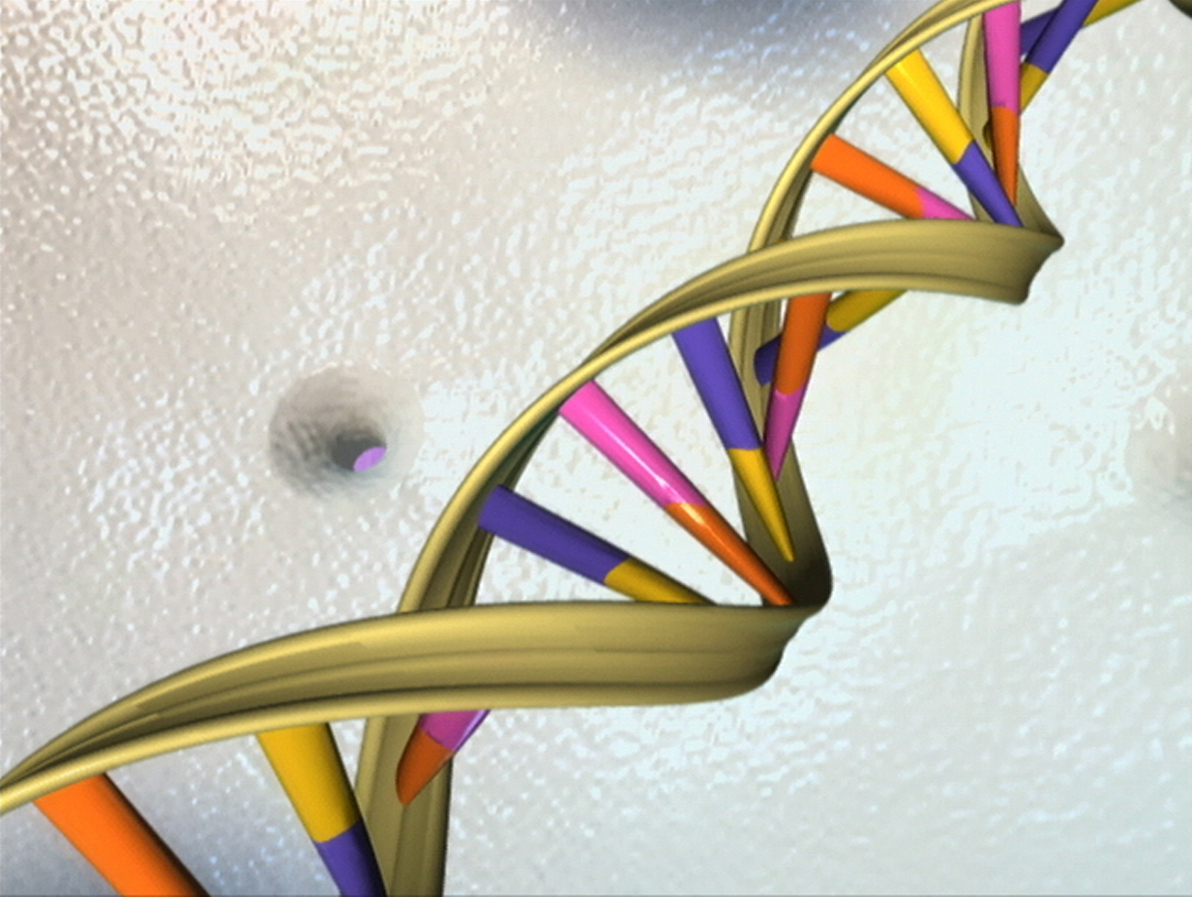
A DNA double-helix illustration introduces the molecular substrate of genome editing. The article explains how guide RNA and Cas9 turn a sequence-recognition mechanism into a programmable editing tool.
National Human Genome Research Institute, NIH · Image source · Public domain

The phrase gene editing compresses several operations into two words. A molecular machine must recognize a location, act there, and leave a cell with a particular lasting change. The 2012 CRISPR-Cas9 landmark clarified a powerful way to perform the recognition and cutting operations. It did not demonstrate that every desired genomic rewrite would automatically follow. Reading the original papers reveals a more interesting achievement: a bacterial defense mechanism became a component that researchers could retarget through RNA, with a clear distinction between a controlled biochemical experiment and the subsequent engineering of a tool for living cells.
A biological defense supplied an address system
CRISPR stands for clustered regularly interspaced short palindromic repeats. In the systems examined by these papers, sequences retained in a microbial CRISPR array give rise to short CRISPR RNAs, or crRNAs. Those RNAs help identify complementary sequences in invading genetic material. Cas denotes CRISPR-associated proteins. The important engineering opportunity was the division between a reusable protein machine and a variable RNA component carrying information about the target.
Deltcheva and colleagues’ 2011 Nature paper identified another essential RNA in the bacterial system they studied: trans-activating CRISPR RNA, or tracrRNA. It pairs with repeat-derived RNA and participates, with a host enzyme and the protein then called Csn1, in producing mature guide RNAs. Csn1 became known as Cas9. This work established that the targeting RNA did not operate as an isolated address label. It belonged to a structured molecular partnership.
The 2012 experiment separated recognition from speculation
Jinek, Chylinski, Fonfara, Hauer, Doudna and Charpentier reported their Science result online in June 2012. Using purified components and DNA substrates, they showed that Cas9 could make sequence-directed double-strand breaks when supplied with the appropriate crRNA and tracrRNA. The two RNAs formed a working structure together. Changing the targeting information in the guide could redirect cleavage. The demonstrated capability was programmable DNA cutting in vitro, meaning outside a living cell.
That boundary matters. A test tube allows researchers to ask whether a defined molecular assembly can perform the reaction. A chromosome adds packaging, cellular compartments, competing processes and repair. Proving the simpler operation makes the larger application plausible and gives it a rational starting point. It does not supply missing evidence for the larger application. The careful historical description is therefore more precise than saying that the complete practice of genome editing appeared in one experiment.
A complementary sequence was necessary but insufficient
Cas9 contains two nuclease domains, HNH and RuvC-like, associated with cleavage of the two opposite DNA strands. Targeting also depends on a nearby protospacer-adjacent motif, abbreviated PAM. The RNA supplies one part of recognition, while the protein’s requirements supply another. This combination explains why specifying a matching sequence alone does not make every position in DNA equally available to a particular Cas9 system.
Independent 2012 work by Gasiunas, Barrangou, Horvath and Siksnys characterized a Cas9 complex from a different bacterial system and demonstrated sequence-directed DNA cleavage and distinct catalytic activities on the two strands. Their experiments also supported the dependence on an appropriate neighboring motif. Different systems can have different PAM requirements; a motif described for one should not silently become a universal CRISPR rule. The parallel work strengthens the mechanistic history while keeping the experimental systems distinct.
The single guide was an engineered simplification
The Jinek paper also joined features of the crRNA and tracrRNA into a chimeric RNA that could direct Cas9 cleavage. This is the basis of the single-guide concept: preserve the targeting information and the structural functions in one RNA construct. It should not be confused with claiming that the native bacterial system already consisted of one interchangeable RNA or that tracrRNA had become biologically unnecessary.
A useful analogy is combining two connected adapters into one manufactured part. The combined part still has to provide both interfaces. Making assembly simpler does not permit one interface to disappear. Cong and colleagues’ subsequent cell experiments reinforce that point: not every chimeric design they examined performed equally well. Molecular architecture, expression and context remained engineering questions after the conceptual simplification. The opportunity was easier retargeting, accompanied by a continuing need to establish whether a chosen implementation actually worked.
Genome editing in cells was the next demonstration
In papers published online in January 2013, Cong and colleagues and Mali and colleagues demonstrated RNA-directed genome engineering in mammalian cells. Cong and colleagues examined endogenous locations in human and mouse cells and demonstrated editing at multiple sites. Mali and colleagues showed RNA-guided changes in human cells, including work at an endogenous locus and experiments involving repair templates. These were cellular demonstrations, distinct from the earlier purified biochemical result.
The distinction also identifies different kinds of success. A detected DNA break establishes cleavage; sequencing a persistent change establishes a genomic outcome. A fluorescent reporter can indicate restoration of a designed function, but its meaning depends on the reporter and controls. None of these measurements, alone, establishes that every cell received the same change or that the approach is appropriate for an individual patient. This account concerns the engineering and evidence behind the historical tools.
The cell decides much of what follows a cut
A double-strand break engages cellular repair. End joining can reconnect DNA and may produce insertions or deletions. Repair using a homologous template can instead incorporate supplied sequence information. Both 2013 studies explored consequences of these repair processes. The nuclease establishes a targeted opportunity for change; it does not itself write an arbitrary replacement passage into the chromosome with guaranteed fidelity.
Consider a hypothetical assay of one hundred independent cells in which twenty contain some detectable change at the intended location. That result would be a twenty-percent modification fraction under the assay’s definition. It would not establish twenty precise replacements. Some outcomes might be small deletions, others insertions, and others a desired template-based change. This invented arithmetic is deliberately simple: naming the denominator and classifying outcomes are necessary before interpreting an efficiency percentage. Different measurements can answer different questions without contradicting each other.
Specificity needed measurement beyond the intended site
The early studies examined sequence dependence, including mismatch effects, while also recognizing that unintended cleavage required further investigation. A genome can contain similar sequences, and cellular accessibility can differ between locations. Demonstrating discrimination in a set of tested substrates is valuable evidence about recognition. It is not an exhaustive survey of every potentially altered location or every possible cellular consequence.
An engineering evaluation should therefore distinguish targeted activity, unintended activity and the eventual distribution of repair outcomes. Imagine a detector tested against ten obvious nonmatches. Passing that test would not establish its behavior against a million closely related inputs. The appropriate next test depends on the claim being made. For genome engineering, confidence requires measurements suited to the relevant scale and use, rather than a universal adjective such as precise replacing a definition of what was checked.
An editable address changed the engineering problem
The lasting significance of the 2012 result was a new relationship between molecular function and information. Researchers could keep a protein framework and alter an RNA address to redirect its action, subject to the system’s biochemical constraints. The 2013 studies then showed how that relationship could support genome changes inside cells. Neither accomplishment needs to be inflated to explain why the combined development mattered.
The useful lesson is modularity with responsibilities attached. Retargeting becomes simpler when information is separable from machinery, but recognition, delivery, reaction and outcome still require separate evidence. A programmable component expands what engineers can attempt. It does not remove the need to understand the system into which the component is placed.
Sources & further reading
Primary papers, project documentation, and research releases used in this article. Publication dates below refer to the sources themselves.
- CRISPR RNA maturation by trans-encoded small RNA and host factor RNase IIINature / Europe PMCPublished Checked
- A programmable dual RNA-guided DNA endonuclease in adaptive bacterial immunityScience / PubMed CentralPublished Checked
- Cas9–crRNA ribonucleoprotein complex mediates specific DNA cleavage for adaptive immunity in bacteriaProceedings of the National Academy of Sciences / PubMed CentralPublished Checked
- Multiplex Genome Engineering Using CRISPR/Cas SystemsScience / PubMed CentralPublished Checked
- RNA-Guided Human Genome Engineering via Cas9Science / PubMed CentralPublished Checked
FOLLOW THE QUESTION
Explore engineering