ENGINEERING
Apollo’s Guidance Computer Kept the Landing Alive Under Load
Apollo 11’s computer alarms reveal how radar interfaces, finite memory, restart protection and human judgment combined during the first lunar landing.
Research checked
Newest cited publication
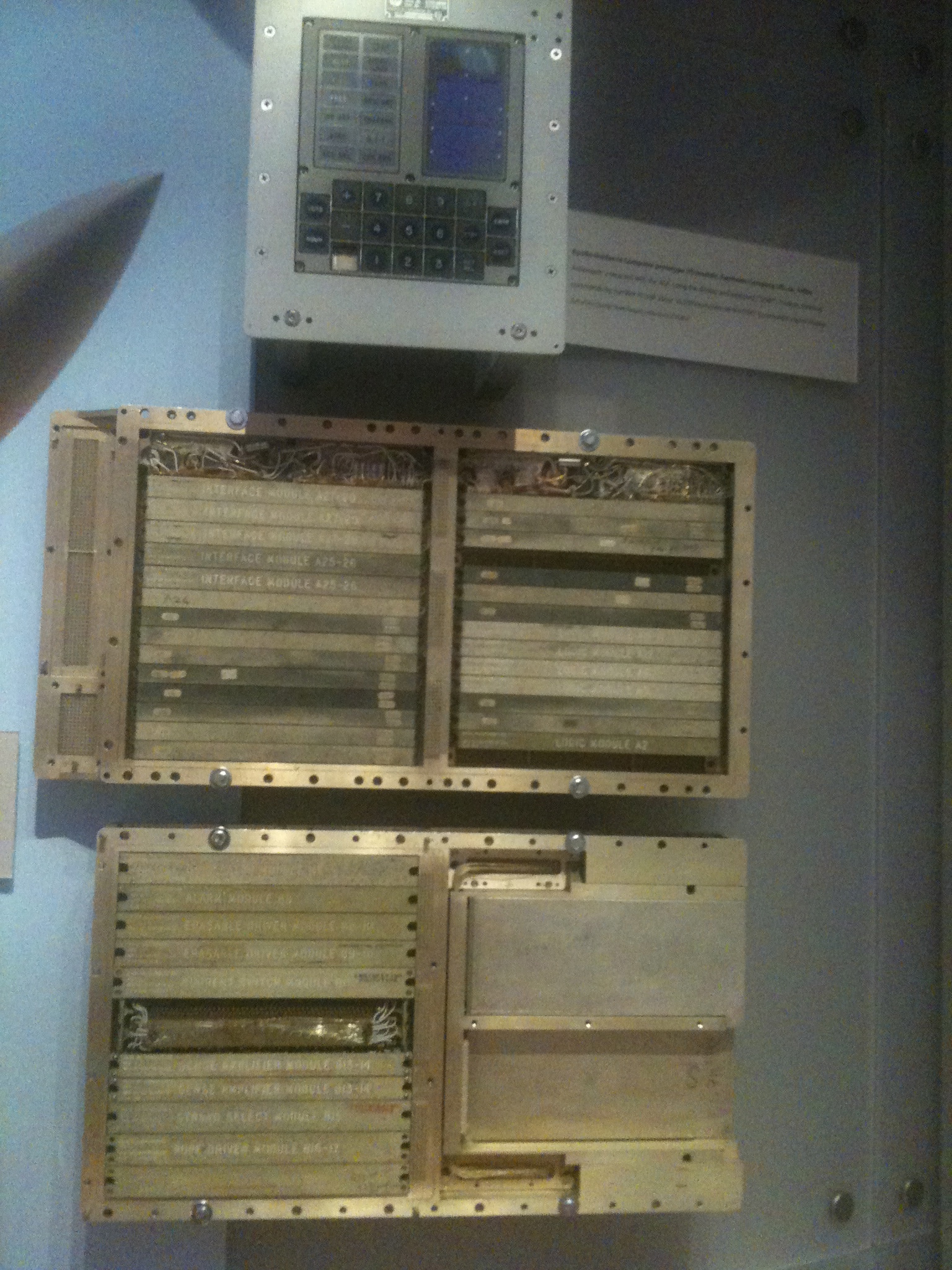
An Apollo Guidance Computer and its Display and Keyboard unit appear in a museum display, illustrating the hardware architecture used for Apollo guidance and astronaut interaction.
Arnold Reinhold / Wikimedia Commons · Image source · CC BY-SA 3.0

The most useful question about Apollo 11’s guidance computer is not how its memory compares with a modern phone. It is what happened when the machine could no longer finish everything requested of it. During the July 20, 1969 landing, program alarms appeared while a spacecraft was descending toward an unfamiliar surface. Continuing required more than a fast processor: the software needed a defined recovery path, the crew needed understandable information, and controllers needed evidence that the flight remained controlled. The engineering landmark lies in that combination. Reading the mission’s technical report alongside the programmers’ accounts also corrects an appealing but misleading story about a computer simply discarding unwanted radar data.
A landing command begins with an estimate of motion
NASA’s descent-planning report describes a chain from the inertial measurement unit to navigation, guidance and the digital autopilot. Accelerometers and gyroscopes supplied information about motion and orientation. Landing radar supplied surface-relative measurements. The computer combined the available information, calculated a desired thrust direction and magnitude, and used engine steering and small control rockets to help achieve them. Braking, visual approach and final landing imposed different requirements on the same connected system.
This separation matters. Navigation estimates where the vehicle is and how it is moving. Guidance chooses how those estimates should change to reach a target. Control makes the hardware follow the requested motion. A correct control command can still take a vehicle toward the wrong place if its position estimate is wrong. Equally, a good target and accurate navigation cannot compensate for an engine that cannot produce the commanded thrust.
For example, suppose an uncorrected velocity-estimation error is one metre per second. Over twenty seconds, simple integration alone would accumulate twenty metres of position error. This is not a reconstruction of Apollo’s trajectory; it explains why continuously reconciling measurements matters more than calculating one perfect-looking landing instruction at ignition.
The scarce resource included room for unfinished jobs
Programmer Peter Adler describes 36,864 words of fixed memory and 2,048 words of erasable memory. The distinction was functional: executable programs generally occupied fixed storage, while changing values and temporary calculations needed erasable storage. Jobs received small temporary working areas. An alarm numbered 1201 indicated that no vector-accumulator working area was available; 1202 indicated that no core set was available. These were Executive allocation failures, not evidence that the permanent landing program had vanished.
Imagine reserving a workbench for each calculation that has started but not finished. Even if every calculation is legitimate, benches fill when work arrives faster than it leaves. Increasing the size of the instruction library would not necessarily help: instructions and active working storage solve different problems. That is why a headline comparison of total memory misses the operational failure mode. The important questions are how many jobs remain alive, what state each needs, and when that state can safely be released.
The radar interface consumed time before useful work could run
The mission report traces the overload to unwanted counter interrupts from the rendezvous-radar coupling data units. Separate 800-hertz resolver-excitation and conversion-reference sources were frequency-locked but not phase-locked. Their disagreement could produce pulses indicating angular changes. Servicing those pulses stole processor cycles without providing useful descent information.
At the documented maximum combined rate of 12,800 pulses per second, approximately 11.7 microseconds per pulse consumes about 0.15 seconds of every second. This multiplication illustrates the report’s roughly fifteen-percent maximum load; it is not a measurement of a constant load throughout the landing. Near peak activity, the planned workload already approached capacity. Repetitive jobs could then be scheduled again before earlier instances finished, exhausting their allocated storage.
This is a coupling between electrical behavior and software scheduling. The alarm appeared in software, but its initiating mechanism crossed a hardware interface. It should not be reduced to an astronaut accidentally requesting too much genuine radar information, or to the computer recognizing useless data and effortlessly ignoring it.
A little missing capacity can create a large queue
Consider an invented scheduling example with one new calculation every two seconds. Each calculation requires 1.7 seconds of processor service. With the processor fully available, the system has 0.3 seconds of slack per interval. Now suppose unrelated input handling leaves only eighty percent of the processor available. Each two-second interval provides 1.6 seconds of service, so the backlog grows by 0.1 processor-second per arrival. Nothing about the calculation itself became harder; the available service rate changed.
After ten arrivals, the accumulated deficit is one processor-second, absent other recovery. A finite pool of working areas can eventually fill even though the individual calculations are small. Making the input interruptions brief does not avoid this problem if they occur frequently enough. Conversely, a single long interruption may be recoverable when sufficient later slack exists. Average load, burst duration, release times and deadlines must all be considered.
These numbers are deliberately not Apollo’s task timings. Their purpose is to separate a capacity problem from a corrupted calculation. A system can retain correct instructions and correct arithmetic while failing to complete work soon enough. Real-time correctness includes when a result becomes available, because a late steering update describes a vehicle that has already moved.
Recovery had to preserve a usable flight state
Adler explains that restart protection reinitialized software execution and resumed selected programs near recorded points in their progress. This was not an ordinary cold start that forgot the flight. Fred Martin’s account emphasizes the priority-driven Executive and the simulations surrounding its behavior. The important achievement was a planned way to recover useful computation while the external process—the descending spacecraft—continued.
Checkpointing is difficult because a partially completed operation can leave several related values inconsistent. Suppose a controller updates a target, a timestamp and a command in separate steps. Restarting after only the target changes could combine a new target with an old command. A defensible recovery design must decide what state is retained together, which operations can be repeated, and which outputs remain safe while calculations resume. This is an explanatory example, not a claim about a particular Apollo variable.
Nor does successful recovery establish unlimited overload tolerance. If interruptions consumed too much capacity, restarting would not manufacture additional computing time. The observed landing demonstrates recovery within the conditions encountered. It does not prove that arbitrary loads, arbitrary state damage or indefinitely repeated restarts would have been survivable.
The crew needed a flight decision, not a software lecture
The landing transcript records the crew reporting alarms and Houston authorizing continuation. It also records the later transition into Program 66 and Armstrong’s attention to selecting an acceptable touchdown area. These events should not be collapsed into a single story in which computer alarms forced the commander to abandon all computer assistance. The flight still involved distinct guidance modes, crew inputs and continuing automated functions.
An alarm number identifies a condition; it does not alone determine the correct operational response. Controllers needed to relate the warning to the actual trajectory and system behavior. The crew needed a timely decision they could act upon while managing other tasks. An interface that merely prints a technically accurate diagnostic can still fail its users if it provides no basis for choosing between continuation and abort.
The broader lesson concerns preparation. A recovery mechanism becomes operationally useful when its behavior has been exercised, its limits are understood, and responsibilities are clear. Human judgment was part of the control system’s practical success, alongside sensors, software and propulsion. Treating either the people or the machine as the sole hero hides the dependencies that made the decision possible.
The lasting result is a way to reason about failure
Apollo’s lesson is especially relevant when a modern device looks healthy in ordinary operation. Spare capacity can disappear through an interface that no application developer considers part of the main algorithm. A scheduler can turn lost execution time into accumulated live state. A reset can either restore coherence or amplify confusion. These mechanisms should be investigated together, with representative hardware behavior rather than convenient nominal inputs.
NASA’s mission report describes subsequent changes to prevent the unwanted radar-counter activity and reduce monitoring workload. Recovery allowed the landing to proceed; removing the initiating problem remained necessary. That distinction gives this historical machine its continuing engineering value. Reliability requires both a useful response to unexpected conditions and a disciplined effort to prevent their recurrence. The achievement was not small memory performing magic. It was a tightly constrained system maintaining enough correct, timely behavior to complete a demanding physical task.
Sources & further reading
Primary papers, project documentation, and research releases used in this article. Publication dates below refer to the sources themselves.
- Apollo 11 Mission ReportNASA Manned Spacecraft CenterPublished Checked
- Apollo Experience Report: Mission Planning for Lunar Module Descent and AscentNASAPublished Checked
- Apollo 11 Program AlarmsPeter Adler, hosted by NASA’s Apollo Lunar Surface JournalChecked
- Apollo 11: 25 Years LaterFred H. Martin, hosted by NASA’s Apollo Lunar Surface JournalChecked
- The First Lunar LandingNASA Apollo Lunar Surface JournalChecked
FOLLOW THE QUESTION
Explore engineering