ARTIFICIAL INTELLIGENCE
AlexNet in 2012: why learned visual features won
AlexNet’s 2012 ImageNet result joined learned visual features, GPU training, and regularization. Its precise benchmark conditions explain the historical breakthrough.
Research checked
Newest cited publication
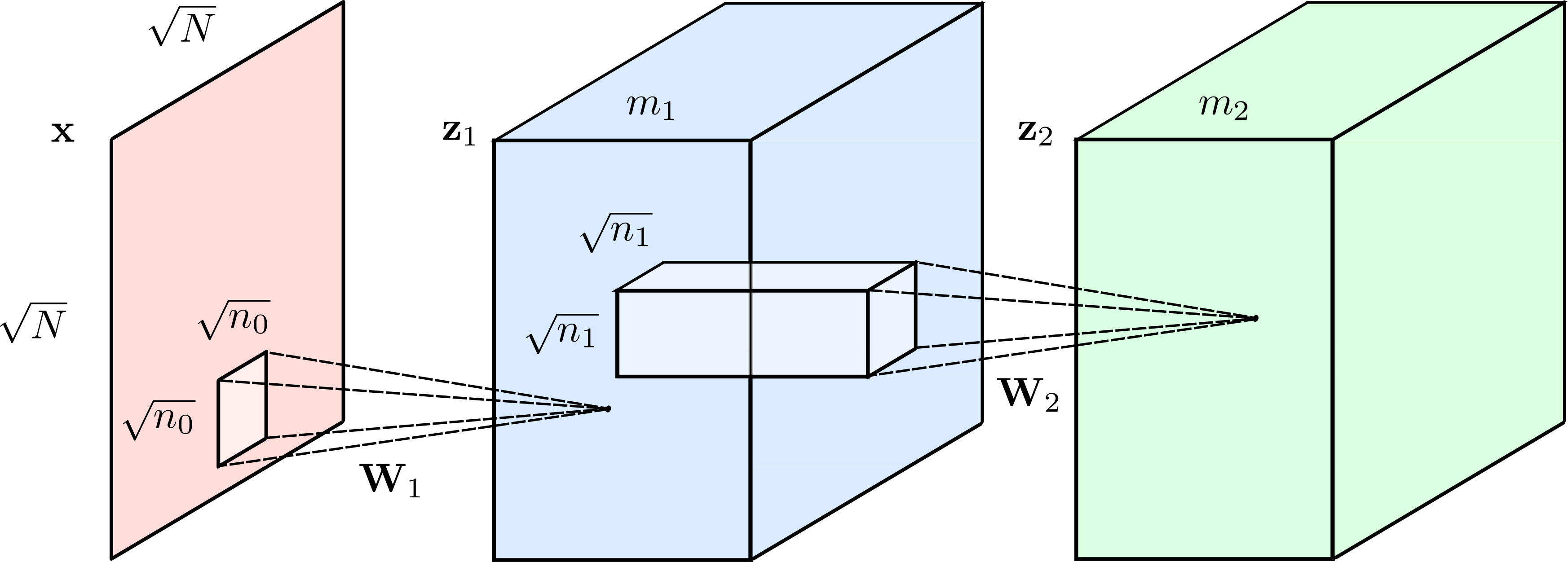
A modern convolutional-layer diagram illustrates learned visual features and changes in spatial resolution. It provides architectural background for AlexNet rather than reproducing the network’s original 2012 figure.
Renanar2 · Image source · CC BY-SA 4.0

The important event in 2012 was not that a computer finally recognized a photograph. Image classification already had a substantial research history. What changed was the strength of the evidence for learning a large visual representation directly from labeled examples. Alex Krizhevsky, Ilya Sutskever, and Geoffrey Hinton demonstrated that approach at a scale that made an unusually large difference on a shared benchmark. Their network became known as AlexNet. Remembering the result accurately requires separating a competition entry from one network, a dataset from the visual world, and a successful combination of engineering choices from a single miraculous invention. Those distinctions make the achievement more intelligible and more useful to study.
The famous number belongs to a specific entry
The official 2012 ImageNet Large Scale Visual Recognition Challenge results list the SuperVision team's leading classification entry at roughly 15.3% error when allowed five guesses, compared with about 26.2% for the next team. The leading entry used extra ImageNet training data. The paper explains that its final result combined seven networks; its single-network 2012 validation error was 18.2%. The 17.0% top-five test error in the paper's abstract belongs to the earlier 2010 dataset. Mixing those figures would conflate models, dataset editions, and evaluation splits.
Five guesses change the question being measured. For example, suppose an image's correct category is a particular dog breed. A system ranks that breed third after two similar breeds. It fails a top-one test but passes a top-five test. Neither result tells us whether it can locate the dog, explain its behavior, or recognize an unfamiliar animal. Using the rounded competition figures, 26.2 minus 15.3 equals a 10.9 percentage-point reduction in top-five error. It is not a 10.9-point improvement on every conceivable task involving images.
ImageNet made a larger experiment possible
The original ImageNet paper appeared in 2009. It described organizing images around WordNet's hierarchy of word meanings and using human annotation to check candidate images. That paper reported a then-current collection of 3.2 million images across 5,247 categories. The full database and the later thousand-category competition subset are different objects. The landmark depended on the availability of a large, organized training resource and a common evaluation process, not on every image from the entire database entering the same experiment.
Labels supply a learning signal, but they also define what success means. A training collection that separates many dog breeds teaches a different decision problem from one that groups all dogs together. Human annotation choices determine which distinctions the system is rewarded for preserving. Consider two photos of the same object under different lighting. Assigning the same category encourages the learner to retain identity while discounting some color changes. That incentive comes from the task and examples; it does not arrive automatically from the number of available pixels. More data helps only when its organization supports the intended question.
A convolution reuses a learned local detector
AlexNet's architecture had five convolutional layers followed by three fully connected layers. A convolutional layer applies shared learned filters across an image. This reuses the same detection rule at different locations instead of learning an entirely independent rule for every patch. Layering such operations lets later computations combine earlier responses over larger portions of the image. Convolutional networks were not invented by the 2012 paper; its historical contribution was demonstrating a particularly effective large-scale implementation and training configuration.
A toy calculation shows why sharing matters. Take a five-by-five color image with three channels and apply one three-by-three filter at stride one, with no padding. Each output uses twenty-seven weights and one bias, so the filter has twenty-eight learned parameters. It produces a three-by-three output map, containing nine values. Giving each of those nine positions its own separate filter would require nine times twenty-eight, or 252 parameters. This example is deliberately smaller than AlexNet and does not describe its first layer. It isolates the effect of a shared local rule.
Compute and nonlinearities changed what could be trained
The authors reported training their large network on two graphics processing units, or GPUs, over several days. Their efficient implementation made repeated convolution practical. They also used rectified linear units, commonly called ReLUs: a positive input passes through while a negative input becomes zero. These choices affected the feasibility of training and experimentation. Hardware was part of the experimental method, because a model that takes too long to train sharply limits the alternatives a researcher can compare.
To understand a ReLU, consider inputs of minus two, zero, and three. The outputs are zero, zero, and three. For a positive input the local slope is one, which avoids the small slopes that some saturating functions exhibit at large input magnitudes. This does not guarantee healthy gradients throughout a deep network: a unit receiving negative inputs can still transmit no local gradient. The broader engineering lesson is to inspect the entire learning loop. Runtime, memory limits, numerical behavior, and validation feedback determine which architectural ideas can actually be tested, rather than existing only as attractive diagrams.
Dropout discouraged fragile dependence on particular units
A large network can memorize useful-looking coincidences in its training examples. AlexNet used dropout in its fully connected layers to reduce overfitting. The later comprehensive dropout paper, published in 2014, describes randomly omitting units during training and using an adjusted full network for prediction. Random omission changes which supporting computations are present on each training step. It encourages useful predictions to remain possible without requiring the same exact collection of intermediate units every time.
An analogy is a classifier that relies on both an object's outline and its background. If the background signal is absent during some training updates, the remaining computation must carry more of the prediction. Actual dropout operates on numerical units, not on neatly named human concepts, so this analogy does not promise that a network learns the correct causal explanation. Nor does dropout remove the need for held-out evaluation. A system can become less dependent on individual units while still exploiting a pattern shared by both its training and validation data.
The result established a direction, not universal vision
The landmark's significance lies in the combination: an organized task at scale, learned filters, feasible GPU computation, effective optimization, and methods for limiting overfitting. An experiment removing one component answers a narrower question than the headline competition comparison. Similarly, averaging several networks changes inference cost and can improve results without showing that a single network has become equally strong. These are ordinary experimental qualifications, and preserving them prevents the history from collapsing into a slogan about size alone.
For a new application, the relevant follow-up would be a fresh evaluation on images representative of its intended setting. Changes in lighting, viewpoints, cameras, categories, and annotation policy can all change the task. A benchmark classifier also lacks an explicit obligation to recognize when no listed category fits. AlexNet showed that learned visual representations could outperform highly developed competing systems under an influential set of conditions. It did not finish computer vision. Its enduring lesson is to align the representation, training signal, computational budget, and acceptance criterion, then make the resulting evidence precise enough for others to challenge.
Sources & further reading
Primary papers, project documentation, and research releases used in this article. Publication dates below refer to the sources themselves.
- ImageNet Classification with Deep Convolutional Neural NetworksAdvances in Neural Information Processing SystemsPublished Checked
- ImageNet: A Large-Scale Hierarchical Image DatabaseIEEE CVPR / Stanford Vision LabPublished Checked
- ILSVRC2012 ResultsImageNetPublished Checked
- Dropout: A Simple Way to Prevent Neural Networks from OverfittingJournal of Machine Learning ResearchPublished Checked
FOLLOW THE QUESTION
Study engineering foundations