ARTIFICIAL INTELLIGENCE
SWE-Lancer and the economics of coding tasks
SWE-Lancer attaches historical payouts to software tasks. Its offline subset and acceptance tests show why a benchmark score should not become a wage forecast.
Research checked
Newest cited publication
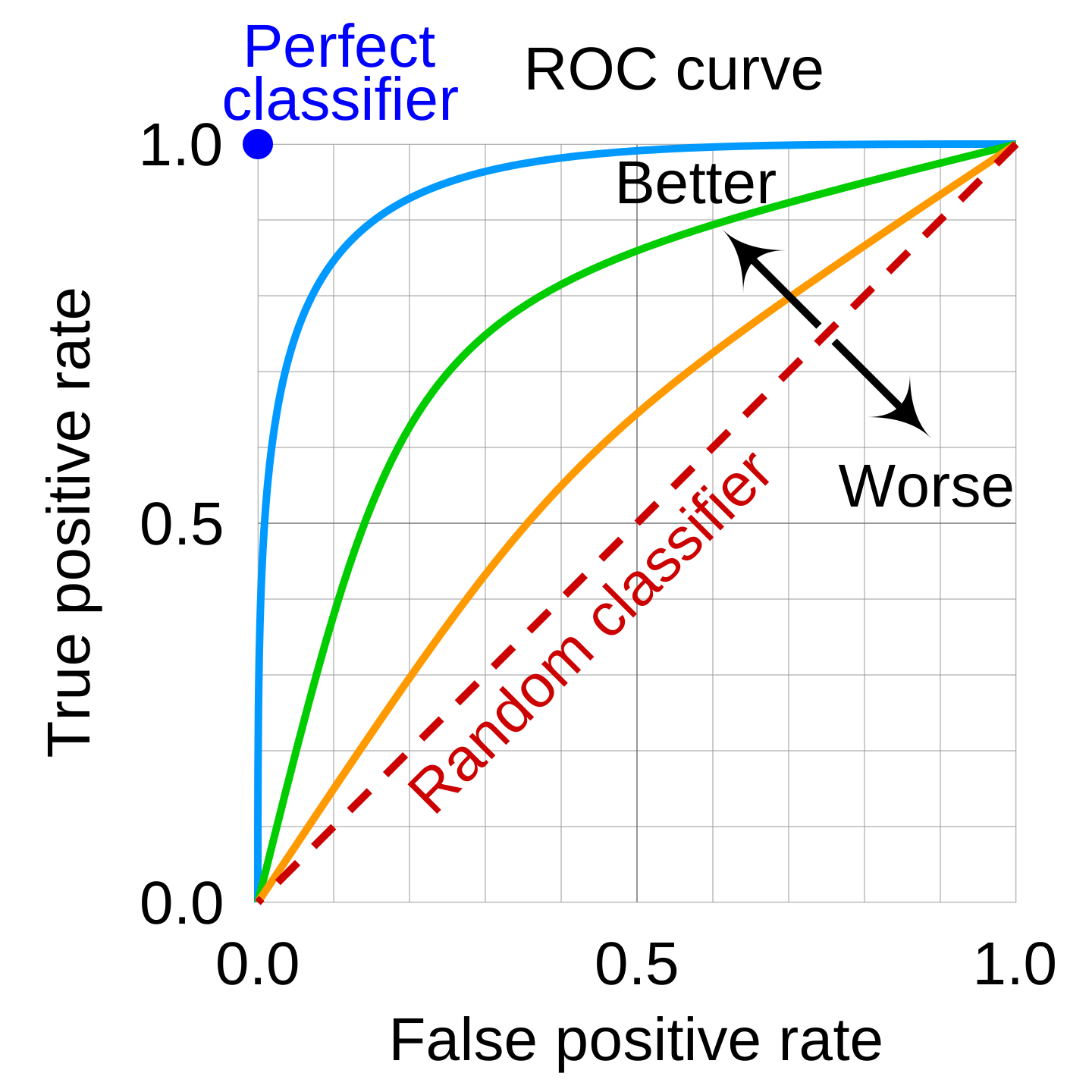
Illustrative ROC curves show how an evaluation metric can expose a tradeoff. SWE-Lancer instead uses the task-specific outcomes and grading procedures described in the article.
CMG Lee and Martin Thoma · Image source · CC BY-SA 4.0

A benchmark expressed in dollars is immediately memorable. It appears to translate an abstract success rate into work that someone valued enough to purchase. SWE-Lancer, introduced in February 2025, used real freelance software tasks and their historical payouts to make that connection concrete. Its continuing significance in 2026 is the distinction between economically motivated evaluation and a measured economic outcome. A model earning benchmark credit did not negotiate with a customer, receive a payment, or maintain a production application afterward. The July 2025 offline update and the broader 2026 debate about coding evaluators help explain how to read the result carefully. The right question is what the priced tasks reveal about engineering capability under the experiment's actual conditions.
A historical price is informative, but incomplete
The SWE-Lancer paper, submitted February 17, 2025, describes more than 1,400 tasks originally posted on Upwork, with approximately one million dollars in aggregate historical payouts. The collection includes implementation work and selection among technical proposals. OpenAI's February 18 announcement gave examples spanning small bug fixes and much larger feature requests. These facts make the dataset distinctive: its tasks came from work that had commercial motivation, rather than being invented solely to produce a standardized programming exercise.
Nevertheless, the amount paid is not a physical measure of task difficulty. A price can reflect urgency, negotiation, scarcity of a particular skill, accumulated context, or a project's payment conventions. Two similarly difficult fixes may carry very different bounties. A costly task may also include coordination that the benchmark does not reproduce. Historical prices therefore supply one useful weighting of completed tasks. They do not establish the current market price for an agent's work, nor do they directly measure the effort a human would need on the benchmark's prepared snapshot.
Writing a patch and selecting a proposal differ
SWE-Lancer separates individual-contributor tasks from managerial selection tasks. The former require a model to modify software and satisfy task-specific end-to-end tests. The latter ask it to choose among implementation proposals, with grading tied to the original engineering manager's choice. These settings probe related but distinct abilities. A system may recognize the strengths of a proposed architecture without being able to implement it reliably; another may produce a working patch while giving weak comparative explanations of alternative approaches.
An original example is a feature that imports a new file format. A proposal can sound sensible because it names a parser and an error-handling strategy, yet leave out how the import affects existing records. Implementing the feature exposes those missing details. Conversely, a proposal-selection evaluator may favor the historical winner even when a different proposal could have worked under a different budget or deployment plan. Agreement with that decision is a defined benchmark target. It should not be generalized into proof that the model is a better engineering manager.
The public offline subset has a different denominator
OpenAI's announcement notes a dataset update dated July 17, 2025, with a public notice on July 28. The current official README says the offline public collection contains 198 adjusted and verified tasks from an original 237-problem subset, with 39 removed. It specifies that valid rollouts run with internet access disabled. This is a narrower, concrete experimental object than the full collection described by the paper's headline. A result on those 198 tasks should identify that subset instead of suggesting the agent attempted every task in the million-dollar collection.
Removing live network dependence can reduce variability from service outages, changed endpoints, and remote application behavior. The tradeoff is that the resulting task distribution differs from work on a live product. This is not necessarily a weakness; controlling irrelevant variation is often essential for measurement. It does mean that the experiment asks a precise question about prepared tasks in a constrained environment. Comparisons need matching task identifiers and environment versions, particularly when a removed task was unusually expensive or difficult and therefore changed both the accuracy and the dollar-weighted result.
End-to-end tests check observable behavior
The release describes tests written and repeatedly reviewed by experienced engineers. End-to-end checks are attractive because a software feature often spans several layers: an input changes application state, which changes what a user sees or can do. A unit test of one helper function can miss that connection. However, any finite test suite samples behavior rather than proving every possible property of the application. The breadth of the test and its alignment with the task remain separate questions from the realism of the original request.
For example, an original date-filter task might pass checks using two records in one timezone and still fail at a daylight-saving boundary. That observation is not a claim about an actual SWE-Lancer test. It illustrates why passing an acceptance suite should be described as satisfying that suite, with additional review required before a production claim. The strongest evaluation deliberately includes valid alternative implementations and plausible incomplete solutions when checking the grader. Historical customer relevance supplies motivation; it does not automatically certify the acceptance rule.
Dollar-weighted success can conceal the workload
Consider an original three-task example with payouts of one hundred, two hundred, and two thousand dollars. Agent A solves the first two tasks; Agent B solves only the third. A wins on task-count accuracy, two out of three versus one out of three. B wins on historical payout, two thousand dollars versus three hundred. Both rankings are arithmetically correct. They emphasize different objectives, and neither tells us whether the systems would be useful on a company's actual incoming work.
A practical cost analysis would also include model usage, runtime, review, unsuccessful attempts, integration, and repair after deployment. If a model produces a patch quickly but a developer spends hours uncovering subtle errors, the benchmark payout alone omits the dominant cost. On the other hand, a partially successful draft may save useful time even when it earns no all-or-nothing benchmark credit. These are reasons to supplement acceptance scores with measured human effort and error consequences, not reasons to invent a conversion from task dollars to wages or jobs.
A task-level breakdown would make these tradeoffs visible. Readers could distinguish broad coverage of modest changes from concentrated success on a few high-priced features, then choose the comparison that matches their own workload.
The 2026 lesson is to inspect the evaluator
On July 8, 2026, OpenAI published a broader audit of SWE-Bench Pro and withdrew its earlier recommendation of that benchmark because of task-quality problems. That report concerns a different dataset; it is not evidence that the same measured defect rate applies to SWE-Lancer. Its relevance here is the general need to examine the relationship between instructions, tests, and reference solutions before interpreting a coding score as capability. Each benchmark needs its own task-level audit rather than inheriting either another benchmark's credibility or its criticism.
A convincing next study would evaluate a declared agent version on the pinned offline tasks, preserve complete trajectories, and publish accuracy alongside historical payout, runtime, and independent review effort. It would then test a separate set of fresh customer tasks without exposing their solutions to the agent. The second stage would ask whether the earlier measurement predicts useful assistance under new conditions. SWE-Lancer makes the commercial motivation of software work visible. The remaining research challenge is establishing the bridge from a priced, replayable task to dependable work in an evolving codebase with an actual customer waiting.
Sources & further reading
Primary papers, project documentation, and research releases used in this article. Publication dates below refer to the sources themselves.
- SWE-Lancer: Can Frontier LLMs Earn $1 Million from Real-World Freelance Software Engineering?arXivPublished Checked
- Introducing the SWE-Lancer benchmarkOpenAIPublished Checked
- SWE-LancerOpenAIChecked
- Separating signal from noise in coding evaluationsOpenAIPublished Checked
FOLLOW THE QUESTION
Study engineering foundations