ARTIFICIAL INTELLIGENCE
Verify the reasoning before taking a vote
Reasoning systems can repeat the same mistake across many answers. Recent claim-level verification research asks whether targeted checks beat another round of voting.
Research checked
Newest cited publication
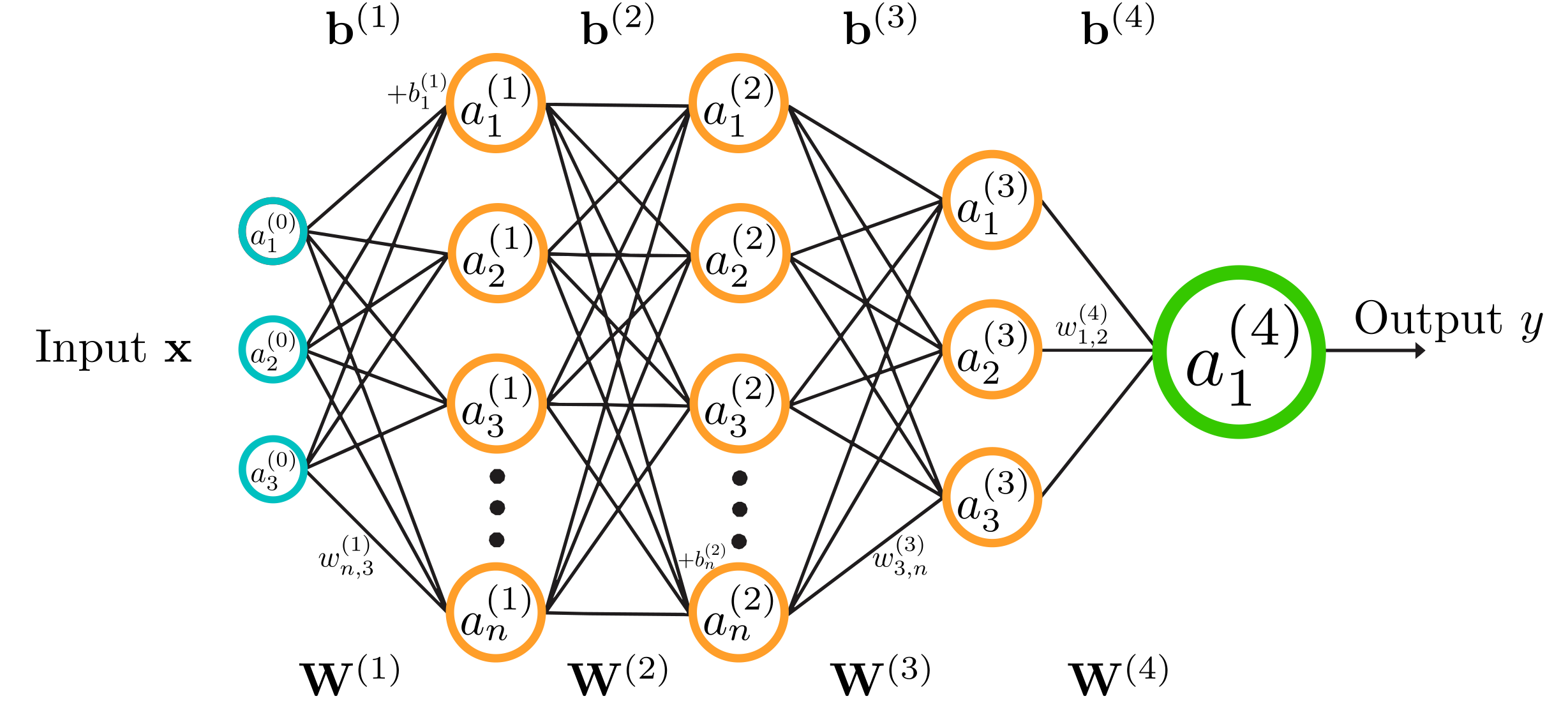
A layered neural-network diagram provides a visual starting point for discussing learned generators and verifiers.
QuantuMechaniX8 · Image source · CC0 1.0

If ten generated solutions agree, should the answer become more believable? Sometimes agreement is useful evidence. Sometimes ten responses are ten variations on one mistake. Test-time reasoning systems increasingly spend computation on both producing candidates and deciding which candidate deserves trust. An August 12, 2026 preprint on Claim-Level Reliability Assessment proposes concentrating that decision on a small set of claims whose failure would undermine the answer. The idea connects older work on process supervision with a practical allocation problem: when a model has already produced plausible alternatives, should the next unit of computation generate another alternative or try to break an existing one?
What a vote can actually tell you
A vote aggregates answers rather than proving them. In a short-answer task, the system groups equivalent final responses and chooses the largest group. This can suppress isolated slips when samples make different errors. It can also amplify a shared misconception. Sampling several times from one model does not create several independently educated experts. The outputs share parameters, training material, and often the same prompt, so their mistakes can be strongly related.
An invented geometry problem illustrates the distinction. Eight solutions accidentally treat a diameter as a radius, while two correctly distinguish them. The majority answer has more support in the sample bank and less support in the geometry. Generating eight more solutions may reproduce the same imbalance. A check focused on the meaning of the given length could be more valuable than another complete derivation. This is an argument for measuring what agreement is made of, rather than interpreting the size of a majority as a direct probability of correctness.
Why checking a process changes the signal
The 2023 paper Let's Verify Step by Step compared supervision of final outcomes with supervision of intermediate mathematical steps. Its process-supervised reward model performed better in the studied solution-selection setting, and the researchers released the PRM800K feedback dataset. The historical result establishes that intermediate judgments can carry useful information beyond the final answer. It does not establish that any contemporary model can reliably verify arbitrary reasoning or that step-level checking has negligible computational cost.
A faulty proof often contains a long stretch of harmless algebra surrounding one invalid inference. An outcome label says only that something went wrong. A step label can identify where the argument leaves its assumptions. That extra localization can help rank candidates or guide repair. Yet the granularity creates its own problem: natural-language steps have no fixed size. A model can compress several inferences into one sentence or expand a trivial calculation across many sentences. The evaluator must judge logical content, not reward an agreeable presentation style.
The 2026 proposal isolates decisive claims
Claim-Level Reliability Assessment, or CLR, asks the generator to expose a compact collection of decision-critical claims. A second request receives the original problem and those claims, and searches for refutations. The paper converts the resulting checks into reliability weights for aggregating candidate answers. This is targeted falsification rather than an assertion that a model-generated explanation is a formal certificate. The same model can serve as generator and checker, so disagreement is created through task structure rather than guaranteed independence.
For example, a proposed number-theory solution might depend on a factorization, a primality claim, and a statement that no larger candidate satisfies the constraints. Each can be attacked differently. Multiplication can test the factorization, a divisor can refute primality, and a counterexample can refute maximality. The asymmetry is useful: breaking one necessary claim can disqualify a solution, even when constructing the whole correct solution would be difficult. However, failing to find a refutation is weaker than proving that no refutation exists.
A reported gain includes a budget comparison
On one reported GPT-OSS-20B setting using the CMIMC25 mathematics benchmark, the CLR preprint raises self-consistency accuracy from 77.50 to 82.19 percent while using 37 percent fewer generated tokens in the compared configurations. These are benchmark-specific experimental results, not a service-level guarantee. The paper compares a generation-plus-verification allocation against more generation calls, which is the right kind of question for a system constrained by inference resources.
The arithmetic helps explain what remains unmeasured by a token saving alone. A service may process short verifier requests inefficiently, encounter extra network overhead, or use a much larger verification model. Conversely, checks might batch well or run concurrently. Equal model calls, equal tokens, equal elapsed time, and equal monetary cost are different matching rules. A fair evaluation should state which resource it holds fixed and report the others. Otherwise, an apparently superior selection rule could be benefiting from a hidden increase in practical computation.
Verification can itself become a reasoning task
The April 2025 DeepSeek-GRM paper studies inference-time scaling for generalist reward modeling. Its approach generates principles and critiques, and uses additional sampling with another reward-model stage to improve aggregation. It extends the resource-allocation question beyond exact mathematical checking. The reported work evaluates reward modeling on its chosen benchmarks; a persuasive critique remains a model output, rather than an automatically reliable judgment of truth or human preference.
Some checks are inexpensive because their acceptance condition is precise. A program compiles, a multiplication matches, or a proof assistant accepts a formal derivation. Other checks require interpreting missing context, reconciling sources, or evaluating a tradeoff. In those cases, the verifier needs evidence and reasoning capacity of its own. My inference is that the best architecture may be heterogeneous: use deterministic tools for local claims where possible, reserve language-model judgment for unresolved interpretation, and preserve an explicit record of which claims were actually checked.
The candidate bank sets one important ceiling
A selection system cannot recover a correct candidate that was never generated unless it also performs repair or new search. The August 2026 inference-protocol paper distinguishes candidate-bank diagnostics from complete system performance. That distinction is essential when reading pass-at-k results: knowing that one of many attempts was correct describes an opportunity for selection, not proof that the deployed selector can recognize the successful attempt without access to the answer key.
A useful experimental report would therefore separate three failure counts. First, no candidate contains a valid solution. Second, a valid candidate exists but is discarded. Third, the selected answer is correct while its reasoning is defective. These categories imply different repairs: improve generation, improve selection, or strengthen process checks. Combining them into one accuracy number conceals where additional computation should go. It can also cause teams to optimize a sophisticated verifier while their main bottleneck remains the inability to propose any correct solution.
How to challenge a verification system
Verification deserves its own adversarial examples. Give the checker a concise wrong argument, a verbose wrong argument, an unfamiliar correct argument, and two arguments differing only at a decisive step. Measure whether its judgment follows the logic or the surface presentation. Also test the claim extractor: if it omits the one false premise, even a strong downstream checker may approve the remaining harmless statements. The claimed bottleneck must actually be present in the information supplied for inspection.
These are proposed evaluation practices, rather than results attributed to a single paper. They follow from treating verification as a fallible component with a defined interface. The emerging 2026 work is valuable because it makes compute allocation more specific. Instead of assuming that another answer or a longer answer is always the next useful move, it asks what uncertainty remains and what check could reduce it. A well-designed system should sometimes count votes, sometimes inspect a claim, and sometimes admit that the available evidence cannot settle the choice.
Sources & further reading
Primary papers, project documentation, and research releases used in this article. Publication dates below refer to the sources themselves.
- Let's Verify Step by StepLightman and colleagues / arXivPublished Checked
- Inference-Time Scaling for Generalist Reward ModelingLiu and colleagues / arXivPublished Checked
- Claim-Level Reliability Assessment for Efficient Test-Time ReasoningXu and colleagues / arXivPublished Checked
- Test-Time Scaling in Reasoning LLMs: Inference Regimes, Evaluation, and ReproducibilityHariri and colleagues / arXivPublished Checked
FOLLOW THE QUESTION
Study engineering foundations