ARTIFICIAL INTELLIGENCE
DeepSeek-R1 and reasoning without a complete script
DeepSeek-R1 made verifiable rewards central to open reasoning research. Its 2026 revision and follow-up studies reveal what those rewards can and cannot establish.
Research checked
Newest cited publication
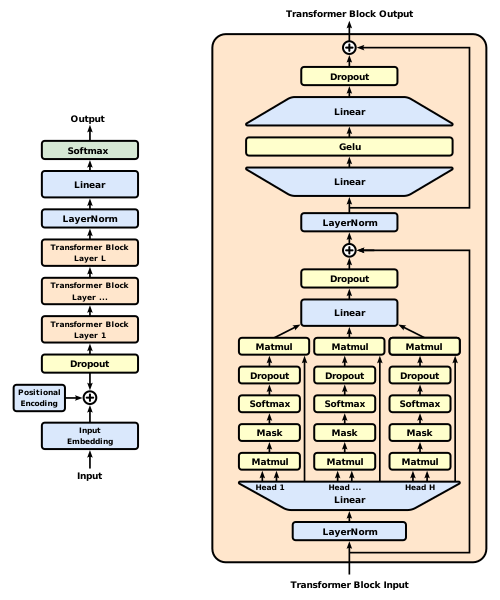
A transformer architecture diagram provides background for the model family in this article; the published R1 training procedure is described in the text.
Marxav; vectorization by Mrmw · Image source · CC0 1.0

A mathematical answer can be checked more cheaply than every sentence used to reach it. That imbalance creates an opening for machine learning: let a model attempt a problem, check the result, and change which attempts it is likely to produce next time. DeepSeek-R1 made this approach unusually visible in January 2025. Its paper received a substantial public revision on January 4, 2026. The result remains relevant because the central question has become sharper: when reward improves the answer, what exactly has improved inside the reasoning process? Separating useful behavior from claims about entirely new abilities is now essential.
What the Zero experiment actually removes
DeepSeek-R1-Zero starts from an already pretrained language model and applies reinforcement learning without first adding a supervised reasoning stage. The distinction matters. It removes one particular source of demonstrations; it does not remove the language, mathematical patterns, or programming material learned during pretraining. The R1 paper reports that longer attempts, checking behavior, and changes of strategy appeared during this training. These are observable changes in generated behavior, rather than direct measurements of a humanlike internal experience.
Consider a hypothetical model that sometimes solves an equation correctly but usually jumps to an attractive wrong answer. Increasing the frequency of its successful method would already be valuable. No new theorem needs to enter the model for reliability to improve. Conversely, the discovery of a genuinely different method would require evidence beyond one successful answer. Keeping these possibilities separate prevents a familiar mistake: treating an improvement in average score as a complete explanation of how the improvement happened.
A reward is also a choice about credit
The training recipe uses Group Relative Policy Optimization, or GRPO. Multiple responses to the same problem are compared using their rewards, and the policy is adjusted toward relatively successful responses. This supplies a learning signal without requiring a human to mark every intermediate sentence. Its attraction is practical: many mathematics answers and executable programs admit automated checks. The checker, however, defines success only to the extent that its tests capture the intended task.
An illustrative programming exercise makes that boundary concrete. Suppose a generated function passes ten visible examples. A model can earn a positive outcome while mishandling an eleventh input, or while relying on an unintended shortcut. Stronger hidden tests change the incentive. They do not automatically make every explanation trustworthy. A useful evaluation therefore asks three questions separately: did the output pass, did the method generalize, and did the written reasoning accurately describe the method? A single scalar reward cannot answer all three questions by itself.
The usable model adds a broader pipeline
The final DeepSeek-R1 is not simply R1-Zero with a different name. The authors describe a staged pipeline involving an initial supervised starting set, reasoning-focused reinforcement learning, filtered generated examples, further supervised training, and another reinforcement learning stage. The official repository also provides smaller distilled checkpoints. Distillation trains a student on examples from a stronger model; it is a different intervention from rewarding the student's own attempts. These distinctions are necessary when comparing model families or reproducing a result.
A recipe can be simple in principle while its implementation remains demanding. Selecting problems, checking answers, filtering malformed generations, scheduling training, and evaluating regressions all influence the final system. A student model can inherit useful solution patterns without reproducing the teacher's training process. That is a useful engineering outcome, but it does not make the student an independent replication of the original reinforcement learning experiment. Researchers need the lineage of the checkpoint as well as the number printed on a leaderboard.
A reproduction needs more than the weights
Open weights let researchers inspect and run a trained checkpoint, but they are only one part of reproducibility. The official release documents checkpoint variants and usage conditions. A training reproduction would additionally need the relevant problem distribution, verification rules, filtering decisions, optimization settings, and a comparable starting checkpoint. An inference reproduction needs the prompt format, sampling parameters, context limit, and answer extraction. These requirements differ because they test different claims: producing similar outputs from a released artifact is not the same experiment as independently obtaining that artifact.
For a reader comparing two R1-derived applications, this becomes a practical checklist of questions rather than a verdict on openness. Did both systems use the same student size? Was one allowed several attempts? Did a hidden selector inspect the answers? Were failures counted? The answers explain which part of a performance gap could plausibly come from reinforcement learning and which part comes from deployment choices. Without that accounting, model names can conceal larger experimental differences than the method under discussion.
Coverage and frequency ask different questions
A study first released on April 18, 2025, by Yue and colleagues challenged a strong interpretation of verifiable-reward training. At large sampling budgets, base models sometimes reached more correct final answers than their reinforced counterparts, even though the reinforced models were stronger on a single attempt. The paper interprets this as evidence that the tested training procedures often concentrate existing successful behaviors. Its conclusion concerns the evaluated models, tasks, and sampling protocols; it is not a theorem that reinforcement learning can never produce new capabilities.
Imagine two hypothetical systems facing the same hundred problems. One solves sixty reliably and almost never solves the remainder. Another solves each of eighty problems only occasionally. The first may be better for a user allowed one attempt. The second may offer more coverage to a search system with a powerful checker and many attempts. Neither description is captured by a single accuracy percentage. A fair comparison needs both the chance of obtaining a useful answer and the cost of identifying that answer among the failures.
A correct answer can conceal a bad method
Wen and colleagues offered a different diagnostic in a June 17, 2025 preprint. They require both the answer and the chain of reasoning to pass evaluation, rather than crediting the final answer alone. Under that criterion, their experiments find benefits from verifiable-reward training that final-answer coverage can obscure. An important limitation is that their reasoning judgments use a language-model verifier. That replaces one measurement problem with a finer measurement that still has its own errors.
The disagreement is productive because it exposes the object being measured. A short-answer benchmark may accidentally reward guessing, cancellation of two errors, or an invalid argument that lands on the right integer. Requiring a sound method can reveal those cases, but an unreliable method judge can also reject unfamiliar valid solutions. The next useful experiment would audit a carefully selected disagreement set with independent mathematical checks. That would tell us whether the metrics disagree because the models behave differently or because the evaluators make different mistakes.
The 2026 question: reward the useful part
A June 16, 2026 preprint on Dynamic Rollout Editing examines a related credit-assignment problem. If a successful generation contains both a useful solution prefix and unnecessary continuation, sequence-level reinforcement can reinforce both. The proposed intervention preserves a verified prefix and edits the remaining thinking within training. It is a specific attempt to improve which parts of a successful trajectory receive preference, rather than a general demonstration that every long response is wasteful.
This suggests a practical research agenda for R1-style systems. Record where a solution first becomes sufficient, distinguish productive checking from repetition, and test the learned stopping behavior on unfamiliar problems. A checker should also be tested against adversarial shortcuts. My interpretation is that the lasting contribution of this line of work is a clearer experimental interface: problems, attempts, rewards, and measurable behavior. Better reasoning will require improving each part of that interface, while remaining precise about which conclusions the resulting evidence actually supports.
Sources & further reading
Primary papers, project documentation, and research releases used in this article. Publication dates below refer to the sources themselves.
- DeepSeek-R1: Incentivizing Reasoning Capability in LLMs via Reinforcement LearningDeepSeek-AI / arXivPublished Checked
- DeepSeek-R1DeepSeek-AIChecked
- Does Reinforcement Learning Really Incentivize Reasoning Capacity in LLMs Beyond the Base Model?Yue and colleagues / arXivPublished Checked
- Reinforcement Learning with Verifiable Rewards Implicitly Incentivizes Correct Reasoning in Base LLMsWen and colleagues / arXivPublished Checked
- Dynamic Rollout Editing for Reducing Overthinking in RL-Trained Reasoning ModelsWei and colleagues / arXivPublished Checked
FOLLOW THE QUESTION
Study engineering foundations