MATHEMATICS
Spreadness offers a new language for arithmetic progressions
Raghu Meka’s July 2026 ICM survey connects a recent progression breakthrough to a principle: objects can mix strongly without individually looking random.
Research checked
Newest cited publication
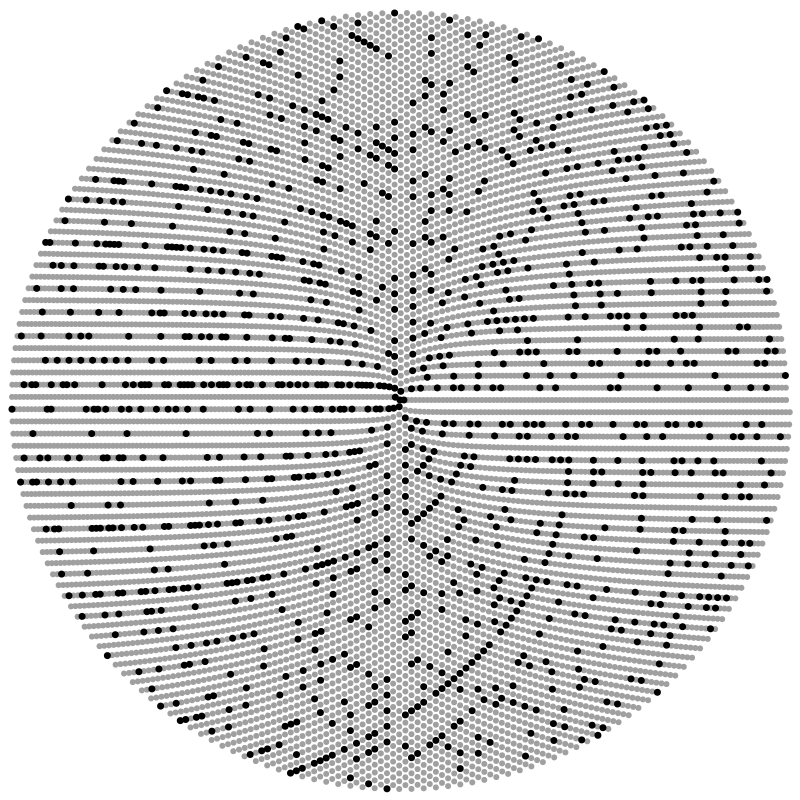
A Sacks spiral supplies visual arithmetic context. The spreadness conditions discussed in the article are precise distributional properties rather than patterns read from this image.
Claudio Rocchini / Wikimedia Commons. Unchanged original image. · Image source · CC BY 2.5

A set of integers can be large and still carefully avoid a simple pattern. Understanding how large is one of additive combinatorics' central problems. Raghu Meka's invited International Congress of Mathematicians survey, published online on 13 July 2026, presents a useful perspective on recent progress: spreadness can imply mixing. The survey synthesizes earlier breakthroughs rather than announcing that their principal progression theorem was first proved in 2026. Its fresh value is the common language it provides for arithmetic sets, matrices and related algorithmic problems. That language clarifies why a weak-looking prohibition on local concentration can force strong behavior after two objects interact.
The pattern is an equation with a degeneracy
A three-term arithmetic progression has the form a,a+d,a+2d. The difference d must be nonzero to exclude the trivial triple that repeats one number. Equivalently, its endpoints x and y satisfy x+y=2z, where z is the middle term. For a small example, {1,2,4} contains no nontrivial progression, while {1,2,3,4} does because 1,2,3 is one. Neither example settles the large-scale problem. The question is how the maximum size of a progression-free subset of {1,...,N} grows as N becomes arbitrarily large.
A naive random-set estimate gives useful intuition but no extremal proof. The interval has on the order of N squared possible three-term progressions. If every integer is retained independently with probability delta, each distinct progression survives with probability delta cubed. One therefore expects on the order of delta cubed times N squared progressions. An extremal set is not chosen independently, however. It can coordinate its exclusions to destroy many patterns at once. The challenge is proving that sufficiently dense coordination must eventually fail, even when its design is adversarial rather than random.
What changed in the recent bound
Zander Kelley and Meka first submitted Strong Bounds for 3-Progressions in February 2023. They proved that progression-free sets have density at most an exponential of a negative power of log N, for a fixed positive power. This is a substantial quantitative change from the preceding logarithmic-density bounds. Their argument first develops ideas in finite-field settings and then adapts them to the more complicated integer setting. Meka's 2026 survey explains this development alongside other uses of the same broad principle. It should not be read as closing the gap to the best constructions.
To compare rate types without pretending to know usable finite constants, let u equal log N. A power-logarithmic density such as u to the power minus two has logarithm minus two log u. A stretched-exponential density such as exp(−u to the power one tenth) has logarithm minus u to the power one tenth. Eventually u to a positive power dominates log u, so the second density is smaller for sufficiently large N. That eventual ordering does not establish a crossover at an everyday integer size. Constants and thresholds can dominate numerical comparisons far below the asymptotic regime.
Spreadness asks where density can increase
Imagine a set occupying one percent of a large finite space. Its density might jump to twenty percent when one restricts attention to a suitable structured region. Such a jump exposes organization that a global density misses. A spreadness condition forbids a substantial increase on every region in a specified family above a specified minimum size. The family matters: affine subspaces, Bohr sets and matrix rectangles are different tests. Requiring uniformity on all arbitrary subsets would be impossible, since choosing the set itself immediately creates a density of one.
Meka's survey emphasizes that spreadness is weaker than full random appearance, yet interaction through an appropriate operation can yield mixing. In groups the operation is convolution; in the matrix setting it is multiplication, with additional hypotheses. This is not the blanket claim that any two spatially scattered sets have a uniform sumset. Both the definition of spread and the quantitative parameters are part of each theorem. The point of the framework is to find a condition that can be obtained efficiently in a proof and is still strong enough to force the needed counting behavior.
A small convolution calculation shows the obstacle
For a finite cyclic group, let r(t) count ordered pairs a,b from a set A whose sum equals t. Take A={0,1} modulo five. The five values of r are 1,2,1,0,0: there is one way to obtain zero, two to obtain one, one to obtain two and none to obtain three or four. The total is four, as it must be from two choices of each input. The average value is four fifths, but no individual output count equals that average. Averages alone reveal little about holes.
Convolution packages these representation counts into a function. After suitable normalization, a uniformly mixed convolution would be close to one at most outputs. This is stronger than merely saying the sumset is large, since a large support can still have wildly uneven counts. It also explains why mixing helps detect progressions: the equation x+y=2z asks whether the pair-sum representation function has enough mass on doubled elements of the original set. One must then control exceptional outputs and trivial solutions. Near-uniform behavior on most outputs is a starting point for that count, not an automatic proof for every prescribed target.
The alternative is a controlled density increase
A common proof strategy presents a dichotomy. Either the set is spread enough for a counting theorem, or a structured region has higher density and one restarts inside it. The bookkeeping must track how much density increases and how much ambient size is lost. Suppose, purely illustratively, that each restart multiplies density by 1.1. Starting from one percent, after forty-nine such increases the density exceeds one, which is impossible. This limits the number of restarts, but says nothing useful unless enough ambient space survives them. Strong quantitative results depend on improving that tradeoff.
Thomas Bloom and Olof Sisask's exposition, first submitted in February 2023 and revised in May 2025, gives a self-contained account of the Kelley–Meka method with simplifications involving Bohr sets. It also extends the method's use in studying long progressions in triple sumsets. Bohr sets provide structured neighborhoods defined by several approximately compatible phase conditions. Their role is one reason the integer argument cannot simply be copied from vector spaces over a finite field: the available structured regions behave differently under restriction and addition. The exposition is background supporting the mechanism, not a separate 2026 discovery.
A common language does not erase different hypotheses
There is a temptation to export the slogan directly into data analysis: if a dataset has no obvious cluster, perhaps its combinations must be random. Mathematical spreadness theorems do not justify that inference. They specify a family of tests, threshold scales, normalization and an operation. Failure to detect clusters with a limited search is not proof that every permitted test is passed. Likewise, a matrix product can require lower bounds on row or column averages to avoid empty or highly unbalanced directions. The relevant structural assumptions cannot be replaced with a visual impression.
The 2026 survey is useful precisely because it displays a reusable architecture while preserving these distinctions. It invites researchers to ask which structured regions are natural in a new setting, whether concentration can be sifted into a density increment, and which interaction turns spread inputs into a reliable counting law. Those are concrete mathematical questions. For arithmetic progressions, the established breakthrough already shows that this viewpoint can change quantitative bounds substantially. The continuing challenge is to sharpen the parameters and reach other patterns without assuming that a shared slogan supplies the missing proof.
Sources & further reading
Primary papers, project documentation, and research releases used in this article. Publication dates below refer to the sources themselves.
- Spreadness Implies Mixing: A New Variant of Structure vs. RandomnessSIAM / International Mathematical UnionPublished Checked
- Strong Bounds for 3-ProgressionsarXivPublished Checked
- The Kelley--Meka bounds for sets free of three-term arithmetic progressionsarXivPublished Checked
FOLLOW THE QUESTION
Explore mathematics