ENGINEERING
Small modular reactors face the factory-to-site engineering test
A September 2026 Clinch River construction permit sharpens the engineering questions around modular manufacturing, site work, inspection and commissioning.
Research checked
Newest cited publication
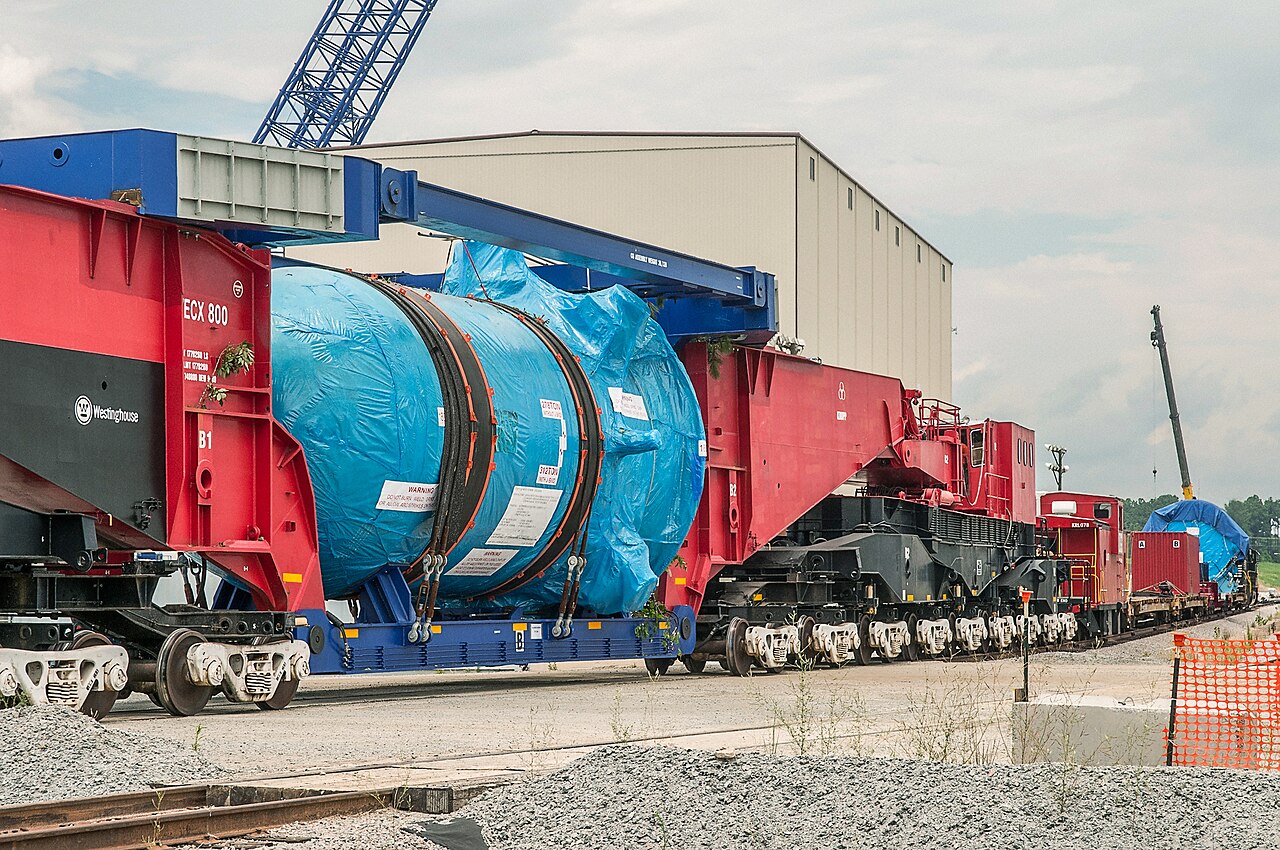
A large reactor vessel arrives at the V.C. Summer site in 2013, illustrating nuclear-component logistics. It is an archive example rather than a small modular reactor.
SCANA / SCE&G, via US Nuclear Regulatory Commission · Image source · CC BY 2.0

A construction permit is a consequential event in nuclear engineering, but it is not an operating power station. On September 29, 2026, the U.S. Nuclear Regulatory Commission announced a permit for the Tennessee Valley Authority’s proposed small modular reactor at Clinch River in Tennessee. The agency described a 300-megawatt boiling-water reactor project and explicitly said a separate operating license would be needed before fuel loading and operation. This milestone puts a practical question at the center of the small modular reactor discussion: how can a design that promises repeatability survive the interfaces between factory production, transport, construction, inspection and eventual plant operation?
Separate permission from demonstrated performance
The Clinch River decision follows the NRC’s review of a specific application. It does not demonstrate that the future unit has achieved its electrical rating, construction schedule or operating cost. The regulator’s September release states that its safety review was completed in June 2026 and that the licensing decision followed a public hearing. This is evidence of an assessment and authorization process. Keeping that boundary explicit makes the milestone more informative: it tells readers which barrier has been crossed and which engineering activities remain ahead of the project.
Another relevant reference point is the NRC’s May 29, 2025 announcement approving the standard design for NuScale’s US460 small modular reactor. Standard design approval and a site-specific construction permit are distinct regulatory products. They should not be counted as interchangeable operating achievements, nor should the details of one reactor be imported into another. Small modular reactor describes a family of development strategies rather than a single machine. Different coolant systems, containment arrangements and construction choices create different inspection requirements and different opportunities for repeated manufacture.
The interface is where modularity earns its value
A module reduces field work only if its boundaries are chosen well. A factory can assemble a subsystem under controlled conditions, check its dimensions and document its materials before shipping it. At the site, however, that subsystem must still connect to foundations, power supplies, cooling, instrumentation and neighboring equipment. A connection that is difficult to reach or sensitive to small alignment errors can consume much of the labor saved during fabrication. Good modular design therefore includes lifting clearances, installation sequence and access for future inspection, not just a convenient outline on a drawing.
Consider a hypothetical pipe assembly delivered with perfectly acceptable internal welds but a final connection displaced beyond the site tolerance. Cutting and remaking the connection may introduce a new inspection step and delay other crews. The lesson is not that factory fabrication fails; it is that geometric control must extend across organizational boundaries. Shared reference points, survey procedures and as-built records help reconcile the factory’s coordinate system with the construction site’s. That relatively unglamorous work can determine whether a repeated design actually produces a repeated installation process.
A repeated product needs a traceable pedigree
Factory scale makes defect prevention more valuable because an unnoticed process problem can affect many units before it is discovered. A credible production system links each safety-important component to material records, fabrication procedures, inspection results and approved design revisions. The objective is not simply to accumulate paperwork. It is to answer a practical question quickly: if a flaw is found in one part, which other parts may share the cause, where are they installed and what evidence justifies continued use or replacement?
Sampling strategies also need to reflect consequence and detectability. A cosmetic variation and an inaccessible pressure-boundary flaw should not receive the same treatment merely because both arise on an assembly line. Repeated manufacture can make specialized tooling and automated inspection economical, but inspection methods require qualification against realistic defects. Measurements must be sensitive enough to detect the failure modes that matter. An average production yield does not establish that rare, consequential defects are controlled, particularly when later access would require substantial disassembly or prolonged plant downtime.
A smaller reactor still has a substantial site
The reactor module does not eliminate civil construction or the plant’s relationship with its surroundings. Foundations, structural supports, electrical systems and heat-rejection equipment still have to meet the demands of the selected site and design. Transport constraints may determine which assemblies can be shipped whole and which must be completed locally. A route survey, for example, can expose bridge-loading or turning-radius constraints before a large component is ready to leave a factory. Those constraints are engineering inputs, not administrative details to discover after procurement.
Commissioning introduces a different set of interfaces. Individual equipment can pass factory tests while the integrated plant reveals unexpected control interactions, sensor errors or incompatible operating sequences. An effective commissioning plan builds from component checks to subsystem tests and then to plant-level demonstrations under the applicable authorization. It records acceptance criteria before results arrive. That helps prevent a schedule-driven tendency to reinterpret a marginal outcome as success. In the Clinch River case, the NRC’s requirement for a separate operating license makes the distinction between construction and operation especially concrete.
Fleet licensing remains a proposal to examine carefully
On April 24, 2026, the NRC announced a proposed Part 57 framework aimed at microreactors and other reactors with comparable risk profiles. Its release described features including requests to approve fleets of identical reactors. The document was a proposal, and its scope should not be generalized to every small modular reactor. Nor do projected review efficiencies establish how a particular future application will perform. The useful engineering issue is the relationship between repeated design evidence and the specific conditions that can still differ among installations.
Identical hardware does not automatically imply identical exposure. Ambient conditions, external hazards, operating duty, support infrastructure and maintenance capability may vary. A fleet approach would need a disciplined definition of what is truly common and how departures are handled. Configuration management becomes central: an improvement introduced into later units must be evaluated for earlier ones, while a local modification should remain visible to fleet engineers. Without that discipline, the phrase identical reactor can hide a slowly diverging collection of machines whose inspection and operating assumptions no longer match.
The first unit should manufacture knowledge as well as hardware
The first construction project has value beyond the electricity it may eventually produce. It can reveal which tasks dominate field labor, which interfaces cause rework and which factory tests predict site acceptance. That knowledge is most useful when captured in a way that changes the next design package or production procedure. Merely completing the first unit does not guarantee that the next will be cheaper. A learning claim needs a documented causal connection between observed difficulty, an implemented change and a later measured improvement.
A convincing future update would separate design maturity, factory output, site progress and operational readiness rather than compressing them into one percentage-complete figure. It would report how repeated components meet acceptance criteria and how deviations are resolved. The 2026 Clinch River permit makes those questions timely, but their answers will come from the work ahead. The engineering opportunity in small modular reactors is a disciplined transfer of complexity into repeatable processes. Whether that opportunity is realized depends on interfaces and evidence as much as on the size of the reactor.
Sources & further reading
Primary papers, project documentation, and research releases used in this article. Publication dates below refer to the sources themselves.
- NRC Approves Construction of Nation’s First Small Modular ReactorU.S. Nuclear Regulatory CommissionPublished Checked
- NRC Approves Standard Design for NuScale US460 Small Modular ReactorU.S. Nuclear Regulatory CommissionPublished Checked
- NRC Proposes a New Licensing Framework to Accelerate Safe, High-Volume Deployment of MicroreactorsU.S. Nuclear Regulatory CommissionPublished Checked
FOLLOW THE QUESTION
Explore engineering