MATHEMATICS
Why Cantor’s Missing Number Defeats Every Infinite List
Cantor’s 1874 and 1891 arguments separate countable lists from the real continuum. Follow the diagonal proof without decimal-expansion ambiguity.
Research checked
Newest cited publication
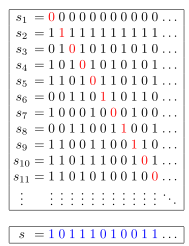
A diagram lists infinite binary sequences and highlights the diagonal entries. Flipping each highlighted digit constructs a sequence that differs from every listed row at its corresponding position.
Jochen Burghardt; based on a diagram by Cronholm144 / Wikimedia Commons. Unchanged original SVG. · Image source · CC BY-SA 3.0

Imagine an infinitely long catalog that claims to contain every real number between zero and one. There is no last page to inspect, so finding a missing entry seems impossible. Cantor’s diagonal argument supplies a systematic answer: use the catalog itself to define an object differing from its first entry in one coordinate, its second in another, and so on. The contradiction concerns every proposed infinite catalog, not the limitations of a particular computer. Historically, Cantor had already proved in 1874 that the reals cannot be listed; the argument conventionally dated 1891 introduced the particularly transparent diagonal method. Separating those two developments helps explain both what infinity permits and where enumeration reaches a genuine boundary.
Counting does not require a largest number
For finite collections, counting ends with a final item. For a countably infinite collection, the relevant property is a correspondence with the positive integers: each object receives a finite positive position, and every object appears. There is no requirement to finish visiting all positions. The even positive integers have exactly this size because position n corresponds to the even integer 2n. Although they omit every odd integer, they still match the positive integers one for one.
This example does not make size comparisons meaningless. It shows why familiar finite reasoning needs a precise replacement. Inclusion asks whether one set lies inside another; cardinality asks whether a bijection exists. These relations need not have the same answer for infinite sets. Cantor’s 1895 treatment develops cardinality through such one-to-one correspondences, abstracting from the nature and ordering of the elements. Counting a set is therefore different from measuring the length of an interval or deciding how densely its points sit.
How a grid turns two indices into one
Place positive fractions p/q in a grid, with positive integer p indexing rows and positive integer q indexing columns. Reading an entire first row before the next would never reach row two. Instead visit the finite diagonals on which p + q is constant: first sum two, then sum three, then sum four. The fraction 7/11 is encountered when that sum reaches eighteen. Its position is finite even though infinitely many later diagonals remain unvisited.
Some cells name the same rational, such as 1/2 and 2/4. Skip duplicate values as they appear, and every positive rational still survives somewhere. Zero and negative rationals can be inserted by an explicit schedule. The same grid technique combines specified enumerations of countably many collections: one index chooses a collection and another chooses an entry within it. Saying that the enumerations are supplied matters. This explanation uses explicit lists rather than silently choosing an enumeration from each member of an arbitrary family.
Algebraic numbers do not exhaust the continuum
Cantor’s 1874 paper begins with real algebraic numbers, the real roots of nonzero polynomials with integer coefficients. Such polynomials can be organized into finite batches by bounding their degree and the absolute values of their coefficients. Each polynomial has only finitely many real roots, bounded by its degree. Reading the batches in increasing order and omitting repeated roots produces an enumeration of the real algebraic numbers. Excluding the zero polynomial is essential: it vanishes at every real number and would invalidate that finite-root argument.
This gives an instructive contrast. The square root of two is irrational but is algebraic because its square equals two. Irrationality therefore does not itself imply membership in a larger-than-countable set. The 1874 article separately proves that no proposed sequence exhausts a real interval, using nested intervals rather than a diagonal digit table. Combining that conclusion with the listability of algebraic numbers yields transcendental reals: numbers that satisfy no nonzero integer-coefficient polynomial. One must keep the enumeration and the non-enumeration arguments distinct to see what the combination establishes.
A different coordinate defeats each row
Now consider every infinite sequence of zeros and ones. Suppose a list contains them all. Write a(n,k) for the k-th bit in row n. Define a new sequence by b(n) = 1 − a(n,n). This is a legitimate infinite binary sequence: each coordinate is specified by one entry already available in the assumed list. It differs from row one at coordinate one, from row two at coordinate two, and from row n at coordinate n for every positive n.
No single row can equal the constructed sequence, because equality of sequences requires agreement at every coordinate. The contradiction does not require b to differ from each row everywhere. One disagreement per row is enough. Nor does the proof demand an extra row after the end of infinity; it defines a mathematical sequence and proves that none of the existing indices names it. Cantor’s 1891 argument uses two symbols rather than a numerical decimal convention. The diagonal mechanism is exactly this separation of row n from coordinate n.
From sequences to reals without a decimal trap
To connect the sequence argument with a real interval, replace every zero bit by the decimal digit one and every one bit by the digit two. Thus the alternating sequence 0,1,0,1,... gives 0.121212... . Distinct binary sequences produce distinct real numbers under this rule. The familiar ambiguity 0.4999... = 0.5000... cannot occur between these expansions, since neither construction ever produces zeros or nines. This choice avoids a gap that appears when an informal diagonal proof changes digits without specifying its representation convention.
There is also a direct numerical check. If two resulting decimals first differ in position n, the contribution there has magnitude 10 to the power minus n. All later digit differences together have magnitude at most one ninth of that amount, by the geometric-series formula. They cannot cancel the first difference. Consequently, an enumeration of the whole interval would yield an enumeration of the image of these binary sequences, and hence a list of all binary sequences. The diagonal contradiction excludes that possibility.
The same idea defeats a list of subsets
A binary sequence can record a subset of the positive integers: put one at position n when n belongs to the subset, and zero otherwise. The diagonal conclusion therefore also says that the collection of all such subsets cannot be enumerated by the positive integers. For a general set A and a proposed map F from its elements to its subsets, define D as the elements x for which x does not belong to F(x). If some d satisfied F(d) = D, membership of d in D would contradict itself.
Thus no such map can cover every subset. Meanwhile x maps injectively to the singleton subset containing x, so the power set is strictly larger in the cardinal sense. This is a modern formulation of the wider diagonal principle expressed in Cantor’s work. It is a theorem about sets and functions, not a claim that some extraordinarily large finite catalog has merely run out of storage. Even an unlimited countable catalog fails because its proposed indexing provides the ingredients for a new omitted object.
A boundary on enumeration, not on precise reasoning
An infinite list need not be generated by an efficient algorithm to fall under the argument. The assumption was simply a mathematical sequence containing every object. Conversely, a finite table of prefixes cannot demonstrate uncountability. It can illustrate how a diagonal is selected, but the theorem requires all positive indices and a contradiction for any alleged enumeration. Appending one newly found sequence to a particular list does not repair the claim of completeness: applying the construction to the revised list produces another omission.
The lasting distinction is mathematical: rational numbers and algebraic numbers admit explicit exhaustive ordering, while all infinite binary choices do not. Infinite sets can resemble one another under inclusion and density yet differ decisively in whether any list can cover them.
Sources & further reading
Primary papers, project documentation, and research releases used in this article. Publication dates below refer to the sources themselves.
- Ueber eine Eigenschaft des Inbegriffes aller reellen algebraischen ZahlenGeorg Cantor; original 1874 paper scan hosted by James R. MeyerPublished Checked
- Über eine elementare Frage der MannigfaltigkeitslehreGeorg Cantor; German original-text transcription at MickindexPublished Checked
- Beiträge zur Begründung der transfiniten MengenlehreGeorg Cantor; German original-text transcription of opening sections at MickindexPublished Checked
FOLLOW THE QUESTION
Explore mathematics