ARTIFICIAL INTELLIGENCE
Sparse autoencoders and the missing features
October 2026 research separates useful reconstruction from reproducible features, sharpening what sparse autoencoders can reveal about language models.
Research checked
Newest cited publication
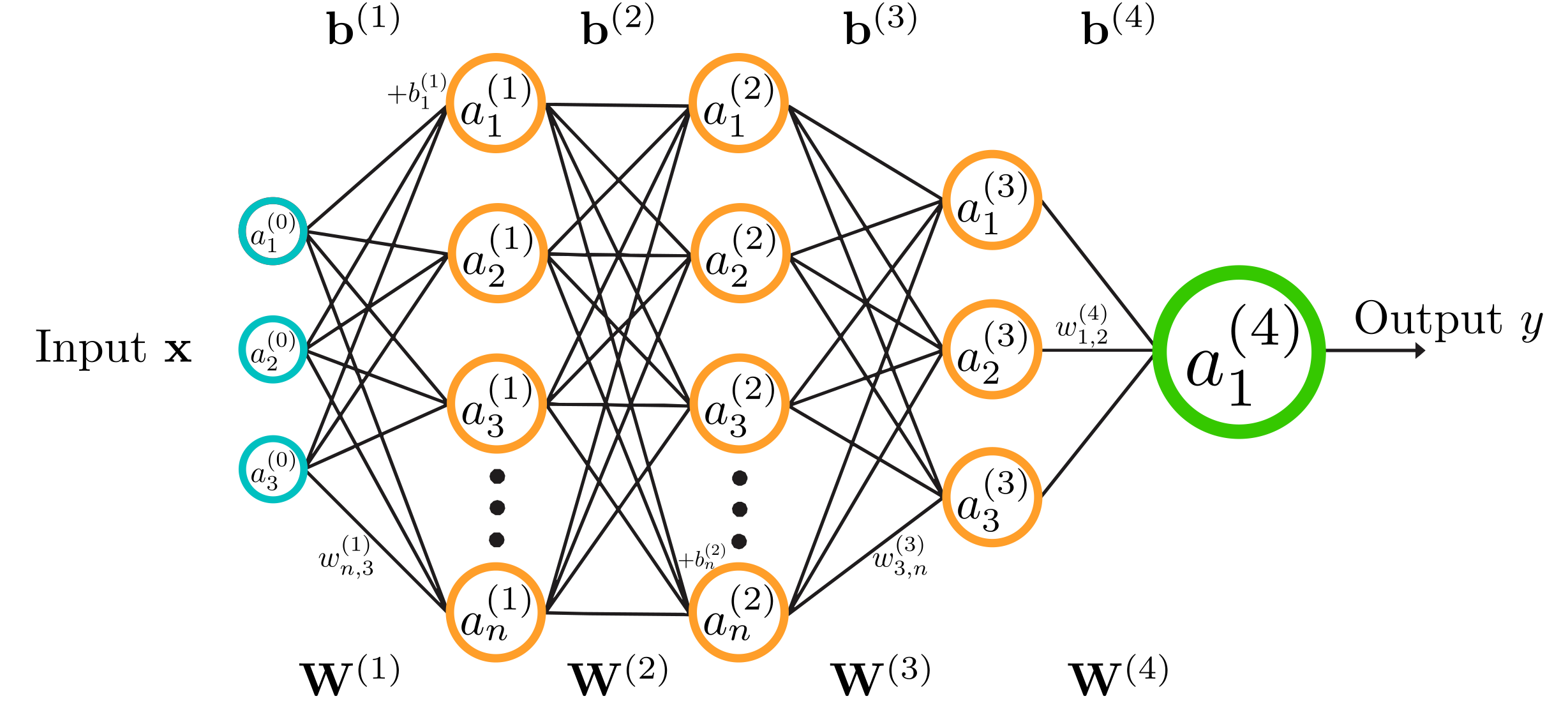
A conventional neural-network illustration provides context for the learned encoder and decoder used to investigate internal features.
QuantuMechaniX8 · Image source · CC0 1.0

Finding a neatly labeled feature inside a language model is exciting. Failing to find one is harder to interpret. Did the model never learn the concept, does it represent the concept in a distributed way, or did the inspection tool miss it? Sparse autoencoders make this question experimentally accessible by learning a sparse dictionary for internal activations. Recent work also makes clear that the dictionary is an instrument with its own biases. A preprint dated October 14, 2026 distinguishes functional performance from feature reproducibility; other 2026 studies examine identifiability, seed dependence, and misleading reasoning labels. Together they shift the question from whether a feature looks intelligible to whether it supports a stable and falsifiable claim.
A dictionary is not a complete inventory
A sparse autoencoder has an encoder that converts an activation into a small set of active coefficients and a decoder that reconstructs the activation from dictionary directions. The dictionary can contain more directions than the original activation has dimensions. Sparsity encourages the system to explain each observation with a limited combination. This arrangement can make patterns easier to inspect than individual model neurons, but the training objective does not supply a definitive list of human concepts or guarantee one direction per concept.
An invented geometric example shows the ambiguity. Data points may lie mostly in a plane embedded in a much larger space. Several coordinate bases can describe that same plane. If the data and regularization do not distinguish those bases, two successful training runs may select different directions. Calling one direction a missing concept in the second run would confuse the absence of a coordinate with the absence of represented information. The practical problem is to determine which distinctions are justified by the observations and assumptions, rather than by a convenient feature name.
More data improves different goals differently
The October 14 preprint studies four sparse-autoencoder architectures on three language models, comparing activation budgets from five million tokens with a five-hundred-million-token reference. It separates functional behavior, such as reconstruction and downstream evaluation, from one-to-one feature matching. Some functional measures approach the reference with much less data, while feature reproducibility can continue improving. This is an initial preprint result in specified settings, rather than a universal prescription for how much data every autoencoder needs.
The distinction changes experimental budgeting. If the task is to approximate activations cheaply, reconstruction may be the relevant target. If the task is to track a named feature across model updates, reproducibility deserves its own measurement. A researcher could otherwise stop training when average reconstruction looks good and then make much stronger claims about individual directions. Conversely, spending more on activation collection without checking feature stability might improve a convenient metric while leaving the scientific question unresolved. The correct budget depends on the claim being made.
Identifiability requires stated conditions
The May 29, 2026 paper Toward Identifiable Sparse Autoencoders connects these models to classical dictionary learning. It distinguishes stability of dictionary directions from stability of the sparse codes assigned to inputs. Its proposed variants modify the architecture and training procedure, and its analysis links near-identifiability to conditions on reconstruction, data coverage, dictionary geometry, and concept co-occurrence. Improved empirical stability is useful, while the mathematical guarantees apply under the stated conditions rather than automatically to arbitrary neural-network activations.
Consider two dictionary directions that are almost parallel. A small change in an input may transfer weight from one coefficient to the other while barely changing the reconstructed activation. The reconstruction can be stable even when a feature-level explanation changes dramatically. Measuring only the final reconstruction misses that instability. This also explains why a theory of identifiability should state what equivalences are allowed: permuting the names of otherwise identical directions is harmless, whereas assigning unrelated sparse codes to the same inputs changes the interpretation materially.
Unstable features need not be mere noise
A June 10, 2026 preprint studies how features reappear across independent training seeds. It reports that stable features carry much of the reconstruction- and prediction-relevant signal in its experiments, while unstable features can collectively occupy reproducible lower-rank subspaces. That finding complicates a simple good-feature versus bad-feature story. Individual directions may be unstable because multiple bases describe related structure, rather than because every unmatched direction is meaningless. The study’s synthetic construction provides a controlled setting for examining that possibility.
The reporting consequence is straightforward: compare both directions and spaces. If a safety-relevant signal moves among several coordinates, an audit based on one named coordinate may vary across seeds even when a broader probe remains informative. On the other hand, agreement at the subspace level does not automatically justify a specific semantic label. A region can be reproducible while its human interpretation remains incomplete. The useful next experiment asks whether a claimed concept can be isolated with counterexamples and whether interventions have the predicted effects across independently trained dictionaries.
Reasoning labels need hostile counterexamples
The January 2026 version of Do Sparse Autoencoders Identify Reasoning Features in Language Models? tests features selected by contrasting reasoning with non-reasoning text. Across its analyzed configurations, token injection and generated counterexamples undermine the interpretation that those candidates uniquely capture reasoning computation. Steering the selected features does not improve the tested benchmarks. These results challenge that selection-and-labeling procedure; they do not establish that no autoencoder could ever reveal anything about reasoning.
A classroom analogy makes the confound concrete. An essay containing therefore, suppose, and consequently may resemble a proof while containing no valid inference. A terse correct solution may omit all three. If a feature activates on those words, the label reasoning overstates the evidence. Good experiments construct both kinds of counterexample. They should also check whether the feature tracks answer length, formatting, topic, or uncertainty. A human-friendly name becomes informative when the proposed meaning survives attempts to separate it from the easiest surface correlation.
Report absence with a field of view
An audit using sparse autoencoders should state the model checkpoint, layer, activation data, dictionary size, sparsity settings, random seeds, matching rules, and intervention tests. It should distinguish not detected from absent. There is no generally available denominator listing every real feature in a frontier model, so a claim of complete coverage requires more than a large dictionary. Rare behaviors and unusual combinations of concepts may occupy little reconstruction variance while still mattering for a specific deployment.
The constructive lesson is to use several forms of evidence together. Behavioral tests reveal what the model does on chosen cases; dictionaries suggest internal patterns; probes test recoverable information; interventions test causal hypotheses. Disagreement between them is valuable because it exposes assumptions. The 2026 results make sparse autoencoders more scientifically useful by clarifying what they have not yet earned. A reliable instrument includes a description of its blind spots, and a responsible explanation treats those blind spots as part of the result.
For a negative finding, the strongest wording identifies the search procedure: which inputs were sampled, which feature families were considered, and what detection threshold was used. An investigator can then expand the dictionary or change the activation distribution and see whether the conclusion changes. This turns an apparently final statement about a model into a reproducible statement about an experiment. It also prevents visual richness from substituting for coverage: a million attractive labels can still leave an important rare behavior poorly measured.
Sources & further reading
Primary papers, project documentation, and research releases used in this article. Publication dates below refer to the sources themselves.
- Diminishing Returns of Data in Sparse Autoencoders: Functional Behavior does not Guarantee Feature ReproducibilityarXivPublished Checked
- Toward Identifiable Sparse AutoencodersarXiv / ICML 2026Published Checked
- Unstable Features, Reproducible Subspaces: Understanding Seed Dependence in Sparse AutoencodersarXivPublished Checked
- Do Sparse Autoencoders Identify Reasoning Features in Language Models?arXivPublished Checked
FOLLOW THE QUESTION
Study engineering foundations